


10 Dental Myths, Debunked
There are many misconceptions about what it takes to keep your teeth healthy. Separate fact from fiction.
Most dental myths come from something that sounds sensible: scrub harder, skip floss if the research is weak, wait until something hurts. The evidence points the other way. Gentle brushing with fluoride toothpaste twice a day, cleaning between your teeth once a day, limiting how often you snack on sugar and starch, and regular checkups still do most of the work. Here are ten common myths and what the evidence says.
1. Does brushing harder clean better?
No. Plaque is soft and comes off with gentle pressure. Scrubbing hard, especially with a firm brush, can wear the gums back and abrade the exposed root surface, which can lead to sensitivity. The ADA recommends a soft-bristled brush held at a 45-degree angle to the gums, using short, gentle strokes. [1] Our post on brushing too hard explains the warning signs.
2. Is flossing no longer necessary?
Flossing still matters, but the evidence is more modest than many people assume. In 2016, news reports pointed out that the 2015-2020 Dietary Guidelines for Americans no longer mentioned flossing. The reason was procedural. The guidelines focus on diet, and their advisory committees hadn't reviewed evidence on brushing or flossing, so the advice wasn't carried forward. The Department of Health and Human Services then told the ADA that cleaning between teeth is an important oral hygiene practice. [3]
The most thorough summary of the research is a 2019 Cochrane review of 35 trials. It found that flossing in addition to brushing may reduce gum inflammation more than brushing alone, and that interdental brushes may work better than floss. The evidence was low certainty, the trials were short, and none measured cavities between teeth. [2] That is a reason to choose a method you'll actually use, not a reason to skip it. The ADA still recommends cleaning between your teeth every day, with floss, interdental brushes, water flossers or other cleaners. [4]
3. Is chewing sugar-free gum as good as brushing?
No. Chewing sugar-free gum for about 20 minutes after a meal increases saliva, which helps neutralize acid and wash away food, and the ADA says it can help prevent decay. [5] But it doesn't remove plaque from the tooth surfaces or between teeth. It's a helpful extra, not a replacement.
4. If my gums bleed when I floss, should I leave them alone?
No. Bleeding usually means the gums are inflamed from plaque left along the gumline and between teeth. [6] Gentle daily cleaning in those spots usually lets the inflammation settle, and the bleeding eases with it. If it doesn't improve after a couple of weeks, or you take a blood thinner, have it checked, because bleeding can have other causes.
5. If I brush well the week before my appointment, will my dentist know?
Usually, yes. Hardened tartar can't be brushed off, and gum inflammation from months of plaque doesn't settle in a few days. That isn't a reason to feel judged. It just means the checkup reflects your everyday routine, which is what we want to see.
6. Is sugar the only cause of cavities?
No. Bacteria in plaque make acid from both sugars and starches. [7] Crackers, chips and bread that cling to teeth can feed bacteria for a long time. How often you snack matters as much as what you eat, because each snack starts a new acid attack.
7. Do sensitive teeth always mean worn enamel?
No. Sensitivity happens when dentin is exposed, and worn enamel is only one way that happens. Gum recession, decay, a cracked tooth, a worn filling and recent whitening can all cause it. [8] A 2013 study of 787 adults in general dental practices found sensitivity was more common in people with gum recession and in people who had whitened at home. [9] Our post on the causes of tooth sensitivity goes through them, and foods to avoid with sensitive teeth covers the common triggers.
8. Is gum disease only a problem for my mouth?
Not entirely. Gum disease and diabetes affect each other. Diabetes raises the risk of gum disease, and gum disease can make blood sugar harder to control. [6] Researchers have also found associations between gum disease and heart disease, rheumatoid arthritis and other conditions, but an association doesn't prove that one causes the other. Treating gum disease is worth doing for your mouth alone.
9. Are whiter teeth healthier teeth?
Not necessarily. Tooth color varies naturally and darkens with age, coffee, tea, red wine and some medications, none of which means a tooth is unhealthy. A bright white tooth can still have decay or gum disease around it. Smoking and some dental problems do change tooth color, so a tooth that darkens on its own should be checked. If you want a lighter shade, our teeth whitening page explains the options.
10. If nothing hurts, do I still need a checkup?
Yes. Early cavities and gum disease usually cause no pain. By the time a tooth hurts, the problem is often bigger and the treatment more involved. Our post on cavity pain explains how decay progresses before it hurts.
Where can I ask about my own routine in Jacksonville?
Bring your questions, and your toothbrush if you like, to your next visit. A comprehensive dental examination shows how your routine is working. Call our office at 904-398-1549 or contact us.
Sources
American Dental Association, MouthHealthy. Brushing your teeth. Accessed October 6, 2026.
Worthington HV, MacDonald L, Poklepovic Pericic T, et al. Home use of interdental cleaning devices, in addition to toothbrushing, for preventing and controlling periodontal diseases and dental caries. Cochrane Database Syst Rev. 2019;4(4):CD012018. doi:10.1002/14651858.CD012018.pub2 (retrieved via PubMed)
ADA News. National media focus on floss; government confirms importance. August 8, 2016.
American Dental Association. Home oral care. Accessed October 6, 2026.
American Dental Association, MouthHealthy. Chewing gum. Accessed October 6, 2026.
National Institute of Dental and Craniofacial Research. Periodontal (gum) disease. Last reviewed August 2026.
National Institute of Dental and Craniofacial Research. Tooth decay. Last reviewed September 2025.
American Dental Association, MouthHealthy. Sensitive teeth. Accessed October 6, 2026.
Cunha-Cruz J, Wataha JC, Heaton LJ, et al. The prevalence of dentin hypersensitivity in general dental practices in the northwest United States. J Am Dent Assoc. 2013;144(3):288-296. doi:10.14219/jada.archive.2013.0116 (retrieved via PubMed)
About the author. CJ Henley, DMD, is a general dentist in Jacksonville whose practice focuses on cosmetic and restorative dentistry, dental implants and dental care around head and neck cancer. Meet Dr. Henley.
CJ Henley, DMD, PA · 3675 Hendricks Avenue, Jacksonville, FL 32207 · 904-398-1549
Updated October 2026.
Cavity Pain: Stages of Tooth Decay and When It Hurts
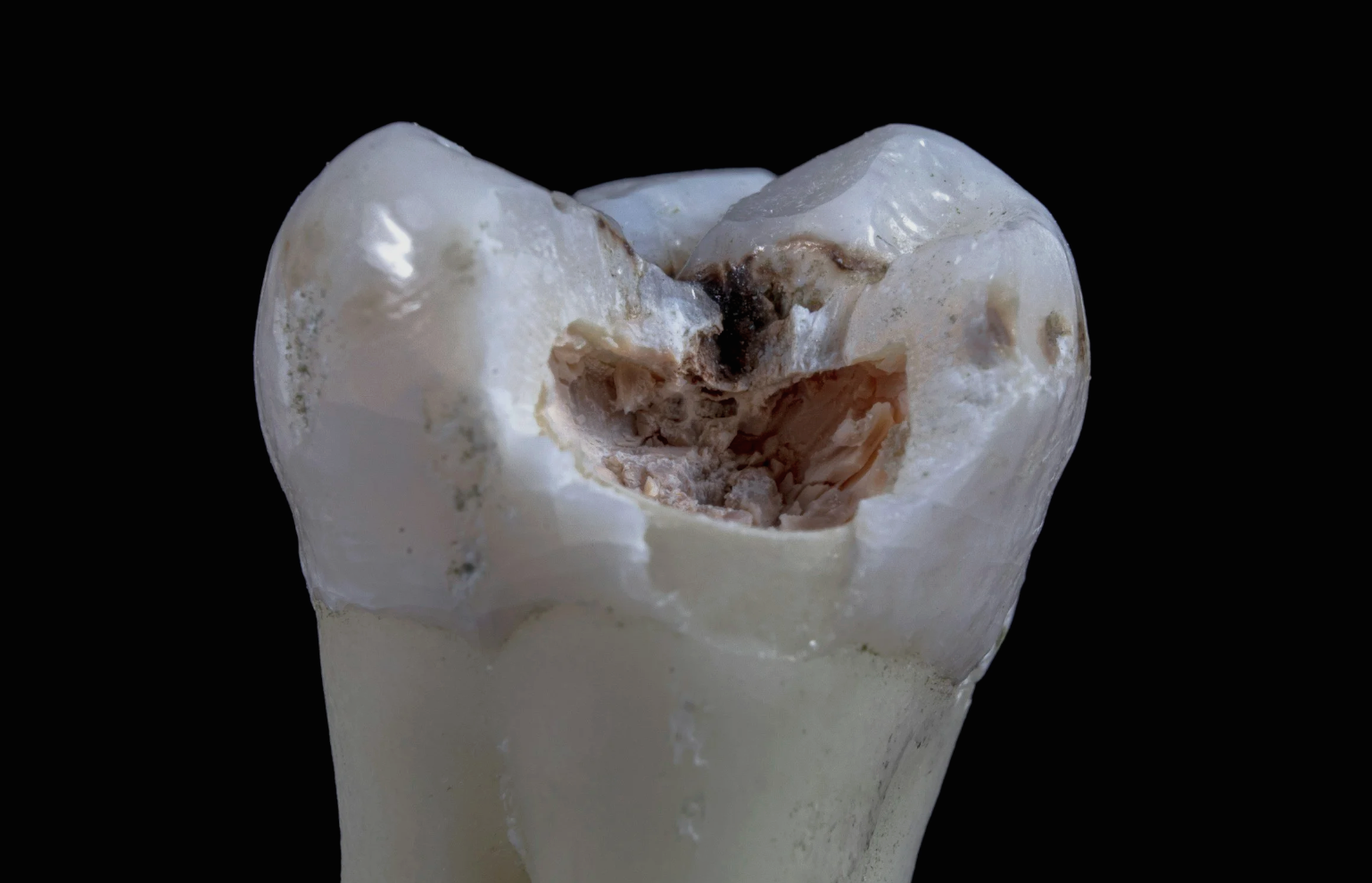
Cavities, which dentists sometimes call dental caries, are spots of tooth decay. They can range in size from tiny to large enough to break teeth.
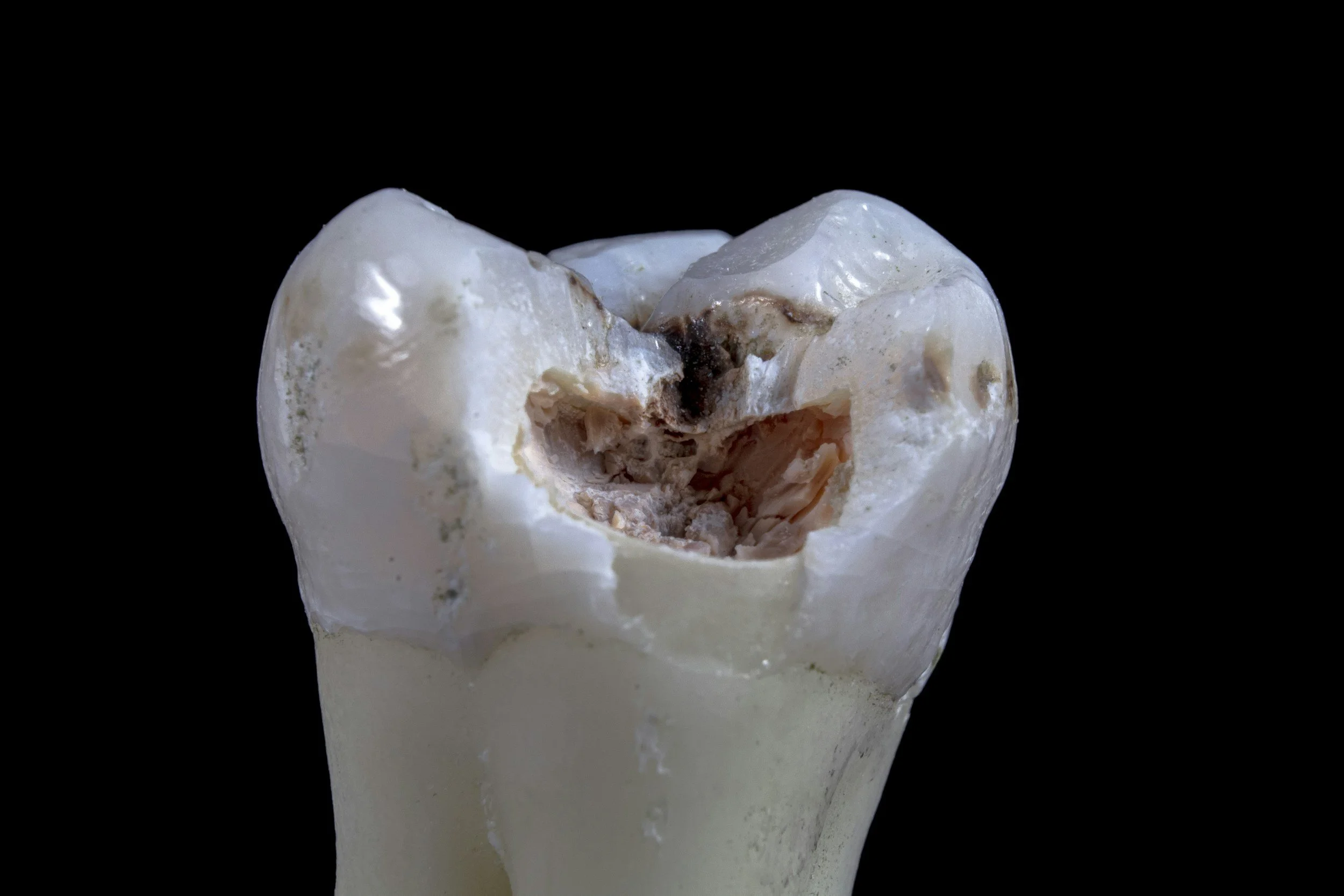
Dental cavity showing tooth decay in enamel and dentin
No, a cavity doesn't always hurt. Early decay in the enamel usually causes no symptoms at all. Pain tends to start once decay reaches the softer dentin underneath, and constant or throbbing pain usually means it has reached the nerve. By the time a cavity hurts, it is generally larger, which is why checkups and X-rays find most cavities before you feel them.
How does tooth decay start?
Bacteria in plaque feed on sugars and starches and make acid. Each time you eat or sip something sugary, that acid pulls minerals out of the enamel. Saliva and fluoride put minerals back between snacks. Decay begins when the losses keep outpacing the repairs. [1]
What are the stages of tooth decay, and when does each one hurt?
1. Early enamel decay (white spot)
The first sign is often a chalky white spot. Enamel has no nerves, so this stage doesn't hurt. It is also the only stage that can be stopped or reversed without a filling. Fluoride toothpaste, a fluoride treatment in the office, fewer sugary snacks and good cleaning can let the enamel remineralize. [1]
2. Decay through the enamel
Once the enamel surface breaks down, a true cavity forms. It may still cause no pain, or you may notice a brief twinge with sweets or cold. A cavity at this stage can't heal on its own and usually needs a filling.
3. Decay into the dentin
Dentin is softer than enamel and full of tiny channels that lead toward the nerve. Decay spreads faster here. Sensitivity to cold, sweets or biting becomes more common. The pain usually stops within a few seconds once the trigger is gone.
4. Decay that reaches the nerve (pulp)
When bacteria reach the pulp, the nerve becomes inflamed. Pain may linger long after a cold drink, throb on its own or wake you at night. At this point the nerve often can't recover, and the choices are usually root canal treatment and a crown, or removing the tooth.
5. Abscess
If the infection spreads past the root tip, it can form an abscess. Signs include severe throbbing pain, swelling of the gum or face, a bad taste, fever and a tooth that hurts to touch. Sometimes the pain eases because the nerve has died, but the infection is still there. A dental abscess needs prompt treatment. [2]
What makes some people more prone to cavities?
Dry mouth. Saliva neutralizes acid and repairs enamel. Many common medicines, including some for blood pressure, anxiety and depression, reduce saliva and can lead to fast decay along the gumline. Learn more about dry mouth.
How often you eat or sip sugar. Frequent snacking or sipping sweet drinks through the day gives enamel little time to recover.
Exposed roots. Root surfaces are softer than enamel and decay more easily.
Existing fillings and crowns. Decay can start again at the edges.
Fluoride exposure. Fluoride toothpaste helps every age group.
When is cavity pain urgent?
Call promptly for swelling in your gum or face, fever, a bad taste with pain, or pain that keeps you awake. Trouble breathing or swallowing, or swelling that spreads quickly toward the eye or neck, needs emergency medical care. Call 911 or go to an emergency department. Our page on dental emergencies covers what to do while you arrange care.
How do I find out if a tooth has a cavity?
If something feels off, or it has been a while since your last exam, call our office at 904-398-1549 or contact us. At a comprehensive dental examination, I look at the teeth and X-rays and also at the reasons decay is happening, such as dry mouth, diet and medications, so that any filling is part of a plan rather than a one-time repair. For other kinds of tooth pain, see why your tooth may hurt.
Sources
National Institute of Dental and Craniofacial Research. Tooth decay. Last reviewed September 2025.
American Association of Endodontists. Tooth pain. Accessed October 6, 2026.
American Dental Association, MouthHealthy. Dietary acids and your teeth. Accessed October 6, 2026.
About the author. CJ Henley, DMD, is a general dentist in Jacksonville whose practice focuses on cosmetic and restorative dentistry, dental implants and dental care around head and neck cancer. Meet Dr. Henley.
CJ Henley, DMD, PA · 3675 Hendricks Avenue, Jacksonville, FL 32207 · 904-398-1549
Updated October 2026.