
Case Studies
Restoring Severely Eroded Teeth While Preserving Natural Esthetics
This patient presented with severe dental erosion related to prolonged acid exposure, resulting in significant loss of enamel, shortened teeth, and compromised smile esthetics. She had been told that her only option was extraction followed by implants or a bridge.
In the esthetic zone, those solutions carry real biological and cosmetic challenges—particularly when it comes to maintaining natural gingival contours.
Rather than removing teeth that were still viable, a multidisciplinary approach was used. Orthodontic treatment created proper space and proportions, allowing for traditional crowns while preserving the patient’s existing gingival architecture.
The result is a smile that is structurally sound, biologically respectful, and intentionally natural—designed to look alive, not artificial.

-
This patient presented with advanced dental erosion affecting the maxillary anterior teeth. The erosion was severe enough to compromise tooth structure, incisal length, and overall smile harmony. The underlying cause was a past eating disorder, which had resulted in prolonged acid exposure and enamel loss over time.
Beyond the structural concerns, the esthetic impact was significant. The teeth appeared shortened, uneven, and worn, with loss of natural translucency and enamel character. Functionally, the dentition was weakened. Esthetically, the smile no longer reflected the patient’s age or personality.
Prior consultations had led her to believe that the teeth were non-restorable, and that extraction followed by implants or a bridge would be required.
-
Implants and bridges can be excellent solutions in the right circumstances. However, in the esthetic zone—particularly the maxillary anterior region—they introduce challenges that must be carefully weighed.
Dental implants require precise management of both hard and soft tissues to achieve a natural appearance. Once natural gingival architecture is lost, recreating it predictably is difficult. Even well-executed implant restorations can appear artificial if the surrounding tissue contours, papillae, or emergence profiles are compromised.
Fixed bridges carry their own biological risks, including preparation of adjacent teeth and long-term maintenance concerns.
In this case, the teeth—while severely eroded—were still viable candidates for restoration if proper space, proportions, and support could be re-established.
Rather than defaulting to extraction-based treatment, a more conservative, multidisciplinary approach was chosen.
-
The foundation of this case was orthodontic treatment.
Orthodontics was used to create proper prosthetic space, re-establish ideal tooth positioning, and correct proportions that had been altered by years of erosion. This step was critical. Without adequate space and alignment, restorative dentistry in eroded cases often leads to over-contoured restorations or compromised esthetics.
By completing orthodontic treatment first, we were able to design restorations that respected both biology and esthetics—without aggressive tooth reduction or artificial contours.
Equally important, this approach preserved the patient’s existing gingival architecture. Maintaining natural soft-tissue contours around the teeth dramatically improves long-term esthetic outcomes and stability.
-
ollowing orthodontic treatment, traditional full-coverage crowns were placed on the maxillary anterior teeth.
The success of this phase relied heavily on collaboration with an exceptional dental laboratory. The ceramics in this case were carefully layered to replicate the optical properties of natural teeth rather than mask them.
Key esthetic principles included:
Gradual color transitions from cervical to incisal regions
Controlled translucency at the incisal edges
Subtle internal characterization rather than uniform opacity
Secondary anatomy and surface texture to manage light reflection
Surface texture is often overlooked in cosmetic dentistry, but it plays a critical role in how light interacts with a restoration. Proper micro-texture allows light to scatter naturally, preventing the flat, artificial appearance that can make restorations obvious.
The result is not a “white” smile, but a lifelike one.
-
he final restorations restored proper tooth length, symmetry, and function while maintaining a natural, age-appropriate appearance. The gingival contours remain intact, the smile line is balanced, and the restorations blend seamlessly with the surrounding dentition.
Equally important, this approach preserved the patient’s natural teeth and avoided the added biological and esthetic risks associated with implants or bridges in the esthetic zone.
With proper maintenance and care, these restorations are designed to last many years while remaining serviceable, repairable, and biologically respectful.
-
his case illustrates what is possible when orthodontics, restorative planning, and high-level ceramic craftsmanship are aligned.
Severe erosion does not automatically mean teeth are hopeless. With thoughtful diagnosis, interdisciplinary collaboration, and attention to detail, it is often possible to preserve natural structures and achieve results that are both durable and beautiful.
The goal is not perfection.
The goal is dentistry that looks alive, functions naturally, and stands the test of time.
Long-Span Fixed Prosthetic Rehabilitation After Head & Neck Radiation
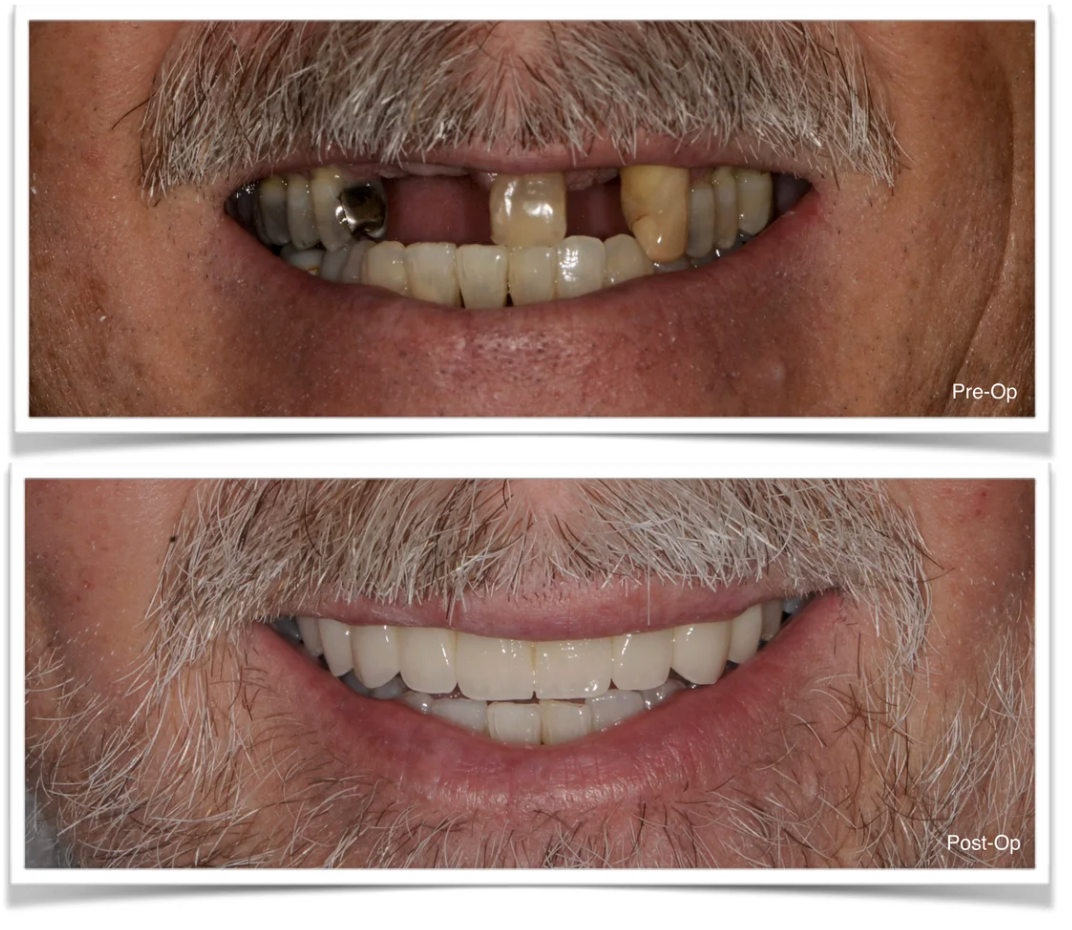
This case documents the conservative rehabilitation of a post-radiation patient referred from MD Anderson following treatment for tonsillar squamous cell carcinoma.
Due to the biological limitations imposed by head and neck radiation, implants and extractions were avoided.
Through multidisciplinary periodontal management and precise restorative planning, a long-span porcelain-fused-to-zirconia fixed bridge was delivered.
The restoration has functioned comfortably and predictably for more than a decade, illustrating the value of biologically respectful, long-term treatment planning in medically complex cases.
-
This patient presented to our practice as a referral from MD Anderson Cancer Center following successful treatment for tonsillar squamous cell carcinoma. His cancer therapy included radiation to the head and neck region. While oncologic control was achieved, the long-term effects of radiation had significantly compromised his oral health.
At presentation, the patient had multiple missing teeth and advanced periodontal disease. The dentition was functionally unstable, and both hard and soft tissues were affected by prior radiation exposure. Chewing efficiency, comfort, and overall quality of life were diminished.
Previous evaluations had emphasized the limitations of treatment in the post-radiation patient. While the need for rehabilitation was clear, the path forward required careful consideration.n text goes here
-
Dental rehabilitation after head and neck radiation demands a fundamentally different approach.
In post-radiation patients:
Dental implants are generally not advisable due to the elevated lifetime risk of osteoradionecrosis.
Tooth extractions should be avoided whenever possible, as healing is unpredictable and complications can be severe.
Surgical intervention must be minimized in favor of conservative, biologically respectful solutions.
In this case, many conventional treatment options were eliminated before planning even began. The remaining teeth, though compromised, represented valuable biological assets that needed to be preserved rather than replaced.
Rather than pursuing extraction-based solutions, the treatment philosophy centered on stability, preservation, and long-term function.
-
A multidisciplinary approach was essential.
We worked closely with a trusted periodontist to address and stabilize the patient’s periodontal disease prior to any restorative intervention. The goal at this stage was not cosmetic improvement, but disease control — reducing inflammation, preserving remaining tooth structure, and establishing a foundation capable of supporting a definitive prosthesis.
Only after periodontal health was adequately managed did restorative planning proceed.
This collaborative approach allowed us to move forward conservatively, without introducing unnecessary surgical risk.
-
The definitive restorative solution involved preparation of the remaining teeth for a long-span porcelain-fused-to-zirconia (PFZ) fixed bridge.
Long-span restorations in post-radiation patients present unique challenges. Occlusal tolerance is low, and even minor discrepancies can lead to discomfort, mechanical failure, or biological breakdown. For this reason, occlusion had to be exact.
Every step — from tooth preparation to bite registration to laboratory communication — was executed with precision. Load distribution, connector design, and prosthetic contours were carefully engineered to support function while respecting the compromised biology of the supporting structures.
-
he final restoration restored functional chewing ability, stability, and comfort while maintaining a natural appearance appropriate to the patient’s age and facial structure.
Most importantly, the treatment respected the biological limitations imposed by prior radiation therapy.
This prosthesis has now been in continuous service for more than a decade, functioning predictably and comfortably — a result that underscores the value of conservative planning, interdisciplinary collaboration, and meticulous execution in medically complex cases.
-
This case illustrates that successful dental rehabilitation after head and neck radiation is not achieved by pushing boundaries, but by respecting them.
When treatment planning prioritizes preservation, stability, and precision, even patients with severely limited options can achieve durable, functional outcomes that meaningfully improve quality of life.
The goal is not aggressive intervention.
The goal is dentistry that works beautifully, quietly, and reliably — for years.