

How Do Dental Implants Work?
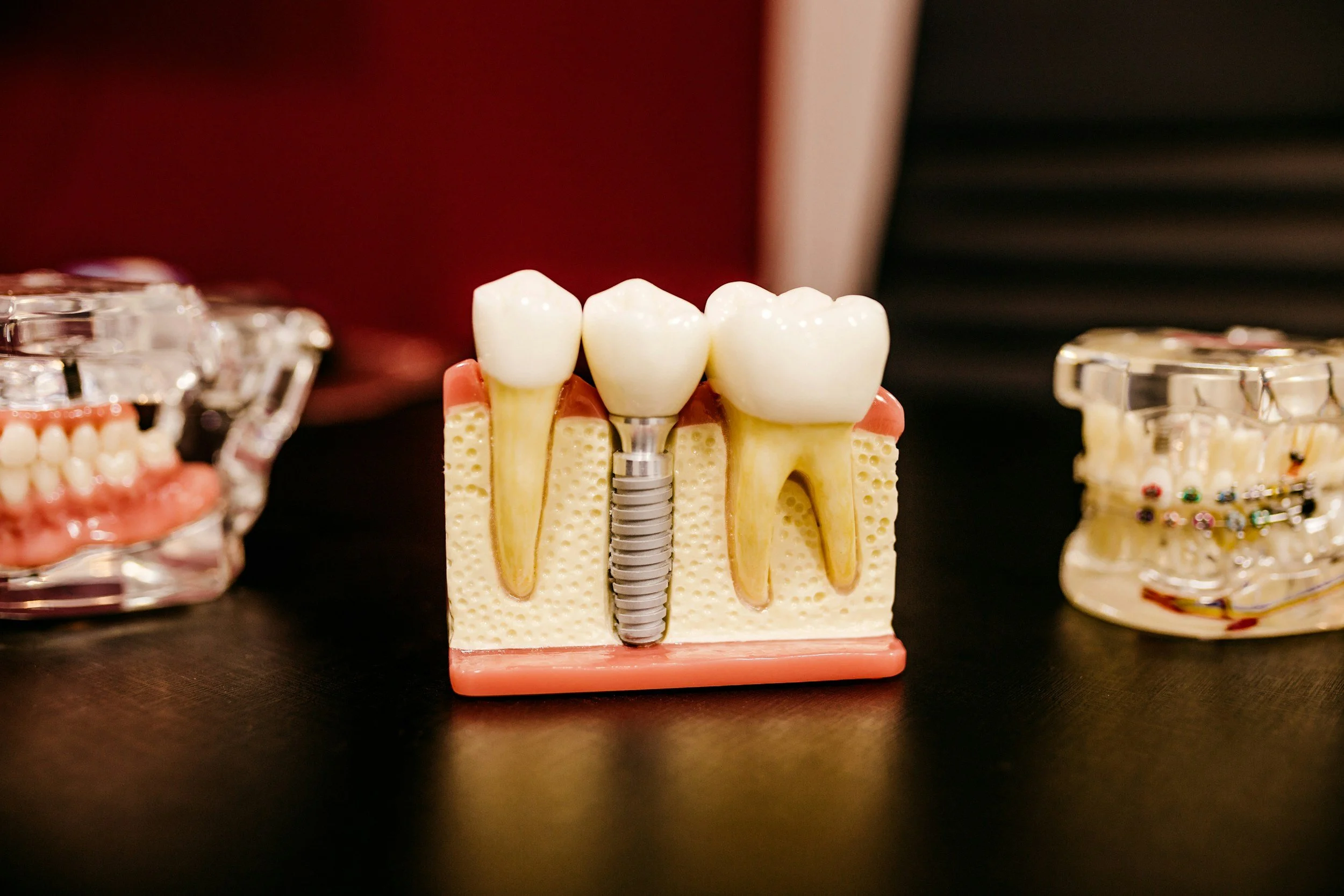
A dental implant replaces the root of a missing tooth. A small titanium or ceramic post is placed in the jawbone, the bone heals tightly against it, and then a crown, bridge or denture is attached on top. Whether an implant is the right choice depends on your bone, gums, bite and health, so the planning matters as much as the surgery.
What are the parts of a dental implant?
An implant restoration has three parts, and each has a job.
The implant. A post, usually titanium, placed in the jawbone where the root used to be.
The abutment. A connector that attaches to the implant and comes through the gum.
The restoration. The part you see and chew with: a crown for one tooth, a bridge for several, or a denture held in place by implants.
What is osseointegration, and why does healing take time?
Implants rely on living bone. After placement, bone grows onto the implant's surface and locks it in place. This is called osseointegration, and it usually takes a few months. Until it happens, the implant cannot take full chewing force.
For that healing to hold up long term, a few things need to be true:
Enough healthy bone in the right place
Healthy gums around the implant
An implant positioned for the way your teeth meet
A healing period that isn't overloaded or disturbed
When one of these is missed, an implant can seem fine at first and develop bone loss, loosening or a broken part years later.
What is evaluated before implant treatment?
I look at the whole mouth before recommending an implant for one space.
How your teeth meet and how hard you bite or grind
Bone volume and anatomy, often with 3D imaging when it answers a real planning question
The teeth and restorations next to the space
How well you can clean around an implant
Your health history and medications
Some situations call for more careful planning or a different approach. These include dry mouth, smoking, uncontrolled diabetes, some bone medications and previous radiation to the head and neck. Radiation in particular changes how the jawbone heals, so implant decisions after cancer treatment are made together with the patient's medical team.
How does the implant support the tooth you see?
Once the implant has healed, the abutment and restoration are attached. The crown is shaped and shaded to match your other teeth and designed for your bite. This step deserves as much attention as the surgery. A crown with the wrong contours can trap plaque or overload the implant, even when the implant itself was placed well.
Can implants replace one tooth or all of them?
Implants can replace:
A single missing tooth
Several missing teeth, often with an implant-supported bridge
A full arch, with a fixed bridge or a removable denture held by implants
Replacing many teeth takes more planning and sequencing. The bite, the bone and long-term wear have to be worked out together.
How long do dental implants last?
Many implants last for decades. A 2019 systematic review of modern implants found that about 96 percent were still in place after 10 years. A more cautious analysis in the same review, which allowed for patients lost to follow-up, estimated about 93 percent, and survival was somewhat lower in people 65 and older. [1]
An implant that is still in place is not the same as one with no problems. The crown can wear or break, screws can loosen, and gum and bone inflammation around an implant can develop. Cleaning at home, regular checkups and protecting implants from grinding all affect how well they hold up.
Is a dental implant right for everyone?
No. Bone loss, some medical conditions, smoking or previous radiation may call for more evaluation, extra procedures such as bone grafting, or a different solution. A bridge or a removable partial denture is sometimes the better choice. Our article on replacing missing teeth with a bridge compares the options.
What should you ask about implant treatment in Jacksonville?
Who will place the implant, and who will make and attach the crown?
What imaging is needed, and what question will it answer?
How long will healing take, and what will I have in the space meanwhile?
What are the alternatives, and what does each need over time?
What maintenance should I expect after treatment?
To talk through a missing tooth, start with a comprehensive dental examination at our office on Hendricks Avenue near San Marco. Bring your medication list and any previous X-rays or treatment plans. You can read more on our dental implants page or contact the office.
Sources
Howe MS, Keys W, Richards D. Long-term (10-year) dental implant survival: a systematic review and sensitivity meta-analysis. J Dent. 2019;84:9-21. doi:10.1016/j.jdent.2019.03.008 (retrieved via PubMed)
U.S. Food and Drug Administration. Dental implants: what you should know.
About the author. CJ Henley, DMD, is a general dentist in Jacksonville whose practice focuses on cosmetic and restorative dentistry, dental implants and dental care around head and neck cancer. Meet Dr. Henley.
CJ Henley, DMD, PA · 3675 Hendricks Avenue, Jacksonville, FL 32207 · 904-398-1549
Updated October 2026.
Gum Disease and Breast Cancer: What the Research Shows

Large studies have found that women who report a history of gum disease are slightly more likely to be diagnosed with breast cancer later. That is an association, not proof that gum disease causes breast cancer, and no study has shown that treating gum disease lowers breast cancer risk. Healthy gums are worth keeping for their own sake, and regular breast cancer screening with your physician remains the step that matters for breast cancer.
What did the research find?
The main evidence comes from the Women's Health Initiative, a long-running study of postmenopausal women in the United States. Researchers at the University at Buffalo followed 73,737 women who had never had breast cancer. About one in four reported having had gum disease. Over an average of 6.7 years, 2,124 women developed invasive breast cancer. [1]
Women who reported gum disease had about a 14% higher risk of breast cancer than women who did not, after the researchers adjusted for known breast cancer risk factors. The link looked stronger in women who had quit smoking within the previous 20 years. [1]
A 2017 analysis of the same cohort, covering all cancers, found a similar result for breast cancer (about 13% higher risk). [2] That study is discussed in our post on gum disease and cancer risk in older women.
Does that mean gum disease causes breast cancer?
No. These were observational studies, which can show that two things occur together but can't show that one causes the other. A few limits are worth knowing:
Gum disease was self-reported. Women answered a questionnaire. Nobody measured their gums.
Shared risk factors. Smoking, age, diabetes and other health factors affect both gum disease and cancer. Researchers adjust for these, but they can't remove every one.
The increase is small. A 14% relative increase is modest, and most women with gum disease never develop breast cancer.
Researchers have proposed possible explanations, such as long-term inflammation or oral bacteria reaching other tissues. Those ideas are still being studied.
What is gum disease?
Gum disease starts as gingivitis: red, swollen gums that bleed when you brush or floss. If plaque stays under the gumline, it can progress to periodontitis, which destroys the bone and tissue that hold teeth in place. About 4 in 10 US adults aged 30 and older have some degree of periodontitis. [3]
What should you do with this information?
Keep up breast cancer screening as your physician recommends. Nothing about your gums changes that advice.
Treat gum disease because it harms your mouth. Bleeding gums, gum recession, loose teeth or persistent bad breath are reasons to see a dentist.
Don't smoke. Smoking raises the risk of both gum disease and many cancers.
Tell your dentist about cancer treatment. If you are facing chemotherapy or radiation, your mouth needs attention before and during treatment. Read about dental care around cancer treatment.
Where can you have your gums checked in Jacksonville?
A comprehensive dental exam includes measuring the gum pockets around each tooth, which is how gum disease is diagnosed. For related research, see our post on gum disease and esophageal and stomach cancer. To schedule a visit, contact our office or call 904-398-1549.
Sources
Freudenheim JL, Genco RJ, LaMonte MJ, et al. Periodontal disease and breast cancer: prospective cohort study of postmenopausal women. Cancer Epidemiol Biomarkers Prev. 2016;25(1):43-50. doi:10.1158/1055-9965.EPI-15-0750 (retrieved via PubMed)
Nwizu NN, Marshall JR, Moysich K, et al. Periodontal disease and incident cancer risk among postmenopausal women: results from the Women's Health Initiative Observational Cohort. Cancer Epidemiol Biomarkers Prev. 2017;26(8):1255-1265. doi:10.1158/1055-9965.EPI-17-0212 (retrieved via PubMed)
Centers for Disease Control and Prevention. Gum (periodontal) disease. Retrieved October 6, 2026.
About the author. CJ Henley, DMD, is a general dentist in Jacksonville whose practice focuses on cosmetic and restorative dentistry, dental implants and dental care around head and neck cancer. Meet Dr. Henley.
CJ Henley, DMD, PA · 3675 Hendricks Avenue, Jacksonville, FL 32207 · 904-398-1549
Updated October 2026.