


Why does toothpaste and orange juice taste so bad?!
Learn the science behind why OJ tastes gross after brushing your teeth
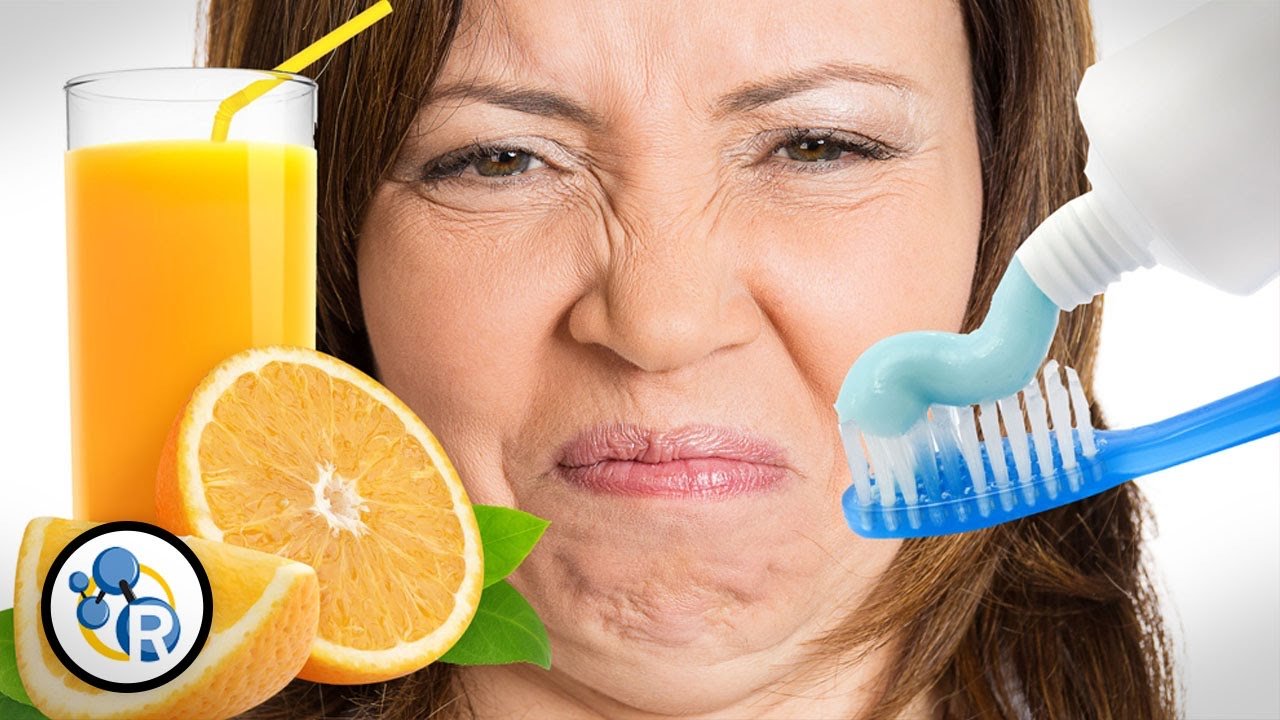
Why Does Orange Juice Taste Terrible After Brushing Your Teeth?
If you’ve ever taken a sip of orange juice right after brushing and thought, “Why does this taste so awful?” you’re not imagining it. It’s a real, predictable effect — and it has more to do with chemistry than the orange juice itself.
The main culprit is a common toothpaste ingredient called sodium lauryl sulfate (SLS). SLS is a foaming agent that helps loosen plaque and debris, but it also temporarily changes how your taste buds perceive flavor.
Here’s what’s happening:
SLS dulls sweetness and amplifies bitterness
SLS can temporarily reduce your ability to taste sweet flavors. At the same time, it makes bitter notes taste stronger. Orange juice has natural bitter compounds and acids — normally they’re balanced by sweetness. After brushing, the sweetness gets muted and the bitterness becomes more obvious.SLS disrupts “taste smoothing” in orange juice
Orange juice contains compounds (including phospholipids) that help coat your mouth and soften bitter flavors. SLS can interfere with that effect, which further lets the bitter taste come through.Mint and citrus don’t play nicely
Many toothpastes leave a strong mint aftertaste. Mint plus acidic citrus can create a weird flavor clash — not the main reason, but it can make the experience worse.
How Long Should You Wait?
A simple fix is to wait about 20–30 minutes after brushing before drinking orange juice or other acidic beverages. This gives saliva time to wash away and dilute residual toothpaste ingredients and lets your taste perception normalize.
If you really want orange juice sooner:
• Rinse your mouth well with water after brushing
• Or brush after breakfast instead of before
Bottom line: nothing is “wrong” with the orange juice — your toothpaste is temporarily changing how your mouth tastes it.

Pulling wisdom teeth can improve long-term taste function, research finds
Patients who had their wisdom teeth extracted had improved tasting abilities decades after having the surgery, according to a new study.
Patients who had their wisdom teeth extracted had improved tasting abilities decades after having the surgery, a new Penn Medicine study published in the journal Chemical Senses found. The findings challenge the notion that removal of wisdom teeth, known as third molars, only has the potential for negative effects on taste, and represent one of the first studies to analyze the long-term effects of extraction on taste.
"Prior studies have only pointed to adverse effects on taste after extraction and it has been generally believed that those effects dissipate over time," said senior author Richard L. Doty, PhD, director of the Smell and Taste Center at the University of Pennsylvania. "This new study shows us that taste function can actually slightly improve between the time patients have surgery and up to 20 years later. It's a surprising but fascinating finding that deserves further investigation to better understand why it's enhanced and what it may mean clinically."
Doty and co-author Dane Kim, a third-year student in the University of Pennsylvania School of Dental Medicine, evaluated data from 1,255 patients who had undergone a chemosensory evaluation at Penn's Smell and Taste Center over the course of 20 years. Among that group, 891 patients had received third molar extractions and 364 had not.
The "whole-mouth identification" test incorporates five different concentrations of sucrose, sodium chloride, citric acid, and caffeine. Each solution is sipped, swished in the mouth, and then spit out. Subjects then indicate whether the solution tastes sweet, salty, sour, or bitter.
The extraction group outperformed the control group for each of the four tastes, and in all cases, women outperformed men. The study suggests, for the first time, that people who have received extractions in the distant past experience, on average, an enhancement (typically a three to 10 percent improvement) in their ability to taste.
"The study strongly suggests that extraction of the third molar has a positive long-term, albeit subtle, effect on the function of the lingual taste pathways of some people," Kim said.
Two possibilities, the authors said, could explain the enhancement. First, extraction damage to the nerves that innervate the taste buds on the front of the mouth can release inhibition on nerves that supply the taste buds at the rear of the mouth, increasing whole-mouth sensitivity. Second, hypersensitivity after peripheral nerve injury from a surgery like an extraction has been well documented in other contexts. There is evidence, for example, from animal studies that repetitive light touch, which might occur during chewing, gradually accentuates neural responses from irritated tissue that can lead to progressive long-term tactile hypersensitivity. Whether this occurs for taste, however, is not known.
"Further studies are needed to determine the mechanism or mechanisms behind the extraction-related improvement in taste function," Doty said. "The effects are subtle but may provide insight into how long-term improvement in neural function can result from altering the environment in which nerves propagate."
The study was supported in part by the National Institute on Deafness and Other Communication Disorders (PO1 DC 00161).