


Interesting Facts About Christmas: Merry Christmas from the Team at CJ Henley, DMD
Ever wondered where some of our Christmas traditions started?

We first shared this holiday post in December 2023. Here are a few Christmas facts and traditions, with the history checked, and our warm wishes for the season from all of us at the office.
Christmas trees. Decorating evergreen trees at Christmas is usually traced to 16th-century Germany. In Britain, Queen Victoria and her German-born husband, Prince Albert, helped make the decorated tree popular in the 1840s.

The first Christmas card. In 1843, Henry Cole in London commissioned the first commercial Christmas card, illustrated by his friend John Callcott Horsley. It showed a family raising a toast, and the first printing ran to 1,000 copies.

Santa's look. Coca-Cola did not invent the modern Santa. The jolly figure grew out of Clement Clarke Moore's 1823 poem A Visit from St. Nicholas and Thomas Nast's 19th-century drawings. Starting in 1931, Haddon Sundblom painted Santa for Coca-Cola ads for more than 30 years, and those ads helped make the warm, red-suited Santa the familiar image.

Stockings. The custom of hanging stockings is often linked to a legend about St. Nicholas, who is said to have left gifts for three poor sisters.

Red and green. A common interpretation is that red stands for the blood of Christ and green, the color of evergreens, for eternal life.

Mistletoe. Kissing under the mistletoe is often linked to a Norse myth about the goddess Frigg. The custom as we know it became popular much later.

A record for lights. Guinness World Records lists the most lights on a residential property as 601,736, set by the Gay family of LaGrangeville, New York, in November 2014.

A very tall tree. The largest artificial Christmas tree on record stood 72.1 meters, about 236 feet, in Colombo, Sri Lanka, in December 2016.

Caroling. The word carol is thought to come from an old French word for a circle dance. Over time, caroling came to mean singing festive songs.

Around the world. In Iceland, children hear about the 13 Yule Lads, folklore figures who visit in the nights before Christmas. In Japan, many families eat KFC at Christmas, a tradition that grew from a marketing campaign in the 1970s.
Merry Christmas from all of us. Our holiday hours are posted on our contact page.
About the author. CJ Henley, DMD, is a general dentist in Jacksonville whose practice focuses on cosmetic and restorative dentistry, dental implants and dental care around head and neck cancer. Meet Dr. Henley.
CJ Henley, DMD, PA · 3675 Hendricks Avenue, Jacksonville, FL 32207 · 904-398-1549
Updated October 2026.
Sources
Victoria and Albert Museum. The first Christmas card. Retrieved October 6, 2026.
The Coca-Cola Company. Haddon Sundblom and the Coca-Cola Santas. Retrieved October 6, 2026.
Guinness World Records. Most lights on a residential property. Retrieved October 6, 2026.
Guinness World Records. Largest artificial Christmas tree. Retrieved October 6, 2026.
Why Does Orange Juice Taste Bad After Brushing? A Dentist Explains the Science
Toothpaste's foaming agent mutes sweetness and makes orange juice taste bitter. Dr. Henley explains the science, and the morning routine that protects your enamel.
Most toothpastes contain sodium lauryl sulfate (SLS), the detergent that makes them foam. For a short time after brushing, SLS mutes your ability to taste sweetness and gives acids a bitter edge. Orange juice is mostly sugar plus citric acid, so you lose the sweet and gain the bitter. It's harmless and temporary, and the better fix is to change the order: juice first, brush about an hour later, and spit instead of rinsing.
By CJ Henley, DMD
The culprit: sodium lauryl sulfate
SLS is a surfactant, which means a detergent. It's in most mainstream toothpastes because it foams, spreads the paste around your mouth and helps lift debris.
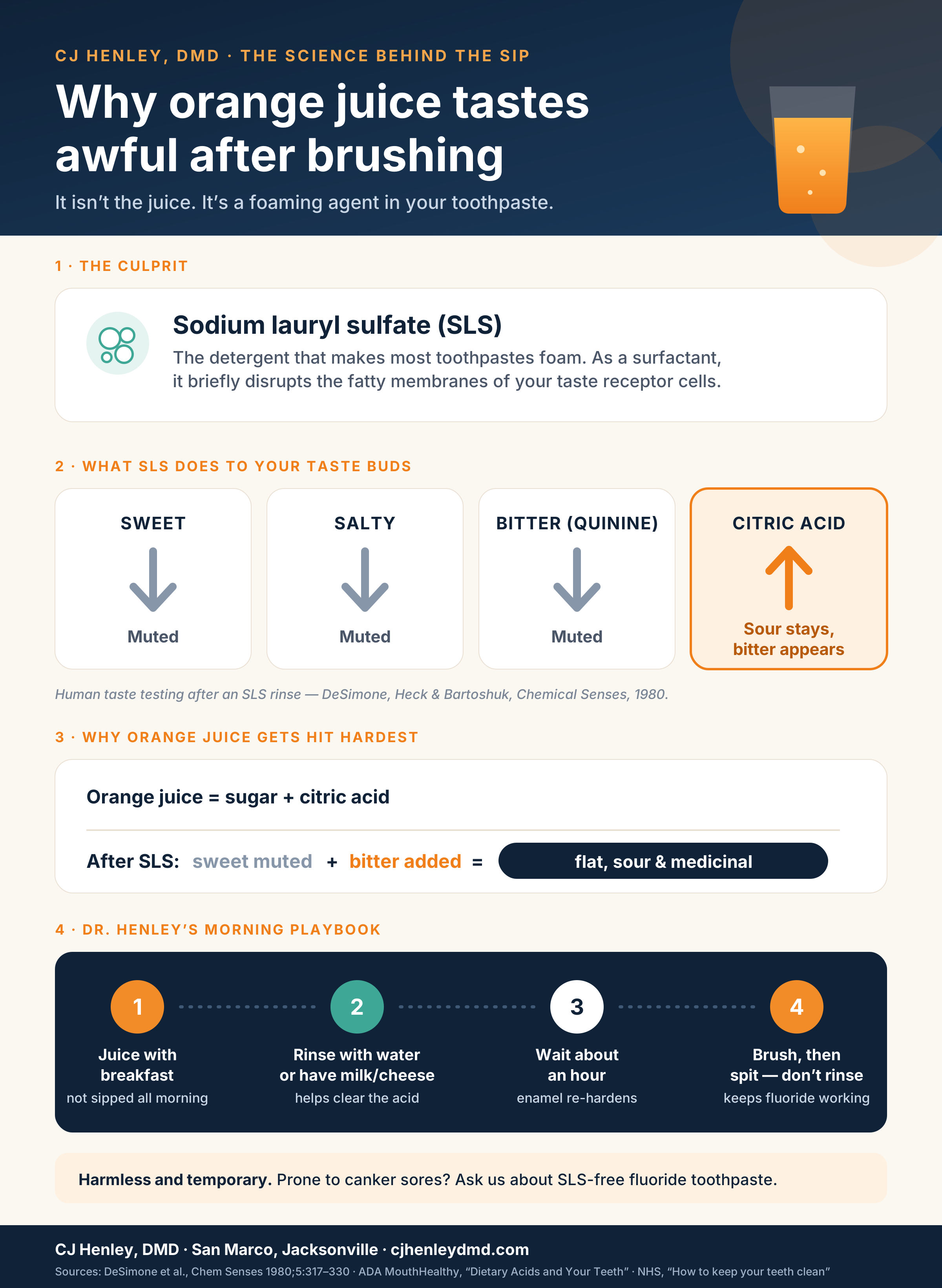
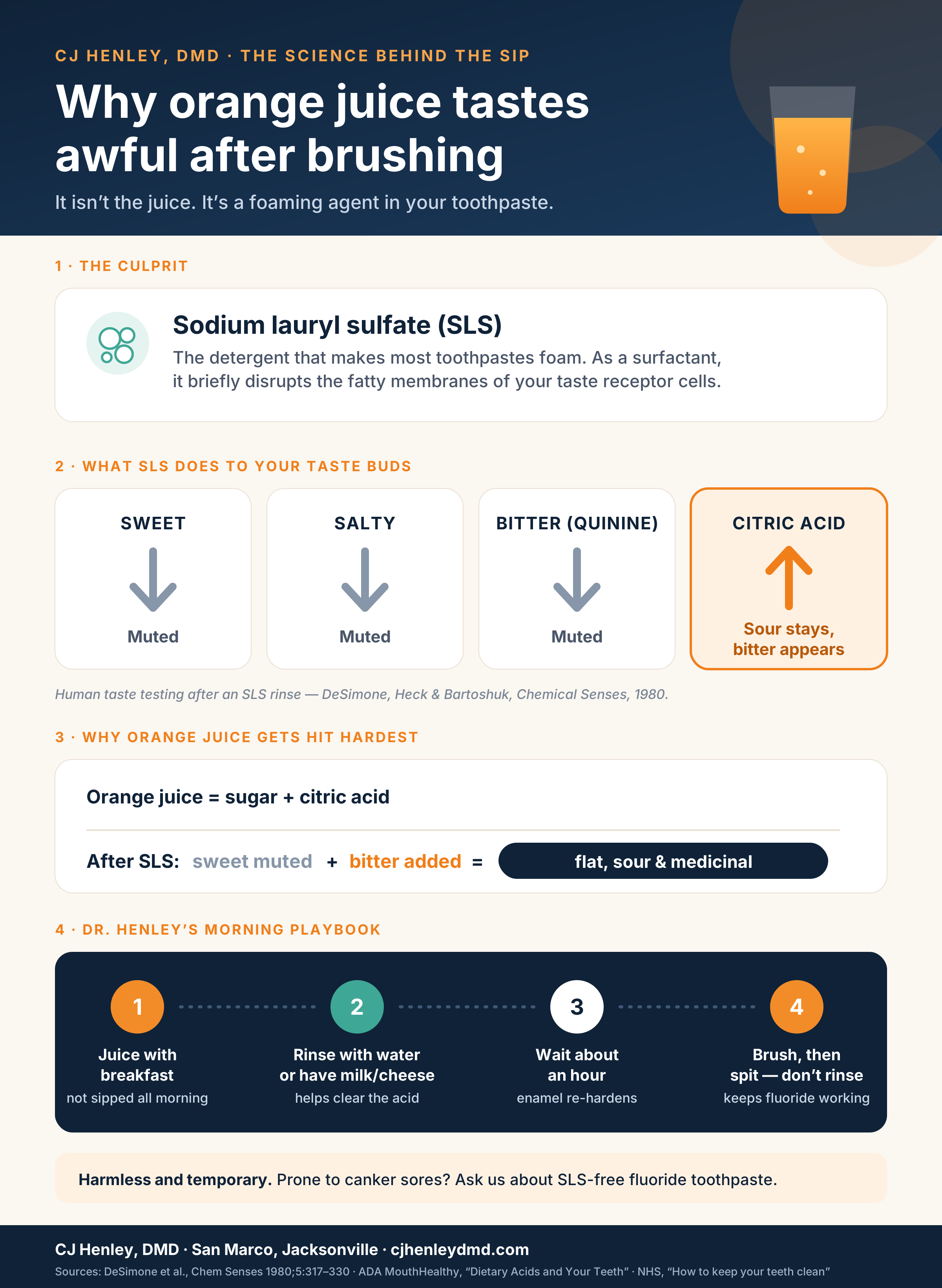
It also happens to be a powerful taste modifier. In a 1980 study published in Chemical Senses, volunteers rinsed with a dilute SLS solution and then tasted test solutions. Sweet (sugar), salty and bitter (quinine) tastes were all suppressed. Citric acid stayed just as sour, but it picked up a distinct bitter taste it didn't have before. (1)
Why orange juice gets hit the hardest
Orange juice tastes good because of a balance between natural sugar and citric acid. After brushing, SLS knocks out the sugar side and adds bitterness to the acid side. What's left is flat, sour and faintly medicinal.
Coffee, water and most other breakfast foods don't have the same sugar-versus-acid balance to disrupt, which is why orange juice is the one everyone notices.
How SLS actually changes taste
Your taste receptor cells are wrapped in fatty membranes. The researchers behind the 1980 study concluded that SLS most likely works by physically disturbing those membranes rather than locking onto one specific receptor, much the way it breaks up grease on a dish. (1)
A second effect may add to the first. Phospholipids (fatty molecules) can selectively blunt bitter taste, as Japanese researchers showed in Nature in 1993. (2) SLS is very good at breaking phospholipids apart, so it may strip away some of that natural bitterness buffer at the same time. Add the lingering mint flavor, which clashes with citrus, and the result is unmistakable.
Is it harmful?
No. The taste distortion is temporary and fades as saliva clears the SLS from your mouth. But the question points to two habits that do matter for your teeth, and most people get them backwards.
1. Don't brush right after orange juice
Orange juice is acidic. Acid temporarily softens the outer surface of enamel, and brushing that softened surface can wear it away. The American Dental Association recommends waiting about an hour after acidic foods or drinks before brushing, so saliva can wash away the acid and help enamel re-harden. (3)
Enamel erosion is permanent. We rebuild worn, eroded teeth in our office, and you can see what that involves in our case studies and before-and-after gallery. Still, the easiest version of that treatment is never needing it. If your teeth already feel sensitive to cold or sweets, erosion is one of the things we look for at a comprehensive exam.
2. Spit, don't rinse
Rinsing with water after brushing seems like the obvious way to get rid of the toothpaste taste. It also washes away the concentrated fluoride your toothpaste just left on your teeth. The UK's National Health Service advises spitting out the excess without rinsing, and not using mouthwash right after brushing either. (4)
My morning routine for juice drinkers
If you drink juice with breakfast:
Have your orange juice with the meal, not sipped over the whole morning.
Afterward, rinse with water, or have a little milk or cheese. (3)
Wait about an hour.
Brush with fluoride toothpaste. Spit, don't rinse.
If you'd rather brush as soon as you wake up, brush, spit and don't rinse, then save the orange juice for later in the morning.
Should you switch to an SLS-free toothpaste?
For most people, timing solves the orange juice problem. But an SLS-free fluoride toothpaste is worth considering if you:
Get recurring canker sores. A systematic review of double-blind trials found that people with recurrent canker sores who switched to SLS-free toothpaste had fewer ulcers, shorter-lasting ulcers and less pain. (5)
Have a dry or sensitive mouth, including during or after cancer treatment.
Simply prefer it and want breakfast to taste right.
Whatever you choose, make sure it contains fluoride. Our toothpaste guide breaks down which ingredients actually matter.
When it isn't the toothpaste
If food tastes off all the time, whether metallic, bitter, burning or just wrong, that isn't SLS. Persistent taste changes can come from medications, dry mouth, burning mouth syndrome, or radiation and chemotherapy for head and neck cancer.
Our practice evaluates these mouth symptoms, including taste changes, burning, dryness and unexplained soreness, through careful oral medicine diagnosis. Dr. Henley serves on the Head and Neck Tumor Board at Baptist MD Anderson, where his role is dental care and coordination, and physicians refer patients to our San Marco office for dental care before, during and after cancer treatment.
Frequently asked questions
Why does orange juice taste bitter after brushing my teeth?
Sodium lauryl sulfate, the foaming agent in most toothpastes, temporarily suppresses sweet taste and adds a bitter note to citric acid. Orange juice depends on sweetness to balance its acidity, so it tastes sour and bitter until the effect fades.
Is it bad to brush right after drinking orange juice?
It's better to wait. Acid softens enamel, and brushing immediately can wear it away. The ADA recommends waiting about an hour after acidic foods or drinks before brushing.
Should I rinse after brushing to get rid of the taste?
No. Rinsing washes away the fluoride left by your toothpaste. Spit out the excess and leave the rest.
Does every toothpaste do this?
Toothpastes that contain sodium lauryl sulfate cause it. SLS-free toothpastes generally don't, so check the ingredient list.
When should I see a dentist about taste changes?
If the bad taste lasts beyond the minutes after brushing, happens with every food, or comes with burning, dryness or soreness, have it evaluated. These can signal dry mouth, medication effects, burning mouth syndrome or other oral conditions.
Questions about taste changes or enamel wear?
Dr. CJ Henley practices general, cosmetic and restorative dentistry in San Marco and welcomes patients from across Jacksonville. New-patient visits are about two hours, so there's time to ask questions and get straight answers, including the "why does this happen?" ones.
Meet Dr. Henley · New patients · Book online · Call 904-398-1549
Related reading: Is sparkling water bad for your teeth? · Foods that support healthy teeth · Dry mouth causes and treatment · Are you brushing too hard?
This article is for general education and isn't a substitute for an exam. Questions about your own mouth? Contact our office.
Sources
DeSimone JA, Heck GL, Bartoshuk LM. Surface active taste modifiers: a comparison of the physical and psychophysical properties of gymnemic acid and sodium lauryl sulfate. Chem Senses. 1980;5(4):317-330. doi:10.1093/chemse/5.4.317 (checked at publisher)
Katsuragi Y, Kurihara K. Specific inhibitor for bitter taste. Nature. 1993;365(6443):213-214. doi:10.1038/365213b0 (retrieved via PubMed)
American Dental Association, MouthHealthy. Dietary acids and your teeth.
NHS. How to keep your teeth clean. Reviewed June 2025.
Alli BY, Erinoso OA, Olawuyi AB. Effect of sodium lauryl sulfate on recurrent aphthous stomatitis: a systematic review. J Oral Pathol Med. 2019;48(5):358-364. doi:10.1111/jop.12845 (retrieved via PubMed)
About the author. CJ Henley, DMD, is a general dentist in Jacksonville whose practice focuses on cosmetic and restorative dentistry, dental implants and dental care around head and neck cancer. Meet Dr. Henley.
CJ Henley, DMD, PA · 3675 Hendricks Avenue, Jacksonville, FL 32207 · 904-398-1549
Updated October 2026.