


What Toothpaste Do Dentists Use? My Personal Picks
Jacksonville dentist Dr. CJ Henley, DMD shares what dentists actually use at home. Learn how to choose the best toothpaste for sensitivity, whitening, and long-term oral health.
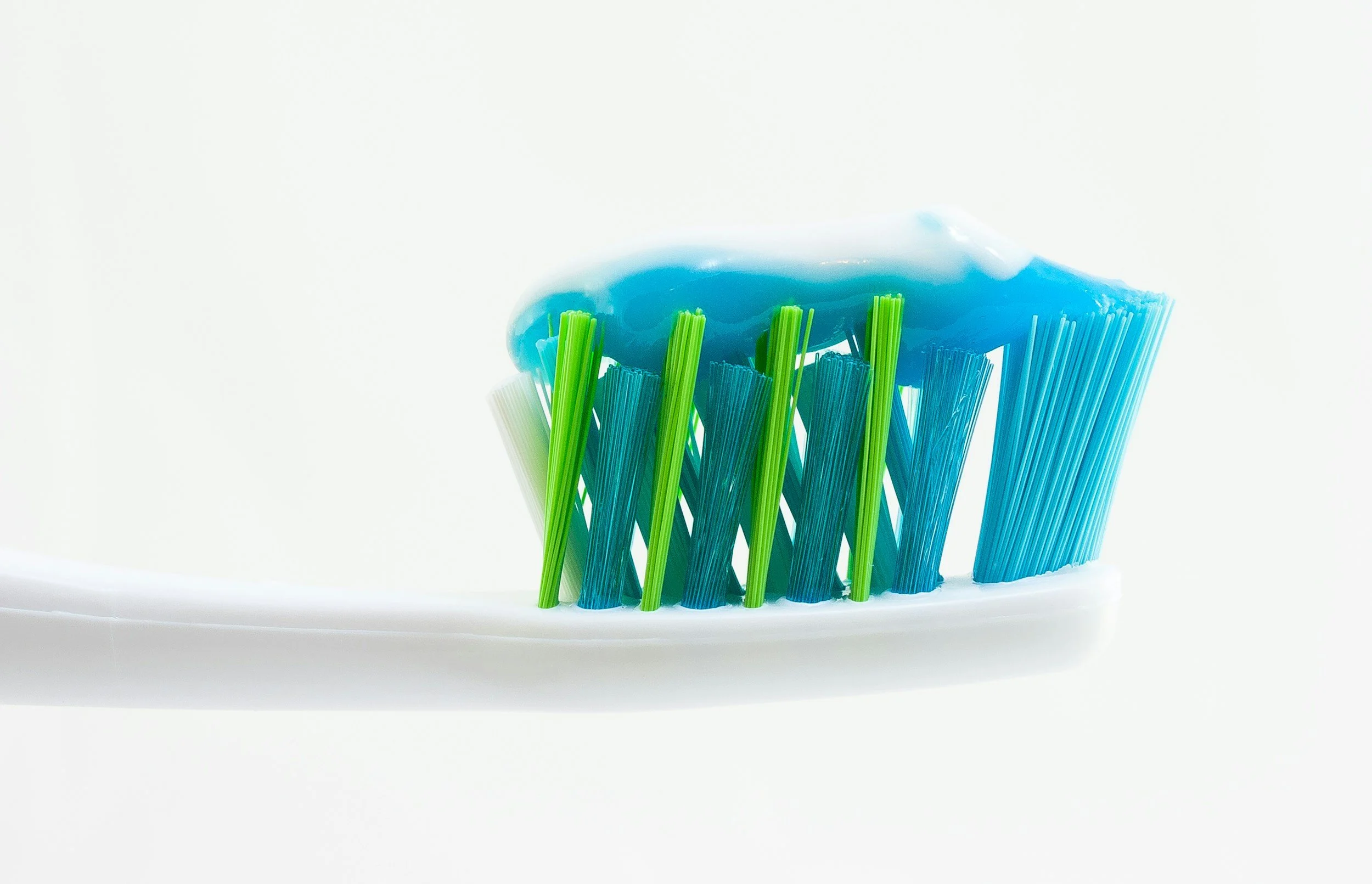
At home I use a fluoride toothpaste with low abrasion, and I switch to a desensitizing fluoride toothpaste when my teeth are sensitive. That's what I recommend for most adults too. The brand matters less than three things: fluoride, gentle abrasives and an active ingredient that fits your needs. For the full ingredient breakdown, see our toothpaste guide. This post is the short, personal version.
Is there one perfect toothpaste?
No. The right choice depends on your mouth: your enamel, your diet, your habits and your medical history. Toothpaste matters more than most people think, though. The right one can reduce sensitivity, help prevent cavities and protect dental work over the years.
What do I look for on the label?
Fluoride. This is the ingredient I won't skip. It strengthens enamel and can help reverse early decay before a cavity forms. Sodium fluoride and stannous fluoride are both good choices.
Low abrasiveness. Abrasives remove surface stains, but they can also wear enamel, exposed roots and restorations. My own rule of thumb is to stay under about 100 on the RDA scale (relative dentin abrasivity) for most people. Most labels don't list RDA, so I usually point patients toward pastes made for sensitive teeth or enamel protection, which tend to be gentler.
An active ingredient for your need. Potassium nitrate helps with sensitivity. Stannous fluoride helps with gum health as well as cavities. Nano-hydroxyapatite is a fluoride alternative some patients ask about. The research on it is growing, but for most of my patients I still recommend fluoride.
What you can skip. Charcoal, "natural" whitening ingredients and oil pulling trends sound appealing, but they don't have good evidence behind them, and some charcoal pastes are quite abrasive.
What do I actually use at home?
People often ask me which toothpaste I use. Here's my honest rotation:
Everyday: a fluoride toothpaste with mild abrasiveness, such as Pronamel or Colgate Total.
When my teeth are sensitive: a desensitizing option such as Sensodyne Repair & Protect.
For a dry mouth: an SLS-free fluoride toothpaste, such as Biotène's fluoride toothpaste. SLS is the foaming detergent in most toothpastes, and some people with a dry or tender mouth find it irritating.
For whitening: I don't rely on whitening toothpaste.
These are my own preferences, not a recommendation for everyone. A different paste may fit your mouth better.
Does whitening toothpaste change the color of your teeth?
Not much. Whitening toothpastes work mainly by polishing off surface stains from coffee, tea and similar foods. They don't significantly change the color inside the tooth.
Changing the tooth's underlying color takes a peroxide bleaching product. That can be an over-the-counter strip or gel, or a professional treatment in the office or with custom trays at home. Both kinds bleach the tooth. A dental exam first is still worthwhile, because whitening won't change crowns, veneers or fillings, it can make sensitivity worse, and discoloration sometimes has a cause that needs treatment. Our teeth whitening page covers the options.
What if I've had radiation to the head and neck?
Radiation to the head and neck can sharply reduce saliva and raise the risk of decay. An SLS-free fluoride toothpaste helps with comfort, but most patients also need a stronger, prescription fluoride plan that we tailor to them. If you're facing or have finished treatment, see our head and neck cancer and dry mouth pages.
When isn't toothpaste enough?
Even a good toothpaste can't make up for missed brushing. Brush twice a day for two minutes with a soft brush, and clean between your teeth daily with floss or small brushes. If you still have bleeding gums, lasting sensitivity or new discoloration, come see me. Sometimes your mouth is telling you something toothpaste can't fix.
A few toothpaste tips
Less is more. A pea-sized amount is plenty for adults. More foam doesn't mean more cleaning.
Spit, don't rinse. Leaving a thin film of fluoride on your teeth helps it work longer. Our post on why orange juice tastes bad after brushing explains this and the role of SLS.
Match your situation. Enamel wear, gum recession, dental implants and cancer treatment can each change what works for you.
Want help choosing?
If you're not sure which toothpaste fits your mouth, ask at your next visit and we'll build it into your home care plan. Contact our office at 3675 Hendricks Avenue in Jacksonville or call 904-398-1549.
Sources
American Dental Association. Whitening (Oral Health Topics).
American Dental Association, MouthHealthy. Fluoride.
About the author. CJ Henley, DMD, is a general dentist in Jacksonville whose practice focuses on cosmetic and restorative dentistry, dental implants and dental care around head and neck cancer. Meet Dr. Henley.
CJ Henley, DMD, PA · 3675 Hendricks Avenue, Jacksonville, FL 32207 · 904-398-1549
Updated October 2026.
Why Does Orange Juice Taste Bad After Brushing? A Dentist Explains the Science
Toothpaste's foaming agent mutes sweetness and makes orange juice taste bitter. Dr. Henley explains the science, and the morning routine that protects your enamel.
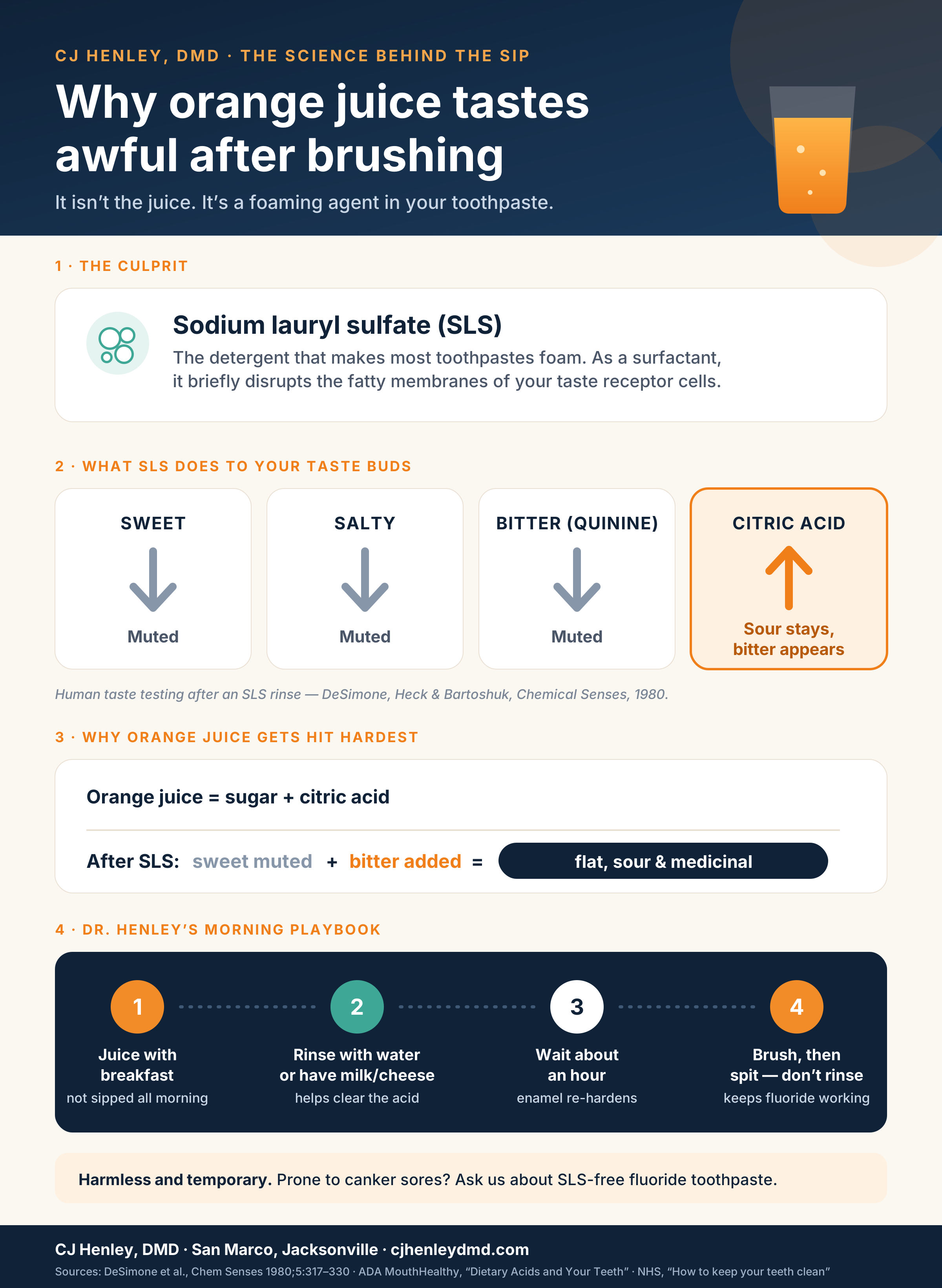
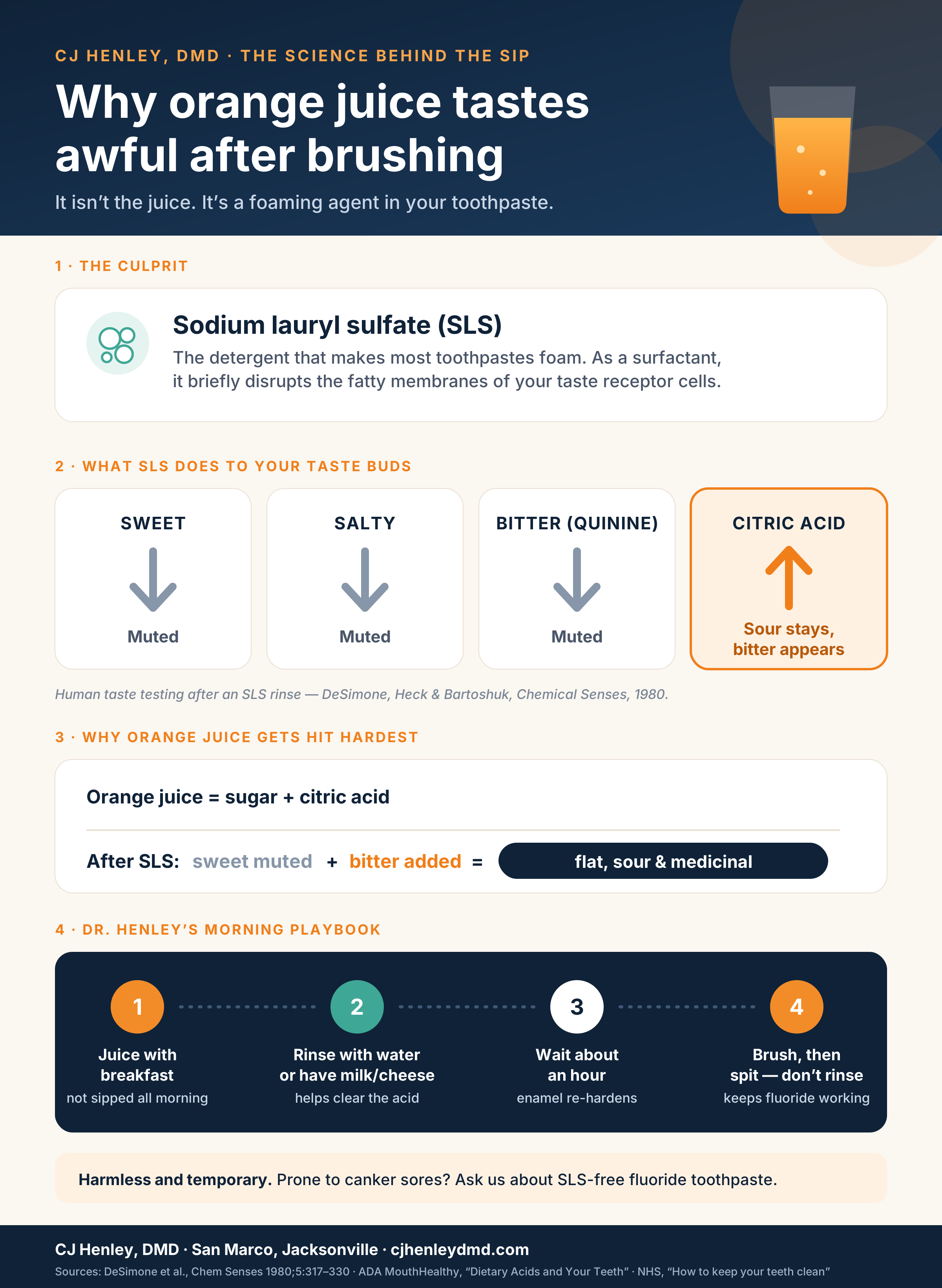
Most toothpastes contain sodium lauryl sulfate (SLS), the detergent that makes them foam. For a short time after brushing, SLS mutes your ability to taste sweetness and gives acids a bitter edge. Orange juice is mostly sugar plus citric acid, so you lose the sweet and gain the bitter. It's harmless and temporary, and the better fix is to change the order: juice first, brush about an hour later, and spit instead of rinsing.
By CJ Henley, DMD
The culprit: sodium lauryl sulfate
SLS is a surfactant, which means a detergent. It's in most mainstream toothpastes because it foams, spreads the paste around your mouth and helps lift debris.
It also happens to be a powerful taste modifier. In a 1980 study published in Chemical Senses, volunteers rinsed with a dilute SLS solution and then tasted test solutions. Sweet (sugar), salty and bitter (quinine) tastes were all suppressed. Citric acid stayed just as sour, but it picked up a distinct bitter taste it didn't have before. (1)
Why orange juice gets hit the hardest
Orange juice tastes good because of a balance between natural sugar and citric acid. After brushing, SLS knocks out the sugar side and adds bitterness to the acid side. What's left is flat, sour and faintly medicinal.
Coffee, water and most other breakfast foods don't have the same sugar-versus-acid balance to disrupt, which is why orange juice is the one everyone notices.
How SLS actually changes taste
Your taste receptor cells are wrapped in fatty membranes. The researchers behind the 1980 study concluded that SLS most likely works by physically disturbing those membranes rather than locking onto one specific receptor, much the way it breaks up grease on a dish. (1)
A second effect may add to the first. Phospholipids (fatty molecules) can selectively blunt bitter taste, as Japanese researchers showed in Nature in 1993. (2) SLS is very good at breaking phospholipids apart, so it may strip away some of that natural bitterness buffer at the same time. Add the lingering mint flavor, which clashes with citrus, and the result is unmistakable.
Is it harmful?
No. The taste distortion is temporary and fades as saliva clears the SLS from your mouth. But the question points to two habits that do matter for your teeth, and most people get them backwards.
1. Don't brush right after orange juice
Orange juice is acidic. Acid temporarily softens the outer surface of enamel, and brushing that softened surface can wear it away. The American Dental Association recommends waiting about an hour after acidic foods or drinks before brushing, so saliva can wash away the acid and help enamel re-harden. (3)
Enamel erosion is permanent. We rebuild worn, eroded teeth in our office, and you can see what that involves in our case studies and before-and-after gallery. Still, the easiest version of that treatment is never needing it. If your teeth already feel sensitive to cold or sweets, erosion is one of the things we look for at a comprehensive exam.
2. Spit, don't rinse
Rinsing with water after brushing seems like the obvious way to get rid of the toothpaste taste. It also washes away the concentrated fluoride your toothpaste just left on your teeth. The UK's National Health Service advises spitting out the excess without rinsing, and not using mouthwash right after brushing either. (4)
My morning routine for juice drinkers
If you drink juice with breakfast:
Have your orange juice with the meal, not sipped over the whole morning.
Afterward, rinse with water, or have a little milk or cheese. (3)
Wait about an hour.
Brush with fluoride toothpaste. Spit, don't rinse.
If you'd rather brush as soon as you wake up, brush, spit and don't rinse, then save the orange juice for later in the morning.
Should you switch to an SLS-free toothpaste?
For most people, timing solves the orange juice problem. But an SLS-free fluoride toothpaste is worth considering if you:
Get recurring canker sores. A systematic review of double-blind trials found that people with recurrent canker sores who switched to SLS-free toothpaste had fewer ulcers, shorter-lasting ulcers and less pain. (5)
Have a dry or sensitive mouth, including during or after cancer treatment.
Simply prefer it and want breakfast to taste right.
Whatever you choose, make sure it contains fluoride. Our toothpaste guide breaks down which ingredients actually matter.
When it isn't the toothpaste
If food tastes off all the time, whether metallic, bitter, burning or just wrong, that isn't SLS. Persistent taste changes can come from medications, dry mouth, burning mouth syndrome, or radiation and chemotherapy for head and neck cancer.
Our practice evaluates these mouth symptoms, including taste changes, burning, dryness and unexplained soreness, through careful oral medicine diagnosis. Dr. Henley serves on the Head and Neck Tumor Board at Baptist MD Anderson, where his role is dental care and coordination, and physicians refer patients to our San Marco office for dental care before, during and after cancer treatment.
Frequently asked questions
Why does orange juice taste bitter after brushing my teeth?
Sodium lauryl sulfate, the foaming agent in most toothpastes, temporarily suppresses sweet taste and adds a bitter note to citric acid. Orange juice depends on sweetness to balance its acidity, so it tastes sour and bitter until the effect fades.
Is it bad to brush right after drinking orange juice?
It's better to wait. Acid softens enamel, and brushing immediately can wear it away. The ADA recommends waiting about an hour after acidic foods or drinks before brushing.
Should I rinse after brushing to get rid of the taste?
No. Rinsing washes away the fluoride left by your toothpaste. Spit out the excess and leave the rest.
Does every toothpaste do this?
Toothpastes that contain sodium lauryl sulfate cause it. SLS-free toothpastes generally don't, so check the ingredient list.
When should I see a dentist about taste changes?
If the bad taste lasts beyond the minutes after brushing, happens with every food, or comes with burning, dryness or soreness, have it evaluated. These can signal dry mouth, medication effects, burning mouth syndrome or other oral conditions.
Questions about taste changes or enamel wear?
Dr. CJ Henley practices general, cosmetic and restorative dentistry in San Marco and welcomes patients from across Jacksonville. New-patient visits are about two hours, so there's time to ask questions and get straight answers, including the "why does this happen?" ones.
Meet Dr. Henley · New patients · Book online · Call 904-398-1549
Related reading: Is sparkling water bad for your teeth? · Foods that support healthy teeth · Dry mouth causes and treatment · Are you brushing too hard?
This article is for general education and isn't a substitute for an exam. Questions about your own mouth? Contact our office.
Sources
DeSimone JA, Heck GL, Bartoshuk LM. Surface active taste modifiers: a comparison of the physical and psychophysical properties of gymnemic acid and sodium lauryl sulfate. Chem Senses. 1980;5(4):317-330. doi:10.1093/chemse/5.4.317 (checked at publisher)
Katsuragi Y, Kurihara K. Specific inhibitor for bitter taste. Nature. 1993;365(6443):213-214. doi:10.1038/365213b0 (retrieved via PubMed)
American Dental Association, MouthHealthy. Dietary acids and your teeth.
NHS. How to keep your teeth clean. Reviewed June 2025.
Alli BY, Erinoso OA, Olawuyi AB. Effect of sodium lauryl sulfate on recurrent aphthous stomatitis: a systematic review. J Oral Pathol Med. 2019;48(5):358-364. doi:10.1111/jop.12845 (retrieved via PubMed)
About the author. CJ Henley, DMD, is a general dentist in Jacksonville whose practice focuses on cosmetic and restorative dentistry, dental implants and dental care around head and neck cancer. Meet Dr. Henley.
CJ Henley, DMD, PA · 3675 Hendricks Avenue, Jacksonville, FL 32207 · 904-398-1549
Updated October 2026.