


Cavity Pain: Stages of Tooth Decay and When It Hurts
Cavities, which dentists sometimes call dental caries, are spots of tooth decay. They can range in size from tiny to large enough to break teeth.
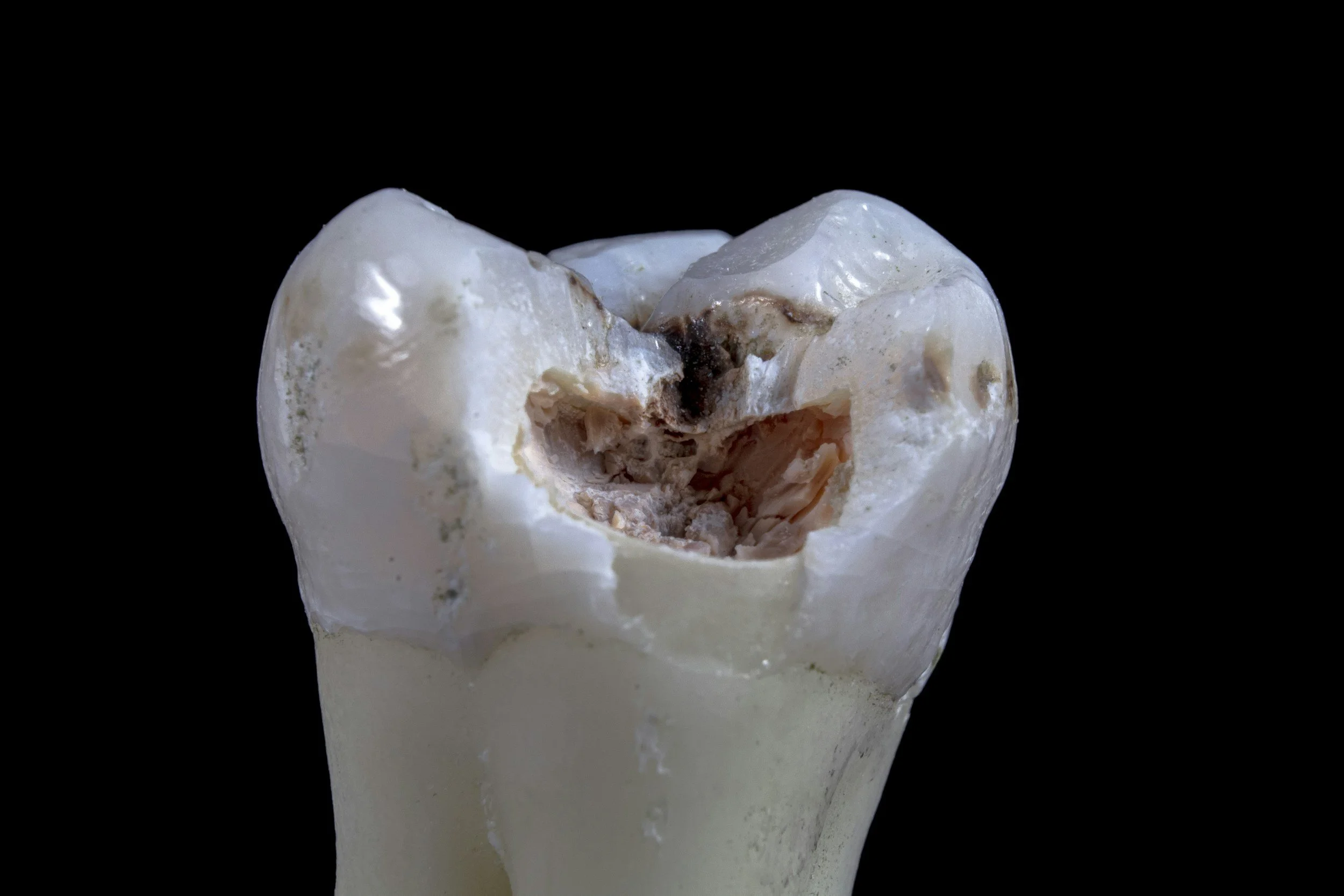
Dental cavity showing tooth decay in enamel and dentin
No, a cavity doesn't always hurt. Early decay in the enamel usually causes no symptoms at all. Pain tends to start once decay reaches the softer dentin underneath, and constant or throbbing pain usually means it has reached the nerve. By the time a cavity hurts, it is generally larger, which is why checkups and X-rays find most cavities before you feel them.
How does tooth decay start?
Bacteria in plaque feed on sugars and starches and make acid. Each time you eat or sip something sugary, that acid pulls minerals out of the enamel. Saliva and fluoride put minerals back between snacks. Decay begins when the losses keep outpacing the repairs. [1]
What are the stages of tooth decay, and when does each one hurt?
1. Early enamel decay (white spot)
The first sign is often a chalky white spot. Enamel has no nerves, so this stage doesn't hurt. It is also the only stage that can be stopped or reversed without a filling. Fluoride toothpaste, a fluoride treatment in the office, fewer sugary snacks and good cleaning can let the enamel remineralize. [1]
2. Decay through the enamel
Once the enamel surface breaks down, a true cavity forms. It may still cause no pain, or you may notice a brief twinge with sweets or cold. A cavity at this stage can't heal on its own and usually needs a filling.
3. Decay into the dentin
Dentin is softer than enamel and full of tiny channels that lead toward the nerve. Decay spreads faster here. Sensitivity to cold, sweets or biting becomes more common. The pain usually stops within a few seconds once the trigger is gone.
4. Decay that reaches the nerve (pulp)
When bacteria reach the pulp, the nerve becomes inflamed. Pain may linger long after a cold drink, throb on its own or wake you at night. At this point the nerve often can't recover, and the choices are usually root canal treatment and a crown, or removing the tooth.
5. Abscess
If the infection spreads past the root tip, it can form an abscess. Signs include severe throbbing pain, swelling of the gum or face, a bad taste, fever and a tooth that hurts to touch. Sometimes the pain eases because the nerve has died, but the infection is still there. A dental abscess needs prompt treatment. [2]
What makes some people more prone to cavities?
Dry mouth. Saliva neutralizes acid and repairs enamel. Many common medicines, including some for blood pressure, anxiety and depression, reduce saliva and can lead to fast decay along the gumline. Learn more about dry mouth.
How often you eat or sip sugar. Frequent snacking or sipping sweet drinks through the day gives enamel little time to recover.
Exposed roots. Root surfaces are softer than enamel and decay more easily.
Existing fillings and crowns. Decay can start again at the edges.
Fluoride exposure. Fluoride toothpaste helps every age group.
When is cavity pain urgent?
Call promptly for swelling in your gum or face, fever, a bad taste with pain, or pain that keeps you awake. Trouble breathing or swallowing, or swelling that spreads quickly toward the eye or neck, needs emergency medical care. Call 911 or go to an emergency department. Our page on dental emergencies covers what to do while you arrange care.
How do I find out if a tooth has a cavity?
If something feels off, or it has been a while since your last exam, call our office at 904-398-1549 or contact us. At a comprehensive dental examination, I look at the teeth and X-rays and also at the reasons decay is happening, such as dry mouth, diet and medications, so that any filling is part of a plan rather than a one-time repair. For other kinds of tooth pain, see why your tooth may hurt.
Sources
National Institute of Dental and Craniofacial Research. Tooth decay. Last reviewed September 2025.
American Association of Endodontists. Tooth pain. Accessed October 6, 2026.
American Dental Association, MouthHealthy. Dietary acids and your teeth. Accessed October 6, 2026.
About the author. CJ Henley, DMD, is a general dentist in Jacksonville whose practice focuses on cosmetic and restorative dentistry, dental implants and dental care around head and neck cancer. Meet Dr. Henley.
CJ Henley, DMD, PA · 3675 Hendricks Avenue, Jacksonville, FL 32207 · 904-398-1549
Updated October 2026.

Sinus Infection and Tooth Pain: What Is the Connection?
A sinus infection, or sinusitis, occurs when viruses or bacteria infect the sinus linings. The results can be uncomfortable symptoms, including facial pain and pressure, runny nose, headache, and, sometimes, tooth pain.

Yes, a sinus infection can cause tooth pain. It usually shows up as a dull ache in several upper back teeth at once, along with congestion or facial pressure, and it often gets worse when you bend over. The reverse also happens: an infected upper tooth can cause a sinus infection. Because the two can look alike, an examination with X-rays is the reliable way to tell them apart.
Why can sinus problems feel like a toothache?
The maxillary sinuses sit behind your cheeks, directly above the upper premolars and molars. In many people the root tips of these teeth sit right at the floor of the sinus, separated by only a thin layer of bone. When the sinus lining swells during an infection, the pressure is felt through the same nerves that supply those teeth. The teeth themselves can be healthy and still ache.
What does sinus-related tooth pain feel like?
A dull, aching pain in the upper back teeth rather than a sharp pain in one tooth
Several teeth on one side hurting at the same time
Pain that gets worse when you bend forward, lie down or step hard
Congestion, facial pressure, nasal drainage or headache at the same time
Sinus-related pain usually isn't set off by hot, cold or biting on one particular tooth. A tooth that hurts sharply with cold or chewing points more toward a dental cause. Our article on why a tooth hurts explains those patterns.
Can a tooth problem cause a sinus infection?
Yes. An infection at the root of an upper back tooth, a failed root canal, gum disease around those roots, or complications from an extraction or implant can spread into the sinus. This is called odontogenic sinusitis, meaning sinusitis that starts from a tooth. It often affects one side only, may come with a foul smell or taste, and tends not to clear up with sinus treatment alone because the source is still there. Treating it usually means treating the tooth, and sometimes the sinus as well.
Should I see a dentist or a physician?
See a dentist first if:
One tooth hurts more than the others
The pain is sharp with biting, chewing, hot or cold
Your gum or face is swollen
The tooth still hurts after your sinus symptoms clear
Sinus symptoms keep returning on one side only
See your physician if you have congestion, fever, nasal discharge or facial pressure, and a dental exam hasn't found a tooth problem. Some people need both. A 2021 international consensus of ear, nose and throat surgeons and dentists concluded that diagnosing sinusitis caused by a tooth generally needs a dentist to confirm the tooth problem and a physician to confirm the sinusitis. [1]
How is the cause diagnosed?
In the office, I test the suspect teeth with cold and with tapping and biting, check the gums, and take X-rays of the upper back teeth. When a standard X-ray doesn't answer the question, 3D imaging can show the root tips and sinus floor more clearly. If the teeth are healthy, that is useful information for your physician too.
Where can I have this checked in Jacksonville?
If an upper tooth aches and you aren't sure whether it's your sinuses, call our office at 904-398-1549 or contact us. A comprehensive dental examination can rule a tooth in or out. Swelling that spreads quickly, trouble breathing or swallowing, or swelling near the eye needs emergency medical care right away.
Sources
Craig JR, Poetker DM, Aksoy U, et al. Diagnosing odontogenic sinusitis: an international multidisciplinary consensus statement. Int Forum Allergy Rhinol. 2021;11(8):1235-1248. doi:10.1002/alr.22777 (retrieved via PubMed)
Craig JR, Tataryn RW, Aghaloo TL, et al. Management of odontogenic sinusitis: multidisciplinary consensus statement. Int Forum Allergy Rhinol. 2020;10(7):901-912. doi:10.1002/alr.22598 (retrieved via PubMed)
American Association of Endodontists. Tooth pain. Accessed October 6, 2026.
About the author. CJ Henley, DMD, is a general dentist in Jacksonville whose practice focuses on cosmetic and restorative dentistry, dental implants and dental care around head and neck cancer. Meet Dr. Henley.
CJ Henley, DMD, PA · 3675 Hendricks Avenue, Jacksonville, FL 32207 · 904-398-1549
Updated October 2026.