


Torus Palatinus: Causes, Cancer Risk, and When Treatment Is Needed
Learn what torus palatinus is, whether it is cancerous, when a hard bump needs a dental exam, and when removal may be recommended.
Oral health • CJ Henley, DMD • Jacksonville, Florida
A torus palatinus is a benign bony growth in the middle of the roof of the mouth. It is usually painless and often needs no treatment.
Torus palatinus is not oral cancer. However, not every lump on the roof of the mouth is a torus. A dental examination can confirm the diagnosis, especially if the bump is newly noticed, changing, painful, bleeding, or associated with a sore that does not heal.
Quick answers
- What is it? An outgrowth of normal bone in the center of the hard palate, also called a palatal torus.
- Is it cancer? No. A confirmed torus palatinus is benign. An unexplained lump still needs an examination.
- Does it hurt? Usually not, although the thin tissue covering it can become irritated.
- Does it need removal? Usually not. Treatment is considered when it interferes with comfort, function, or a dental appliance.
What is torus palatinus?
A torus palatinus is a firm outgrowth of normal, mature bone along the midline of the hard palate, the bony front part of the roof of your mouth. The plural is palatal tori. It usually develops slowly and is considered an anatomical variation rather than a disease.
Some tori form a smooth dome. Others look like a broad ridge or a cluster of rounded lobes. They are more common in women. Estimates of how many people have them vary substantially between populations and studies. [1] [2]
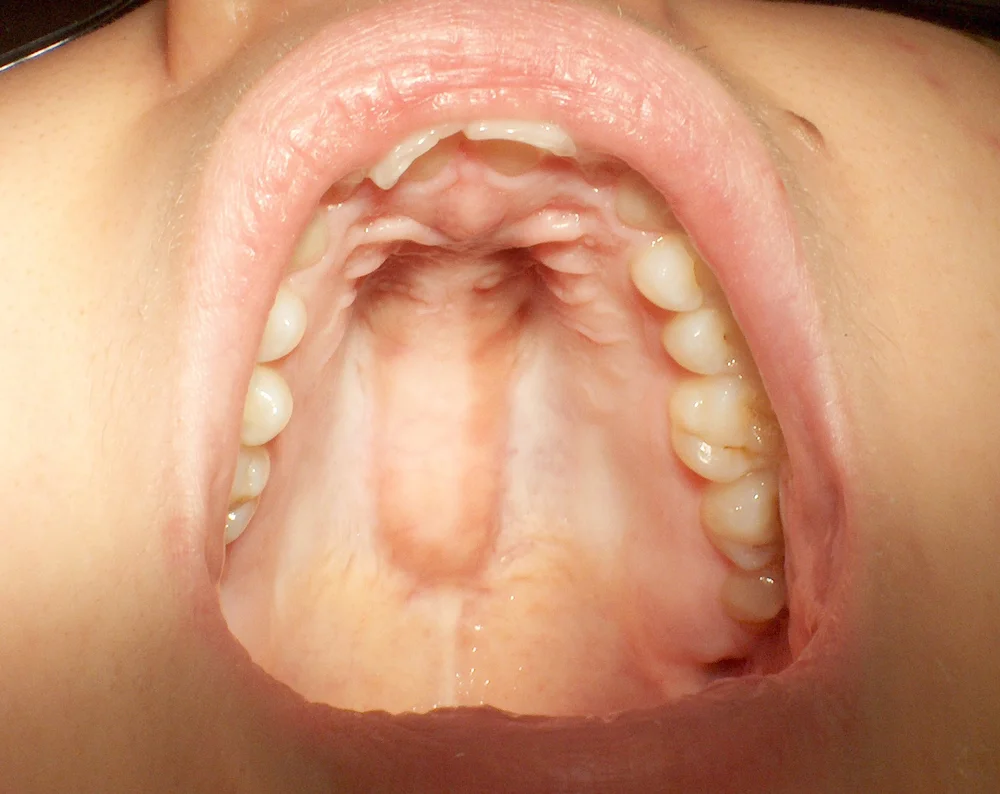

A typical palatal torus
- Centered on the hard palate
- Hard and bony
- Usually covered by intact tissue
- Stable or slowly growing
Changes to have checked
- Rapid enlargement or a new swelling
- Unexplained pain, bleeding, or numbness
- A sore that does not heal
- Persistent red or white patches
These features help explain what a dentist looks for. They are not a self-diagnosis checklist.
Is torus palatinus cancerous?
No. Torus palatinus is a benign bony growth, not oral cancer. The important step is confirming that a lump really is a torus. Other conditions can develop on the palate, and their appearances can overlap.
An oral cancer screening includes examining the mouth for concerning changes. If an area is suspicious, further testing or a biopsy may be needed. An examination alone cannot definitively rule out every condition.
When should a bump be examined?
- A newly noticed or changing lump, particularly one growing quickly.
- A swelling that is off-center, soft, or fluid-filled.
- A sore, ulcer, or red or white patch that persists for more than two weeks.
- Unexplained bleeding, numbness, or persistent pain.
These findings do not automatically mean cancer, but they deserve evaluation. Do not wait two weeks if symptoms are rapidly worsening. [4]
Seek urgent care for rapidly spreading swelling or difficulty breathing or swallowing.
Why an examination matters
A dentist considers the location, texture, history, surrounding teeth, and tissue over the bump. Our oral medicine evaluations help assess unusual lumps, sores, and other changes in the mouth.
| Condition | Possible features | Why evaluation matters |
|---|---|---|
| Palatal torus | A hard, usually slow-growing prominence in the center of the hard palate. | Often needs no treatment once the diagnosis is confirmed. |
| Salivary gland growth | A swelling that may occur toward the side or back of the palate. It can be painless. | Salivary gland tumors can be benign or malignant. A biopsy may be needed. |
| Dental abscess | Palatal swelling associated with an infected tooth. Pain may occur. | Needs dental treatment to address the infection. |
| Nasopalatine duct cyst | A swelling near the front of the palate, sometimes in the midline. | A midline location alone does not establish that a lump is a torus. |
Further reading: National Cancer Institute: salivary gland tumors and diagnosis and management of nasopalatine duct cysts.
A typical torus can often be identified through examination. If the findings are unusual or surgery is planned, imaging may help assess the underlying anatomy. A CBCT scan provides a three-dimensional view when clinically indicated. It is not routinely needed for every torus. A biopsy is generally unnecessary for a typical torus but may be recommended when the diagnosis is uncertain.
Palatal and mandibular tori: a visual comparison
Palatal tori occur on the roof of the mouth. Mandibular tori occur on the inner surface of the lower jaw, beside the tongue. These photographs show examples in different people.


Tori vary in size and shape. Comparing your mouth with a photograph cannot confirm a diagnosis. Have a new or changing lump examined.
What causes torus palatinus?
The precise cause is not fully understood. Research points to a combination of inherited traits and environmental or functional influences. [3]
- Genetics: Tori can run in families.
- Bite forces: Teeth grinding and clenching, called bruxism, may contribute. They are not an established single cause of palatal tori.
- Other influences: Age, population differences, diet, and bone density have been studied, but their roles are not fully settled.
A palatal torus does not by itself prove that you grind your teeth or need a night guard.
Can torus palatinus cause pain or irritation?
Most palatal tori cause no discomfort. The tissue covering the bone is relatively thin, however, and hard or sharp foods can scratch it. Hot foods can burn the tissue, and an appliance that rubs the area can cause soreness.
A prominent torus may also interfere with the comfort or fit of an upper denture. Grooves between lobes can collect food, requiring attention during oral hygiene.
If the area becomes painful, have the cause assessed rather than assuming the torus explains every symptom. Avoid foods that repeatedly scrape the area, keep it gently clean, and have a rubbing appliance checked.
When is torus palatinus removal recommended?
Most people do not need removal. Surgery may be considered when the torus causes a specific problem: [1]
- It prevents a planned upper denture from fitting or functioning properly.
- It causes recurrent painful tissue injury that does not respond to conservative care.
- Its size interferes with speech, chewing, or swallowing.
The decision depends on your symptoms, anatomy, medical history, and dental treatment needs. A denture can sometimes be designed around a torus. Removal is not automatic simply because you need a denture.
What does removal involve?
When appropriate, an oral surgeon or another appropriately trained dentist lifts the overlying tissue, reduces and smooths the excess bone, and closes the area with sutures. Local anesthesia is used, with sedation considered according to the procedure and your needs.
A protective surgical stent may be used while the palate heals. Your surgeon will discuss risks such as bleeding, infection, wound-healing problems, and an opening into the nasal cavity. The nearby anatomy matters when planning surgery. [5]
Recovery varies with the size of the torus, the extent of surgery, and your health. Your dental team will provide instructions about food, cleaning, pain control, and follow-up. Initial comfort and complete tissue healing are not the same milestone.
Noticed a new bump on the roof of your mouth?
Schedule an examination with C.J. Henley, DMD at our Hendricks Avenue office in Jacksonville. We can assess the area and discuss whether observation, treatment, or a referral is appropriate.
3675 Hendricks Avenue, Jacksonville, FL 32207 · Contact and directions
Frequently asked questions
Does torus palatinus go away on its own?
A torus is made of bone and generally does not disappear on its own. If it causes no problems, it can usually be left alone and checked during routine dental visits.
Can a torus palatinus grow back after surgery?
Regrowth has been reported. Removal does not guarantee that a torus will never return. Your surgeon can discuss the likelihood in your situation and what to watch for afterward.
Can teeth grinding cause a bump on the roof of the mouth?
Grinding and clenching may contribute to the development of oral tori, but the relationship is not a proven single cause. An examination can assess both the bump and any evidence of grinding.
Does a palatal torus affect braces or clear aligners?
A torus does not necessarily prevent orthodontic treatment. Its size and position can affect appliances that contact the palate, such as some retainers and expanders. Your dentist or orthodontist will assess the fit and treatment plan.
Are bony bumps beside the tongue related?
Similar growths on the inner surface of the lower jaw are called mandibular tori. They often occur on both sides, beside the tongue. Like palatal tori, they are made of normal bone and usually need no treatment unless they cause problems. Not every lump in this area is a torus.
Can I remove or shrink a torus at home?
No home remedy has been shown to remove a palatal torus. Do not try to file, cut, or puncture it. If it bothers you, a dentist can determine whether treatment is needed.
About C.J. Henley, DMD
C.J. Henley, DMD, is a general dentist in Jacksonville, Florida. General dentistry guides his care, and his practice focuses on cosmetic and restorative dentistry, dental implants and dental care around head and neck cancer. He also evaluates oral medicine concerns and serves on the Head & Neck Tumor Board at Baptist MD Anderson Cancer Center.
CJ Henley, DMD, PA · 3675 Hendricks Avenue, Jacksonville, FL 32207 · 904-398-1549
Updated October 2026.
References and further reading
- García-García AS, et al. Current status of the torus palatinus and torus mandibularis. Med Oral Patol Oral Cir Bucal. 2010;15(2):e353-e360.
- Haugen LK. Palatine and mandibular tori. A morphologic study in the current Norwegian population. Acta Odontol Scand. 1992;50(2):65-77.
- Loukas M, et al. The tori of the mouth and ear: a review. Clin Anat. 2013;26(8):953-960.
- National Institute of Dental and Craniofacial Research. Oral cancer: signs, symptoms, and diagnosis.
- Treatment of the Partially Edentulous Maxilla in the Presence of Tori. Dentistry Today. August 1, 2005.
- Torus palatinus: symptoms, causes and treatment. Cleveland Clinic.

Can Brushing Your Teeth Lower Your Diabetes Risk?
There's a new, unexpected reason to keep your pearly whites gleaming: avoiding diabetes.
Recommended Videos
Possibly, but only a little, and it hasn't been proven. A large Korean study found that people who brushed three or more times a day were about 8% less likely to develop diabetes over ten years than people who brushed less often. That is an association, not proof that brushing prevents diabetes. What is well established is that diabetes and gum disease affect each other, so caring for your gums matters more if you have diabetes or are at risk of it.
What did the study find?
Researchers at Ewha Womans University in Seoul used health records from 188,013 adults in Korea's national health screening program. None had diabetes at the start. The researchers looked at gum disease, the number of missing teeth and how often people said they brushed, then followed them for a median of ten years. About 16% developed diabetes. [1]
After adjusting for age, exercise, smoking, alcohol and other health factors:
Brushing three or more times a day was linked to about 8% lower diabetes risk.
Gum disease was linked to about 9% higher risk.
Missing 15 or more teeth was linked to about 21% higher risk. [1]
What are the limits?
It is observational. People who brush more often may also eat better, exercise more or see doctors more, and not all of that can be adjusted for.
Brushing was self-reported, at a single point in time.
The study was in Korea, and results may differ in other populations.
The effect is small. Weight, physical activity and diet remain the main things you can change to lower type 2 diabetes risk.
The authors concluded that better oral hygiene "may be associated" with lower diabetes risk, and that more research is needed. [1]
How are gum disease and diabetes connected?
This part is not in doubt. People with diabetes are more likely to develop gum disease, and it tends to be more severe, especially when blood sugar runs high. Severe gum disease, in turn, can make blood sugar harder to control. [2] Researchers think long-term inflammation from infected gums is part of the reason.
What should you do?
Brush twice a day with fluoride toothpaste and clean between your teeth daily. Brushing after meals is reasonable if you want to brush more often.
Keep your blood sugar in your target range if you have diabetes.
Tell your dentist if you have diabetes or prediabetes, and tell your physician if you have gum disease.
Watch for bleeding, swollen or receding gums. These are signs to see a dentist.
If you have diabetes and your mouth feels dry, our post on how to stop dry mouth caused by diabetes has practical steps. For other connections between your gums and your health, see can gum disease affect your overall health?
Where can you have your gums checked in Jacksonville?
A comprehensive dental exam at our office includes a full gum evaluation and a review of your medical history. Contact us or call 904-398-1549.
Sources
Chang Y, Lee JS, Lee KJ, Woo HG, Song TJ. Improved oral hygiene is associated with decreased risk of new-onset diabetes: a nationwide population-based cohort study. Diabetologia. 2020;63(5):924-933. doi:10.1007/s00125-020-05112-9 (retrieved via PubMed)
National Institute of Diabetes and Digestive and Kidney Diseases. Diabetes, gum disease and other dental problems.
About the author. CJ Henley, DMD, is a general dentist in Jacksonville whose practice focuses on cosmetic and restorative dentistry, dental implants and dental care around head and neck cancer. Meet Dr. Henley.
CJ Henley, DMD, PA · 3675 Hendricks Avenue, Jacksonville, FL 32207 · 904-398-1549
Updated October 2026.