

CJ Henley, DMD, PA / San Marco, Jacksonville, Florida
Teeth grinding and bruxism treatment in Jacksonville.
Custom night guards, jaw relief, and repair for worn teeth.
Bruxism is clenching or grinding your teeth, while you sleep, while you are awake, or both. At our San Marco office we find out how much damage grinding has done, protect your teeth and dental work with a custom-made night guard, ease the jaw pain and morning headaches that often come with it, and rebuild teeth that have already worn down.
- 1 in 4adults clench or grind while awake1,2
- 1 in 8adults or more grind often during sleep1,2
- Mostnight grinders don’t know they do it until a partner or a dentist notices
- 3–4 motypical relief from one round of Botox for clenching and jaw muscle pain

What is bruxism?
Clenching and grinding your teeth, without meaning to.
Bruxism is repeated jaw-muscle activity that clenches or grinds the teeth or braces the jaw. Sleep bruxism happens at night; awake bruxism happens during the day, usually as clenching. Many cases are mild. It needs treatment when it wears or breaks teeth, damages dental work, or causes jaw pain or headaches.
Your teeth are only meant to touch briefly, when you chew and swallow. With bruxism, the jaw muscles press the teeth together or slide them side to side for long stretches, often with far more force than chewing. Clenching is silent. Grinding can be loud enough to wake a sleeping partner.
A 2018 international consensus describes bruxism as a muscle activity rather than a disease in otherwise healthy people.3 That matters for treatment: there is no single cure, so good care focuses on protecting your teeth, reducing what drives the habit, and relieving symptoms such as jaw pain. When grinding comes with jaw-joint pain, clicking, or trouble opening, we also evaluate for TMJ and TMD.
Because worn teeth are often the first clue, grinding is usually caught at a comprehensive dental exam, sometimes years before a patient feels anything.
Two kinds of bruxism
Sleep bruxism vs. awake bruxism.
They can happen together, but they behave differently, and the plan for each is a little different.
Sleep bruxism
of adults grind often during sleep in one large review; newer pooled estimates run higher1,2
- What it looks like
- Rhythmic grinding or clenching in brief bursts through the night, often with sound.
- Typical clues
- Morning jaw soreness or temple headache, a partner who hears it, flattened or chipped teeth.
- Often linked with
- Snoring and sleep apnea, caffeine, alcohol, nicotine, some medications, family history.
- Main help
- A custom night guard to protect teeth, plus a sleep evaluation when breathing is a concern.
Awake bruxism
of adults clench or brace their jaw during the day1
- What it looks like
- Silent clenching or bracing while concentrating, driving, at a computer, or under stress.
- Typical clues
- Tired jaw by late afternoon, tension headaches, ridges on the cheek or scalloped tongue edges.
- Often linked with
- Stress, anxiety, focus-heavy work, stimulants, some antidepressants.
- Main help
- Habit awareness (“lips together, teeth apart”), stress management, and a daytime guard in some cases.
Signs and symptoms
How do you know if you grind your teeth?
Common signs of teeth grinding are a sore or tired jaw on waking, dull headaches at the temples, teeth that look shorter, flatter, or chipped, new cold sensitivity, broken fillings or crowns, and a partner who hears grinding at night. These signs suggest bruxism but don’t prove it, because a cracked tooth, a cavity, or a jaw joint problem can feel similar.
Want more detail on nighttime clues? Read how to tell if you grind your teeth at night.
Quick self-check
Do I grind my teeth? Check what sounds familiar.
This is not a diagnosis. It helps you decide whether an evaluation is worth scheduling, and it gives us a useful starting point at your visit.
Causes and risk factors
Why do I grind my teeth at night?
There is rarely one cause. Sleep bruxism is regulated by the brain during brief arousals from sleep, not by a “bad bite.” Stress and anxiety, snoring and sleep apnea, caffeine, alcohol and nicotine, certain medications, acid reflux, and family history all raise the odds.
What happens if bruxism isn’t treated
How grinding wears teeth down, stage by stage.
Untreated grinding can flatten and shorten teeth, wear through enamel into the softer, yellow dentin, crack teeth, break fillings, crowns, and veneers, and contribute to jaw pain and headaches. Enamel does not grow back, so the goal is to catch wear early and protect what remains.
-
Stage 1
Healthy
Rounded corners and a slightly translucent biting edge.
Routine checkups
-
Stage 2
Early wear
Edges flatten and corners square off. Small flat, shiny facets appear.
Night guard; smooth or bond small chips
-
Stage 3
Into dentin
Enamel wears through. Yellow dentin shows, wears faster, and may feel sensitive.
Night guard plus bonding or crowns
-
Stage 4
Advanced
Teeth are noticeably short, chipped, or cracked, and the bite and smile have collapsed.
Rebuild with crowns, then protect with a guard
Dashed outline shows the tooth’s original shape. Illustration only; wear patterns vary from person to person.
Real patients from our San Marco office
Rebuilding teeth worn down by grinding: before and after.
When grinding has already taken length and shape from the teeth, we can rebuild them. Because these patients grind, we chose porcelain-fused-to-zirconia for its strength under heavy bite forces, and each now wears a custom night guard to protect the new work. Drag the slider on each photo to compare.
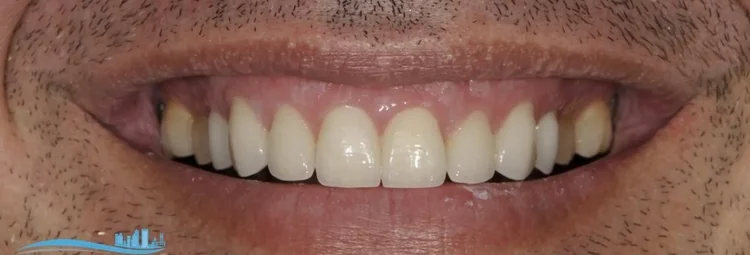
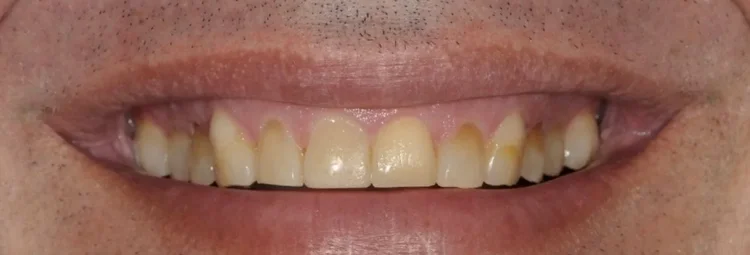
Teeth worn short by years of grinding
Grinding had shortened and flattened these teeth and exposed the yellower dentin beneath the enamel. Porcelain-fused-to-zirconia restorations rebuilt their length, shape, and color.
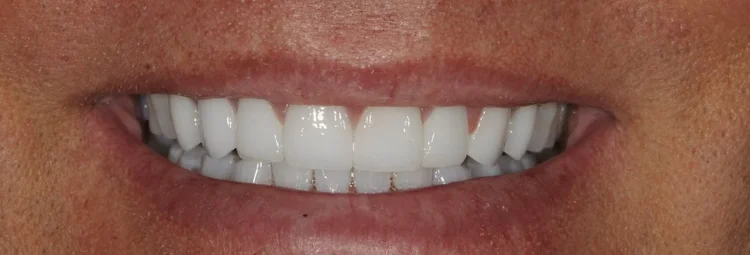
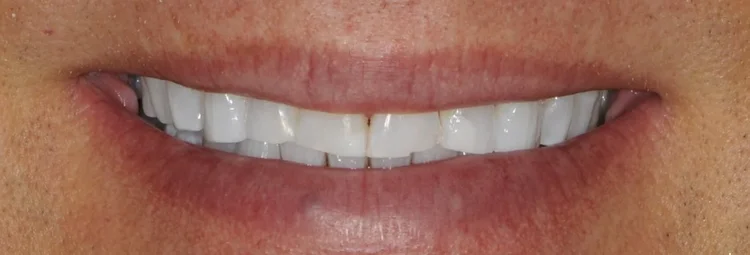
A whole upper arch flattened by bruxism
Every upper tooth had lost length. Full and three-quarter crowns rebuilt the arch together, removing only as much tooth as each one needed.
Heavy grinders need restorations chosen for strength. Read why we often use full-contour zirconia for a heavy bite, and see more cases in our before and after gallery. If you are considering cosmetic dentistry, veneers, or dental implants, controlling grinding first is part of making them last.
Custom night guards in Jacksonville
Custom night guard vs. store-bought: what’s the difference?
A custom night guard is made from a precise scan of your teeth, so it fits closely, stays put, spreads biting force evenly, and is adjusted to your bite. Store-bought boil-and-bite guards are thicker and softer and fit loosely. They can work as a short-term stopgap but can shift the bite, wear through quickly, and in some people increase clenching.
| Feature | Custom guard from your dentist | Boil-and-bite (drugstore) | Stock / one-size |
|---|---|---|---|
| Fit | ✓ Made from a digital scan of your teeth | Molded at home; often loose or bulky | ✗ Generic shape |
| Bite checked and balanced | ✓ Adjusted in the chair so the teeth meet evenly | ✗ No | ✗ No |
| Material | Hard or dual-laminate (soft inside, hard outside), chosen for how hard you grind | Soft thermoplastic | Soft or rubbery plastic |
| Comfort and speech | ✓ Thin, low-profile | Bulky; can affect sleep and breathing | Bulkiest |
| Durability for heavy grinders | ✓ Often several years | Weeks to months | Weeks to months |
| Protects crowns, veneers, implants | ✓ Designed around your dental work | Limited | Limited |
| Wear and fit monitored | ✓ Checked at each visit | ✗ No | ✗ No |
Hard, soft, or dual-laminate?
For most people who grind at night, we recommend a hard acrylic or dual-laminate guard. In a small sleep study, hard splints reduced nighttime jaw-muscle activity in most people, while soft guards increased it in half of them.7 Soft guards still have a place for light clenchers and some teens.
Night guard vs. occlusal splint
The terms overlap. “Night guard” usually means a protective appliance for grinding. An “occlusal splint” is a guard that is carefully adjusted to the bite and often used for TMJ and jaw muscle pain.
What a night guard does, and doesn’t do
A guard protects your teeth, fillings, crowns, veneers, and implants, and it can ease morning jaw soreness. It usually does not stop the grinding itself.4 That is why we also look at stress, sleep, medications, and daytime habits.
If you snore or might have sleep apnea
A standard night guard is not a sleep apnea treatment, and in some people it can make breathing during sleep worse. If you snore loudly, wake gasping, or are tired despite a full night in bed, talk with your physician about a sleep evaluation. Newer options exist too, such as the daytime sleep apnea device cleared by the FDA.
Bruxism treatment
How we treat teeth grinding and clenching.
Teeth grinding treatment works in layers: protect the teeth with a custom night guard, reduce triggers such as stress, caffeine, and poor sleep, relieve jaw pain with conservative care and, in selected cases, Botox, and repair teeth that are already worn or broken.
01 Protect
Custom night guard
The core of treatment. It takes the wear instead of your teeth and dental work.
02 Reduce triggers
Habits and sleep
Daytime awareness, stress management, less evening caffeine and alcohol, and a sleep evaluation when needed.
03 Relieve
Jaw pain care
Warm compresses, gentle stretches, short-term pain relief, and, for selected patients, Botox.
04 Repair
Restore worn teeth
Bonding, crowns, or a full rebuild once grinding is under control.
Daytime clenching: lips together, teeth apart
Your teeth should rest apart, with the tongue lightly on the roof of the mouth. Put small reminders where you clench (your monitor, steering wheel, or phone) and check in a few times a day. Over a few weeks, many people catch the habit sooner.
At-home relief for a sore jaw
Warm, moist heat on the jaw muscles, a softer diet for a few days, no gum chewing, and avoiding very wide yawns help. An over-the-counter pain reliever can help for a short time when it is safe for you. Our home care instructions cover the basics.
Botox for clenching and facial pain
For selected patients with painful, overworked jaw muscles or heavy clenching, we offer botulinum toxin (Botox) injections into the chewing muscles. Effects typically last three to four months. Read our full section on Botox for bruxism and facial pain.
Medications and other care
If grinding began after starting a new medication, we can share what we see with your prescriber, who may adjust it. For persistent jaw pain we coordinate with physical therapists, orofacial pain specialists, or physicians. Chronic facial pain is also part of our oral medicine and diagnosis work.
We do not grind down healthy teeth or permanently reshape the bite as a first step for bruxism. When a single high spot is overloading a tooth, a small, targeted bite adjustment may help, but only after a careful evaluation.
Botox for bruxism and facial pain
Botox for teeth grinding, clenching, and jaw and facial pain in Jacksonville.
Botox (botulinum toxin) injections relax the overworked chewing muscles that power clenching and grinding. In selected patients they can reduce jaw and facial muscle pain, tension headaches at the temples, and the force of grinding for about three to four months at a time. Dr. Henley provides Botox for bruxism and jaw muscle pain at our San Marco office, alongside a night guard rather than in place of one.
How Botox helps bruxism
The masseter and temporalis muscles generate the force behind clenching and grinding. A small dose of botulinum toxin temporarily reduces how hard those muscles can contract. You can still talk, smile, and chew normally, but the muscles can no longer clamp down with the same force overnight. That can mean less muscle pain, fewer morning headaches, and less strain on teeth and dental work.
Systematic reviews report that Botox can reduce bruxism-related pain, the number of grinding episodes, and maximum bite force,9 and that it relieves muscle-related TMD pain better than placebo, with results similar to conventional treatments.10 The number of high-quality trials is still small, and results vary from person to person.
Botox for jaw and facial pain
Many people with bruxism feel it as facial pain: aching cheeks, sore temples, pain in front of the ear, or tension headaches that start in the jaw. When that pain comes from tight, overworked chewing muscles (myofascial pain) and has not improved with a night guard and conservative care, Botox is one of the most useful next steps we offer.
Not all facial pain is muscle pain. A cracked tooth, an infected tooth, a jaw joint problem, sinus disease, or nerve pain such as trigeminal neuralgia can feel similar and need different treatment. That is why every Botox consultation starts with a careful exam, part of our oral medicine and facial pain diagnosis work, and why we coordinate with your physicians when the pain points elsewhere.
Who is a good candidate?
- Jaw or facial muscle pain from clenching that hasn’t settled with a night guard and self-care.
- Heavy grinders who keep chipping teeth, guards, or dental work despite wearing a guard.
- Morning temple headaches linked to nighttime clenching.
- Enlarged, overworked masseter muscles that make the jaw feel tight and look wide.
Botox may not be right if you are pregnant or breastfeeding, have a neuromuscular condition such as myasthenia gravis or ALS, have had a reaction to a botulinum toxin product, or have an infection at the injection site. Tell us about all your medications, including certain antibiotics. Pain that comes mainly from inside the jaw joint usually responds less to Botox than muscle pain does.
Day 0
Consult and injections
Exam, then a few small injections with a fine needle. The visit is short and you can return to normal activities right away.
Days 3–7
Starts working
Muscles begin to relax. Chewing tough foods may feel tiring for a few weeks.
About 2 weeks
Full effect
We check your response and fine-tune the plan for next time.
3–4 months
Wears off gradually
We reassess. Many patients repeat treatment; some need it less often over time.
Side effects and safety
Side effects in the jaw muscles are usually mild and temporary: tenderness or a small bruise, a mild headache, or a tired feeling when chewing hard foods. Rarely, the toxin affects a nearby muscle and makes a smile look slightly uneven for a few weeks. With repeated treatment, the masseters can become slimmer, which narrows the lower face, an effect some patients welcome. Some studies have raised questions about reduced jawbone density after repeated injections, which is one reason we use the lowest effective dose and reassess before each round.
Is Botox FDA-approved for bruxism?
No. Botox is FDA-approved for other uses, including chronic migraine, and its use for bruxism and TMD is off-label. That is common and legal in medicine and dentistry, but it means we discuss the evidence, the expected benefits, the limits, and the alternatives with you before recommending it. The cost depends on how much Botox you need, which we work out at your exam. Dental insurance usually does not cover Botox for grinding, so we give you the fee before treatment.
Botox and a night guard work together
Botox reduces muscle force; a night guard protects tooth surfaces. Many patients do best with both, especially those with veneers, crowns, or implants to protect. Botox does not repair worn teeth and does not treat sleep apnea.
What to do after your injections
Stay upright for a few hours, skip rubbing or massaging the treated areas that day, and avoid strenuous exercise until the next day. Keep wearing your night guard. Call us if you notice anything unexpected.
Your visit
Getting a custom night guard at our San Marco office.
Most patients need two short visits: one to evaluate and scan, and one to fit the finished guard. We use digital intraoral scanning, so there is no tray of impression putty.
Bring any guard you already have, a list of your medications, and notes on when your jaw hurts. If you are new to the practice, start with our new-patient forms.
Evaluation
We review your symptoms, sleep, medications, and history, then examine your teeth, dental work, jaw muscles, and jaw joints for signs of grinding. X-rays or other imaging are used only when they will change the plan.
Digital scan
A quick, radiation-free 3D scan of your upper and lower teeth and bite. We choose the guard design and material for how hard you grind and the dental work you have.
Fitting and bite adjustment
We fit the finished guard, check that it seats fully and comfortably, and adjust it so your teeth meet evenly on it.
Follow-up
Most people adjust within a week or two. Bring your guard to every checkup so we can check its fit and wear, and look at your teeth.
Care and lifespan
How to clean a night guard, and how long it lasts.
Rinse your night guard after each use, brush it gently with a soft toothbrush and cool water, let it dry, and keep it in a vented case. A custom hard guard often lasts several years; heavy grinders may wear through one sooner.
- Every morning: rinse, brush gently with a soft brush and mild soap or non-abrasive cleaner, and let it air-dry.
- Avoid heat: hot water, dishwashers, and a hot car can warp it.
- Skip toothpaste: it is abrasive and scratches the surface, where bacteria collect.
- Store it safely: a vented case, away from pets. Dogs love to chew night guards.
- Weekly: soak in a denture or retainer cleaner if we recommend one for your material.
- Replace or reline if it cracks, feels loose, no longer seats fully, or has holes worn through.
Some extra saliva and a slight awareness of your bite in the morning are normal for the first several days. A guard that causes tooth pain, rocks, or changes how your teeth meet during the day needs an adjustment, so call us.
Children and teens
My child grinds their teeth at night. Should I worry?
Grinding is common in children, reported in anywhere from about 6% to nearly half of kids depending on the study,8 and many outgrow it. It deserves an evaluation if it comes with snoring or mouth breathing, headaches or jaw pain, or noticeable wear on the teeth.
Baby teeth often show some flat wear, and that alone is usually not a concern. We look at how the teeth and jaws are developing, check for wear on the permanent teeth, and ask about sleep. Loud snoring, pauses in breathing, restless sleep, or daytime tiredness are worth raising with your pediatrician, because enlarged tonsils and airway problems can go along with grinding.
Night guards are rarely needed for young children whose teeth and jaws are still changing. For teens with permanent teeth and real wear, a guard may make sense. Stress can play a role at any age; see our articles on childhood stress and early molars and early childhood dental issues, or read about children’s dental care at our office.
Cost and insurance
What does a custom night guard cost?
The fee depends on the design and material your evaluation calls for, and whether a TMJ-style occlusal splint is needed instead of a protective guard. We give you the fee before anything is made.
It helps to compare the cost of a guard with the cost of what it protects. Repairing one cracked tooth or replacing a broken crown usually costs more than a guard, and a guard protects every tooth at once.
We are an out-of-network practice. Some dental plans cover part of an occlusal guard, often with a frequency limit. We can help you understand how to use your benefits; you are responsible for amounts your plan does not pay. Call our team with your plan details to ask about fees and payment arrangements. If you are planning around retirement, see dental insurance after retirement.

Teeth grinding dentist near you
Night guards and bruxism care in San Marco, Jacksonville.
Dr. CJ Henley has cared for Jacksonville patients for years, and much of his work is cosmetic and restorative dentistry, including rebuilding smiles worn down by grinding. That means we look at bruxism with the long view: protecting what you have now, and planning restorations that will stand up to a heavy bite later.
Our office on Hendricks Avenue is easy to reach from San Marco, Southbank, San Jose, Riverside, Avondale, Ortega, St. Nicholas, Downtown, and Mandarin. Patients with complex medical histories, including head and neck cancer survivors, are welcome; read about our complex and medically involved care. If your jaw opening became limited after radiation, see radiation-induced trismus, which is a different condition.
See what patients say in our reviews, or learn more about our San Marco dental office.
Frequently asked questions
Questions about teeth grinding and night guards.
Why do I grind my teeth at night?
Sleep grinding is driven by the brain during brief arousals from sleep, not by a “bad bite.” Stress and anxiety, snoring or sleep apnea, caffeine, alcohol, nicotine, some antidepressants and stimulants, acid reflux, and family history all make it more likely. Often several of these combine.
Is teeth grinding a serious problem?
Mild grinding may need nothing more than monitoring. It becomes a problem when it wears teeth down, cracks teeth, breaks fillings, crowns, or veneers, or causes jaw pain and headaches. Lost enamel does not grow back, so it is worth having an exam if you notice signs.
Will a night guard stop me from grinding?
Usually not. A night guard protects your teeth and dental work from grinding forces and can ease morning jaw soreness, but most people still grind on the guard. Reducing triggers such as stress, evening caffeine and alcohol, and untreated sleep problems is how the grinding itself is addressed.
Is a custom night guard better than a store-bought one?
For most people who grind, yes. A custom guard is made from a scan of your teeth, fits closely, is thinner, lasts longer, and is adjusted so your teeth meet evenly. Boil-and-bite guards are bulky and loose, wear out quickly, can shift the bite, and in some people increase clenching. They are fine as a short-term stopgap.
What type of night guard is best for heavy grinding?
Heavy grinders usually do best with a hard acrylic or dual-laminate guard (soft inside, hard outside). Hard surfaces let the jaw glide instead of chew, and they last longer. Soft guards suit light clenching or some teens. We choose the material at your evaluation.
How long does a night guard last?
A custom hard night guard often lasts several years. Heavy grinders can wear through one sooner. Replace or reline it if it cracks, feels loose, no longer seats fully, or has holes worn through. Bring it to every checkup so we can check it.
How do I clean my night guard?
Rinse it after each use, brush it gently with a soft toothbrush and cool water or mild soap, let it air-dry, and store it in a vented case. Avoid hot water, dishwashers, and toothpaste, which can warp or scratch it. A weekly soak in a denture or retainer cleaner helps if your material allows it.
Can I wear a night guard with crowns, veneers, or dental implants?
Yes, and it is especially important if you have them. Porcelain can chip under grinding forces, and implants do not have the natural cushioning ligament that teeth have. We design the guard around your dental work and usually recommend one after cosmetic or implant treatment for patients who grind.
Does a night guard help TMJ pain and morning headaches?
It often helps when grinding or clenching is part of the cause, by reducing strain on the jaw muscles overnight. Jaw pain has many causes, though, so we examine the muscles and joints first. A carefully adjusted occlusal splint is one part of conservative TMJ and TMD care.
Is teeth grinding linked to sleep apnea?
Sleep grinding is more common in people with obstructive sleep apnea, though it is not clear which one drives the other. If you snore loudly, stop breathing or gasp during sleep, or feel tired after a full night, talk with your physician about a sleep evaluation. A standard night guard does not treat sleep apnea.
Can antidepressants cause teeth grinding?
Yes. Some SSRIs and SNRIs, as well as ADHD stimulants, have been linked with new or worse grinding, often within weeks of starting or raising a dose. Do not stop a medication on your own. Tell your prescriber and us; a guard can protect your teeth while your prescriber decides whether any change makes sense.
Does Botox work for teeth grinding?
For many people, yes. Botox injected into the masseter and temporalis muscles reduces clenching force, grinding episodes, and jaw muscle pain for about three to four months at a time. It is not FDA-approved for bruxism, the number of high-quality studies is still small, and it does not replace a night guard for protecting teeth. We offer it for selected patients after an exam.
Can Botox help facial pain and TMJ pain?
It can help facial pain that comes from tight, overworked chewing muscles, such as aching cheeks, sore temples, and clenching headaches, especially when a night guard and self-care have not been enough. It helps less when pain comes mainly from inside the jaw joint, and other causes of facial pain, such as a cracked tooth or nerve pain, need different treatment. That is why we examine you first.
How long does Botox for jaw clenching last, and does it hurt?
It starts working within a few days, reaches full effect in about two weeks, and usually lasts three to four months, though this varies from person to person. The injections use a very fine needle and take only a few minutes; most people describe a brief pinch. Many patients repeat treatment, and some need it less often over time.
Will Botox for bruxism change the shape of my face?
It can slim the lower face over repeated treatments, because the masseter muscles get smaller when they work less. Some patients like this effect. It does not change your smile when it is placed correctly, though rarely a nearby muscle is affected for a few weeks.
Should I worry if my child grinds their teeth?
Usually not. Grinding is common in children and many outgrow it. Have it checked if it comes with snoring or mouth breathing, headaches, jaw pain, or noticeable wear, and mention snoring or restless sleep to your pediatrician. Night guards are rarely needed for young children whose teeth and jaws are still changing.
Does insurance cover a night guard?
Some dental plans cover part of an occlusal guard, often with limits on how frequently they will pay. We are an out-of-network practice and can help you understand how to use your benefits. Call our team with your plan details to ask about fees before scheduling.
Where can I get a custom night guard in Jacksonville?
CJ Henley, DMD, PA provides grinding evaluations and custom night guards at 3675 Hendricks Avenue, Jacksonville, FL 32207, in San Marco. Call 904.398.1549 or request an appointment online. Bring any current guard and a list of your medications.
More reading: What is bruxism, and does a night guard help? · Dental FAQ
Your next step
Protect your teeth before grinding takes more of them.
If you wake with a sore jaw, someone hears you grind, or your teeth look shorter than they used to, a grinding evaluation will show how much wear has happened and what will protect what remains. If a tooth has cracked or a crown has broken, see emergency dental care.
CJ Henley, DMD, PA3675 Hendricks Avenue
Jacksonville, FL 32207
Prefer a nonurgent text? 904.762.5616 is our practice on-call and text line. Please don’t send sensitive health information by text, and call for anything urgent.
Related pages
Sources
- Manfredini D, et al. Epidemiology of bruxism in adults: a systematic review of the literature. J Orofac Pain. 2013;27(2):99-110.
- Zieliński G, et al. Global prevalence of sleep bruxism and awake bruxism in pediatric and adult populations: a systematic review and meta-analysis. J Clin Med. 2024;13(14):4259.
- Lobbezoo F, et al. International consensus on the assessment of bruxism: report of a work in progress. J Oral Rehabil. 2018;45(11):837-844.
- National Institute of Dental and Craniofacial Research. Bruxism.
- Garrett AR, Hawley JS. SSRI-associated bruxism: a systematic review of published case reports. Neurol Clin Pract. 2018;8(2):135-141.
- Sleep bruxism and obstructive sleep apnea: a systematic review. J Clin Med. 2025.
- Okeson JP. The effects of hard and soft occlusal splints on nocturnal bruxism. J Am Dent Assoc. 1987;114(6):788-791.
- Machado E, et al. Prevalence of sleep bruxism in children: a systematic review. Dental Press J Orthod. 2014;19(6):54-61.
- Fernández-Núñez T, Amghar-Maach S, Gay-Escoda C. Efficacy of botulinum toxin in the treatment of bruxism: systematic review. Med Oral Patol Oral Cir Bucal. 2019;24(4):e416-e424.
- Zhu M, et al. Effects of botulinum toxin type A in patients with painful temporomandibular joint disorders: a systematic review and meta-analysis. Ann Med Surg. 2024;86(7).