
CJ Henley, DMD, PA / San Marco, Jacksonville, Florida
Emergency dentist in Jacksonville, FL.
Same-day care in San Marco.
If you have a toothache, a broken tooth, a lost crown, swelling, or a knocked-out tooth, call us. We see dental emergencies the same day during office hours at our San Marco office on Hendricks Avenue, and new patients are welcome. Please call first so we can get you in and tell you what to do on the way.
Existing patients after hours: call or text our on-call line, 904.762.5616.
- Same dayemergency visits during office hours, new patients welcome
- Milkis the first-choice way to carry a knocked-out adult tooth1
- 60 minof dry time and a knocked-out tooth’s root cells are likely lost1
- Neverput a knocked-out baby tooth back in1
Top-rated on Google: 4.9 stars from more than 225 patient reviews.
you have trouble breathing, speaking, or swallowing; swelling near your eye or down your neck; a fever with facial swelling; bleeding that won’t stop after 15–20 minutes of firm pressure; or a possible broken jaw or head injury.3,4,5 Once you are stable, call us at 904.398.1549 and we will treat the tooth.
What counts as a dental emergency?
Is it a dental emergency? Three levels of urgent.
A dental emergency is anything that threatens your airway, your health, or a tooth that can still be saved: spreading swelling, uncontrolled bleeding, a knocked-out adult tooth, severe pain, or a broken tooth. Some problems need the ER now, some need an emergency dentist today, and some can wait a few days for a regular visit.
Level 1
Call 911 or go to the ER now
- Trouble breathing or swallowing
- Swelling near the eye or down the neck
- Fever with facial swelling
- Bleeding that won’t stop with pressure
- Possible broken jaw or head injury
Then call us once you’re stable.
Level 2
Call an emergency dentist today
- Knocked-out adult tooth (call right away)
- Tooth pushed out of place or very loose
- Severe toothache, or pain that keeps you awake
- A dental abscess or swelling in the gum
- A broken tooth or cracked tooth that hurts
Call 904.398.1549.
Level 3
Call to book in the next few days
- Lost crown or filling with no pain
- A small chip with no sensitivity
- Mild sensitivity to cold
- A veneer that came off, kept safe
- Food stuck that floss won’t free
Call to book a visit.
Quick self-check
Do I need an emergency dentist? Check what applies.
This is not a diagnosis. It suggests which level of care to reach for first. If you are unsure, call.
ER, urgent care, or dentist?
When should I go to the ER for tooth pain?
Go to the ER for trouble breathing or swallowing, swelling near the eye or spreading down the neck, a high fever with swelling, bleeding that won’t stop, or a possible broken jaw. Emergency rooms and urgent care centers can relieve pain and start antibiotics, but they can’t fill, crown, or pull a tooth, so you will still need a dentist to fix the cause.3,5
| What you need | Our San Marco office | Urgent care | Emergency room |
|---|---|---|---|
| Airway trouble, swelling near the eye or neck | ✗ Go to the ER first | ✗ Not equipped | ✓ Airway care, IV antibiotics, imaging |
| Broken jaw or facial bones | ✗ ER first; we treat the teeth after | ✗ No | ✓ Yes |
| Pain relief and antibiotics | ✓ Yes, after finding the cause | ✓ Prescriptions; sometimes a numbing block | ✓ Yes |
| Drain an abscess | ✓ Yes, and treat the tooth behind it | ✗ Usually not | For spreading infections |
| Emergency tooth extraction | ✓ Yes; complex surgical cases referred | ✗ No | ✗ Not usually |
| Root canal, filling, crown, bonding | ✓ Yes | ✗ No | ✗ No |
| Replant a knocked-out tooth | ✓ Yes, splinted the same day | ✗ No | ✗ Not usually |
Emergency rooms do treat dangerous dental infections, and a spreading tooth infection belongs there first. For everything else, urgent dental care from an emergency dentist in Jacksonville is the faster route to fixing the tooth. Our general and family dentistry team handles most urgent problems in one visit.
Emergency dental care in Jacksonville
Dental emergencies we treat in our San Marco office.
We treat toothaches, broken and cracked teeth, lost crowns, fillings and veneers, infections and abscesses, knocked-out and loosened teeth, children’s dental injuries, broken dentures, and loose implant crowns, most of them the same day.
Severe toothache
Before you come in
Rinse with warm water and floss gently in case food is trapped. An over-the-counter pain reliever such as ibuprofen or acetaminophen helps if it is safe for you; follow the label. Don’t put aspirin on the tooth or gum.2,4
What we’ll do
Find the cause with a focused exam and X-rays: a deep cavity, a cracked tooth, an inflamed nerve, or a sinus problem. Toothache relief may be a filling, a root canal, or an extraction. Pain since recent work? See tooth pain after a filling.
Broken, chipped, or cracked tooth
Before you come in
Rinse with warm water, save any pieces in milk, and hold a cold compress on your cheek. Cover sharp edges with dental wax.
What we’ll do
A small chip can often be smoothed or repaired with bonding the same day. A broken tooth with a large piece gone usually needs a crown. A cracked tooth that hurts when you bite may need a crown or a root canal; 3D imaging helps when a crack is hard to see.
Lost crown, filling, or veneer
Before you come in
Keep the crown or veneer in a bag and bring it. Don’t use super glue or household glue.3 If the crown seats fully, a small dab of denture adhesive from the drugstore can hold it in place until your visit. If it doesn’t seat, leave it out.
What we’ll do
If the tooth underneath is healthy, we recement or rebond the crown or veneer. If not, we treat the tooth and place a temporary. For a lost veneer we can make a veneer temporary so your smile looks right while a new one is made.
Abscess, tooth infection, or swelling
Before you come in
A dental abscess is a pocket of infection: throbbing pain, a bad taste, a bump on the gum, swelling. Use a cold compress, not heat. Swelling near the eye, down the neck, or with fever means the ER first.4
What we’ll do
Drain the abscess when needed, start antibiotics if they are called for, and treat the source: root canal treatment, with referral to an endodontist when the tooth calls for it, or a tooth extraction. Antibiotics alone don’t fix the tooth.
Loose or pushed-out tooth
Before you come in
If an adult tooth is pushed out of position or very loose, don’t force it or wiggle it. Bite gently on a damp cloth to hold it still and call us right away; this is a same-day dental emergency.3
What we’ll do
Take X-rays, reposition the tooth, and splint it to its neighbors so it can heal. We check the nerve at follow-up visits, because injured teeth sometimes need a root canal weeks later.
Wisdom tooth pain and dry socket
Before you come in
Rinse with warm water and keep the area clean. Swelling into the cheek, trouble opening your mouth, or trouble swallowing needs prompt care. Read more about wisdom teeth.
What we’ll do
Soothe an inflamed gum flap, treat infection, and dress a painful dry socket. Impacted wisdom teeth that need surgery are referred to an oral surgeon.
Cut lip, tongue, or gums; bleeding
Before you come in
Rinse gently, then press clean, damp gauze or a damp tea bag on the spot for 15–20 minutes. A cold compress helps swelling. If bleeding won’t stop or the cut is large, go to the ER.3
What we’ll do
Clean the area and check nearby teeth, which are often chipped or loosened too.
Broken denture or loose implant crown
Before you come in
Bring every piece of the denture; don’t glue it yourself. If an implant crown feels loose, chew on the other side and bring it if it comes off.
What we’ll do
Repair the denture, or retighten or recement the implant crown. For a poking braces wire, use orthodontic wax and call your orthodontist.
Something stuck between your teeth? Try floss, gently; don’t use a pin or other sharp object.2 If it won’t come out, call us. For more first aid, read our post on how to deal with a dental emergency.
Knocked-out tooth
What to do if a tooth gets knocked out.
For a knocked-out adult tooth, every minute counts. Pick it up by the crown, not the root, rinse it briefly in milk, saline, or saliva if it is dirty, and put it back in the socket if you can. If you can’t, keep it in milk and get to an emergency dentist right away. Never put a baby tooth back in.1
01 Find
Hold it by the crown
Pick up the tooth by the white part. Don’t touch, scrub, or dry the root.
02 Replant
Put it back if you can
Rinse briefly in milk, saline, or saliva if dirty, slide it into the socket, and bite on a cloth to hold it.
03 Keep wet
Or store it in milk
In order of preference: milk, a tooth-saving solution (HBSS), saliva spat into a cup, or saline.1
04 Go
Call and come now
Call 904.398.1549 on the way. Bring the tooth and any pieces.
Why the clock matters: 30 and 60 minutes
Cells on the root surface reattach a replanted tooth, and they start drying out within minutes. Under the 2020 International Association of Dental Traumatology guidelines, a tooth replanted within about 15 minutes has the most favorable outlook; after about 30 minutes dry most of those cells have died; after 60 minutes dry they are likely gone.1 That is why sources say 30 minutes or an hour. Replanting late is still worthwhile.
What not to store it in
Plain tap water is a poor storage liquid for the root cells; use it only if nothing else is available, because it still beats letting the tooth dry out.1 Don’t wrap the tooth in a tissue, and don’t clean it with soap or alcohol.
At the visit we clean the socket, reposition the tooth, take X-rays, and splint it to its neighbors, usually for about two weeks.1 Most knocked-out adult teeth with fully formed roots need a root canal afterward, and we follow the tooth closely for months.
Children’s dental emergencies
Kids’ dental injuries: baby tooth or adult tooth?
We see children for dental emergencies the same day during office hours at our Jacksonville office. The most important rule: a knocked-out baby tooth should not be put back in, because replanting it can damage the adult tooth developing underneath. A knocked-out adult tooth should go back in as soon as possible.1
Baby tooth (usually under age 6)
Replanting can harm the adult tooth underneath1
- Right away
- Calm your child, press a damp cloth on the gum to stop bleeding, and use a cold compress.
- Call us
- The same day, so we can check the gum, nearby teeth, and the adult tooth underneath.
Adult tooth (front adult teeth come in around 6–8)
Or keep it in milk and come straight in1
- Right away
- Hold it by the crown, rinse briefly if dirty, and put it back, or store it in milk.
- Call us
- Immediately, at 904.398.1549.
When your child needs the ER or pediatrician first
If your child hit their head and lost consciousness, vomits, seems confused or unusually sleepy, or has a cut that won’t stop bleeding, get medical care first. We see the teeth after.
Children’s emergency dental care at our office
We see children usually from about age 2 to 3, with a parent or guardian. Read about children’s dental care here, or how to prepare your child for a dental visit.
Medically complex emergencies
Dental emergencies after cancer treatment or with medical conditions.
If you have had radiation to the head and neck, take bone-strengthening medicines such as bisphosphonates or denosumab, take a blood thinner, or have diabetes or a weakened immune system, tell us when you call about a dental emergency. These change how an extraction or infection is handled, and our Jacksonville team plans around them.
Head and neck radiation
Radiation reduces blood supply to the jawbone, so removing a tooth from bone in the radiation field can trigger osteoradionecrosis, bone that doesn’t heal. One systematic review found it in about 7% of patients after extractions in irradiated jaws, with the highest risk for lower teeth that received high doses.7 We try to save the tooth first and plan any extraction with your oncology team. Learn about our dental care around head and neck cancer, and, if your jaw opening is limited, radiation-induced trismus. Dr. Henley serves on the Head and Neck Tumor Board at Baptist MD Anderson.
Bisphosphonates and denosumab
These carry a small risk of medication-related osteonecrosis of the jaw (MRONJ); extraction is the most common trigger. The American Association of Oral and Maxillofacial Surgeons estimates the risk at under 5% for the higher doses used for cancer and under 0.05% (about 5 in 10,000) for osteoporosis doses.6 Don’t stop your medicine on your own. See osteoporosis medications and your dental health.
Blood thinners, diabetes, and other conditions
- Blood thinners: keep taking them unless your prescribing physician says otherwise; we coordinate when needed.
- Diabetes, chemotherapy, or immune-suppressing drugs: infections can move faster, so call early.
- Pregnancy: don’t leave an infection untreated; tell us how far along you are.
- Heart valves or joint replacements: if a physician has told you to take antibiotics before dental work, tell us.
This is the focus of our complex and medically involved care. Physicians can use our physician referrals page.
Same-day emergency dental care
What happens at a same-day emergency dental visit?
Call first. We ask a few questions, give first-aid advice, and offer a same-day time at our Jacksonville office while we are open. At the visit we find the cause, explain your options and the fee, and relieve the pain or fix the problem before you leave whenever we can.
We don’t take walk-ins; calling ahead lets us hold a chair for you. New patients are welcome; if you have time, fill out our new-patient forms first.
Call 904.398.1549
Tell us what happened. A knocked-out tooth or swelling is seen first.
Exam and imaging
A focused exam and the X-rays needed to see the problem. When a crack or infection is hard to see, we may use 3D dental imaging.
Options and fees first
We explain what we found and the fee before treatment begins. You decide.
Relief today
Repair, recement, drain, start a root canal, splint, or remove a tooth that can’t be saved. Our home care instructions cover what comes next.
A plan to finish
If the tooth needs a crown, a dental implant, or cosmetic repair, we plan it with you, in the same practice.
Checklist
What to bring to the emergency dentist.
Bring the tooth or any broken pieces (in milk), any crown, veneer, or denture that came off, a list of your medicines, and your insurance card if you have one. For a child, a parent or guardian should come.
- The tooth or pieces, in milk or the patient’s saliva, never dry.
- The crown, veneer, or denture, in a bag or case.
- Your medicine list, including blood thinners and bone medicines such as alendronate or denosumab.
- Cancer treatment details: where and when you had head and neck radiation, and your oncologist’s name.
- Photo ID and your dental insurance card, if you have one.
- A parent or guardian for anyone under 18.
Cost and insurance
How much does an emergency dentist cost?
The cost of emergency dental care depends on two things: the exam and X-rays needed to find the problem, and the treatment you choose. We explain the fee before treatment begins, and you can ask for a temporary fix and decide on the rest later.
Recementing a crown differs from a root canal or extraction, so we don’t quote prices by phone. Once we know what is wrong, we give you the fee for each option. Patients without dental insurance are welcome at our Jacksonville office.
We are an out-of-network practice. Some dental plans cover part of an emergency exam and treatment, often with a frequency limit. We can help you understand how to use your benefits; you are responsible for amounts your plan does not pay. Call our team with your plan details to ask about fees and payment arrangements. If you are planning around retirement, see dental insurance after retirement. Our post on why crown costs vary in Jacksonville explains what goes into restorative fees.
After hours and weekends
What if it happens at night or on a weekend?
If you have trouble breathing or swallowing, spreading swelling, a fever with swelling, or bleeding that won’t stop, go to the ER. Existing patients can call or text our on-call line, 904.762.5616. New patients should use the first-aid steps above and call 904.398.1549 when we open for a same-day visit.
| Monday, Tuesday, Thursday | 8 AM–5 PM |
|---|---|
| Wednesday | 8 AM–4 PM |
| Friday | 8 AM–noon |
| Saturday and Sunday | Closed |
We don’t have routine weekend hours, and holiday hours may vary. Same-day emergency visits are offered while the office is open; call as early in the day as you can, especially on a Friday.
Our on-call phone and text line, 904.762.5616, is for existing patients. An immediate response isn’t guaranteed, and texting is not a substitute for emergency care. Please don’t send sensitive health information by text.
Why choose us for emergency dental care
An emergency dentist who also plans what comes next.
Dr. CJ Henley is a general and restorative dentist who also practices oral medicine. The dentist who relieves your pain can also restore the tooth afterward and coordinate with your physicians. Patients rate the practice 4.9 stars on Google from more than 225 reviews, for emergencies and everyday care alike.
Prevention
How to prevent dental emergencies.
Most dental emergencies we see in Jacksonville start as small problems: a cracked filling, a cavity, or a worn tooth. Regular exams catch them early, and a custom mouthguard for sports and a night guard for grinding prevent many broken teeth.
Do
- Keep up with dental exams and fix cracked fillings early.
- Wear a custom sports mouthguard for contact sports.
- Wear a night guard if you grind or clench.
- Save 904.398.1549 in your phone and keep a small cup for milk in your sports bag.
Avoid
- Chewing ice, popcorn kernels, hard candy, or pens.
- Using your teeth to open packages or bottles.
- Ignoring new sensitivity or a tooth that hurts to bite.
- Waiting on jaw pain that keeps coming back; see TMJ and TMD treatment.
Emergency dentist near you
Emergency dental care in San Marco, Jacksonville.
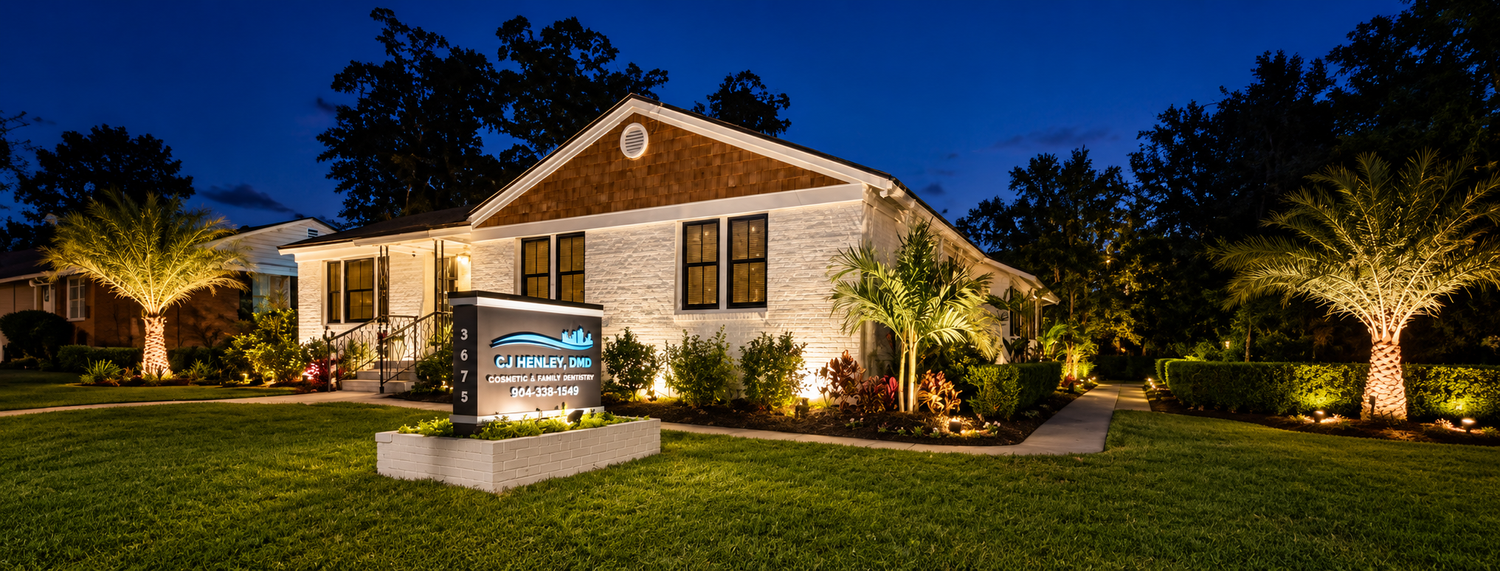
Dr. CJ Henley has cared for Jacksonville patients for years, much of it cosmetic and restorative dentistry, so an emergency tooth is stabilized with the final repair in mind. Patients also come from Miramar, Lakewood, and the Southside when they need an emergency dentist in Jacksonville the same day.
Our office on Hendricks Avenue is easy to reach from San Marco, Southbank, San Jose, Riverside, Avondale, Ortega, St. Nicholas, Downtown, and Mandarin. Patients with complex medical histories, including head and neck cancer survivors, are welcome; read about our complex and medically involved care.
Emergency dentist for Mandarin and the Southside.
If you live in Mandarin, an emergency dentist for Mandarin in San Marco is a straight drive north on San Jose Boulevard or a few exits up I-95, and we see dental emergencies the same day during office hours. From the Southside, Baymeadows, and Deerwood, I-95 north brings you to our Hendricks Avenue office. Call 904.398.1549 before you leave so we can tell you what to do on the way, for example keeping a knocked-out tooth in milk or a lost crown in a bag.
Coming from farther away? Patients also reach us from the Beaches, Ponte Vedra, and Orange Park for a broken veneer, a cracked tooth, or a dental infection that needs care today.
See what patients say in our reviews, or learn more about our San Marco dental office. ¿Necesita un dentista de urgencia en Jacksonville? Se habla español en nuestra oficina; llámenos al 904.398.1549.
Frequently asked questions
Questions about dental emergencies.
Can I be seen the same day for a dental emergency?
Yes, during office hours. When you call 904.398.1549 with a dental emergency, we offer a same-day visit whenever we are open, and we see the most urgent problems, such as a knocked-out tooth or swelling, first. Call as early in the day as you can, especially on Fridays, when we close at noon.
Do you see new patients for emergencies?
Yes. New patients are welcome for same-day emergency visits. Call first so we can hold a time for you, and fill out the new-patient forms online if you have a few minutes. Bring a list of your medicines and your insurance card if you have one.
Do you take walk-ins?
No. Please call before you come. Calling lets us hold a chair for you, tell you what to bring, and give you first-aid advice on the way, which matters most for a knocked-out tooth. Call 904.398.1549 during office hours.
What counts as a dental emergency?
A dental emergency is anything that threatens your airway, your health, or a tooth that can still be saved. That includes facial swelling, an abscess, bleeding that won’t stop, a knocked-out or loosened adult tooth, a broken tooth, and severe toothache. A lost crown or small chip without pain is urgent but can usually wait a day or two.
When should I go to the ER instead of the dentist?
Go to the ER or call 911 for trouble breathing, speaking, or swallowing, swelling near the eye or spreading down the neck, a high fever with facial swelling, bleeding that won’t stop after 15 to 20 minutes of pressure, or a possible broken jaw. For pain, broken teeth, and lost crowns, an emergency dentist is the faster route to a real fix.
Can urgent care or the ER pull a tooth?
Usually not. Urgent care and emergency rooms can prescribe pain relievers and antibiotics, and some can give a numbing block, but they generally don’t extract teeth, do root canals, or place fillings or crowns. You will still need an emergency dentist to treat the tooth itself.
Is a toothache an emergency, and what can I take while I wait?
A severe toothache, or one with swelling, fever, or a bad taste, should be seen the same day. While you wait, ibuprofen or acetaminophen can help if they are safe for you; follow the label. Rinse with warm water and floss gently. Don’t put aspirin on the gum, and don’t give aspirin to children.
My face is swollen from a tooth. Is that an emergency?
Yes. Swelling from a tooth usually means an abscess. Call us the same day. If the swelling is near your eye, spreading down your neck, making it hard to swallow, breathe, or open your mouth, or comes with a fever, go to the ER first.
What should I do if a tooth gets knocked out, and how long do I have?
Hold it by the crown, rinse it briefly in milk, saline, or saliva if dirty, and put it back in the socket, or keep it in milk. Come in right away. The outlook is most favorable when it is back within about 15 minutes; after about 60 minutes dry, the root cells are likely lost, but replanting can still be worthwhile.
Should I put my child’s knocked-out baby tooth back in?
No. Baby teeth should not be replanted, because it can damage the adult tooth forming underneath. Press a damp cloth on the gum, keep the tooth, and call us the same day so we can check the area. If you can’t tell whether it is a baby tooth or an adult tooth, keep it in milk and call.
Do you treat children’s dental emergencies?
Yes. We see children for same-day dental emergencies during office hours, usually from about age 2 to 3, with a parent or guardian present. If your child also hit their head, lost consciousness, or is vomiting, get medical care first. Very complex cases in young children are referred to a pediatric dentist.
My crown or veneer fell off. What should I do? Can I glue it back?
Keep it and bring it in. Don’t use super glue or household glue, which can damage the tooth and the crown. If it seats fully, a small dab of denture adhesive can hold it until your visit. We can usually recement a lost crown or rebond a veneer, or place a temporary if the tooth needs work first.
I lost a filling. Is that an emergency?
It is urgent but rarely a true emergency unless it hurts. Keep the area clean, avoid chewing on that side, and call to be seen within a few days. If the tooth is painful, sensitive for a long time after hot or cold, or has a sharp broken edge, call for a same-day visit.
Can a chipped or broken tooth be fixed the same day?
Often, yes. Small chips can usually be smoothed or repaired with bonding at the same visit. A broken tooth that has lost a large piece usually gets a temporary the same day and a permanent crown later. If the break reaches the nerve, the tooth may need a root canal first.
Is wisdom tooth pain an emergency? What is dry socket?
Wisdom tooth pain becomes urgent when there is swelling, fever, trouble opening your mouth, or trouble swallowing. Dry socket is a painful socket after an extraction when the healing clot is lost. We can treat inflamed gums and dress a dry socket; impacted wisdom teeth that need surgery are referred to an oral surgeon.
How much does an emergency dental visit cost?
It depends on the exam and X-rays needed and the treatment you choose, so we don’t quote a price before we see you. We explain the fee for each option before treatment begins, and you can choose a temporary fix and decide on the rest later.
Does dental insurance cover emergency visits? What if I don’t have insurance?
Some dental plans cover part of an emergency exam and treatment, often with limits on how frequently they will pay. Patients without insurance are welcome. We are an out-of-network practice and can help you understand how to use your benefits. Call our team with your plan details to ask about fees before scheduling.
What should I bring to my emergency appointment?
Bring the tooth or any pieces in milk, any crown, veneer, or denture that came off, a list of your medicines, details of any head and neck radiation or bone medicine infusions, photo ID, and your insurance card if you have one. A parent or guardian should come with anyone under 18.
What if my tooth pain goes away on its own?
Still have it checked. A toothache that suddenly stops can mean the nerve inside the tooth has died, and an infection can keep growing without pain until it causes swelling. Call to be seen within a few days, or sooner if swelling or a bad taste appears.
What if it happens after hours or on a weekend?
If a dental emergency happens after hours and you have trouble breathing or swallowing, spreading swelling, fever with swelling, or bleeding that won’t stop, go to the ER. Existing patients can call or text our on-call line, 904.762.5616; an immediate response isn’t guaranteed. New patients should use the first-aid steps on this page and call 904.398.1549 when we open.
I’ve had radiation for head and neck cancer. What should I do if I have a dental emergency?
Call us and tell us about your radiation when you call. Removing a tooth from bone that was in the radiation field can lead to osteoradionecrosis, so we look for ways to save the tooth, plan any extraction carefully, and coordinate with your oncology team. Bring your treatment dates and your oncologist’s name.
I take a bisphosphonate, denosumab, or a blood thinner. Does that change emergency treatment?
It can. Bisphosphonates and denosumab carry a small risk of jaw osteonecrosis after extractions, higher at cancer doses than at osteoporosis doses, so we weigh other options first. Keep taking a blood thinner unless your prescriber says otherwise. Don’t stop any of these on your own; we coordinate with your physician when needed.
How long does an emergency appointment take?
It depends on what is needed. A visit to find the problem and relieve pain is shorter than one where we also repair, splint, or remove a tooth the same day. When you call, we will tell you how much time to plan for, and we explain each step before we start.
I’m anxious about dental work. How will you keep me comfortable?
Tell us when you call. We explain what we found and what we plan before starting, make sure the area is thoroughly numb, agree on a hand signal so you can stop us at any time, and take breaks when you need them. Many urgent problems can be stabilized with a short, simple first visit.
What if I have a dental emergency while traveling?
Use the same first aid: keep a knocked-out tooth in milk, save broken pieces, and go to a local ER for spreading swelling or trouble breathing. A local emergency dentist can stabilize the tooth. Ask for copies of any X-rays and notes, and call us when you are back in Jacksonville so we can finish the treatment.
Where can I find an emergency dentist in Jacksonville?
CJ Henley, DMD, PA provides same-day emergency dental care during office hours at 3675 Hendricks Avenue, Jacksonville, FL 32207, in San Marco, near Southbank, Miramar, St. Nicholas, and Downtown. New patients are welcome. Call 904.398.1549 before you come in.
Is there an emergency dentist near Mandarin or the Southside?
Yes. Our San Marco office at 3675 Hendricks Avenue is a short drive north from Mandarin on San Jose Boulevard or I-95, and from the Southside and Baymeadows on I-95. We see dental emergencies the same day during office hours, and new patients are welcome. Call 904.398.1549 first so we can get you in and tell you what to do on the way.
More reading: Six reasons your tooth hurts · Numbness after a dental visit · Dental FAQ
Your next step
In pain or have a broken tooth? Call us now.
If you have a toothache, a broken tooth, a lost crown, swelling, or a knocked-out tooth, call and we will see you the same day while we are open. For trouble breathing or swallowing or swelling that is spreading, go to the ER first. Once the emergency is behind you, a comprehensive dental exam helps prevent the next one.
CJ Henley, DMD, PA3675 Hendricks Avenue
Jacksonville, FL 32207
Existing patients after hours: 904.762.5616 is our practice on-call and text line. An immediate response isn’t guaranteed. Please don’t send sensitive health information by text, and call 911 for a medical emergency.
Related pages
Sources
- Fouad AF, Abbott PV, Tsilingaridis G, et al. International Association of Dental Traumatology guidelines for the management of traumatic dental injuries: 2. Avulsion of permanent teeth. Dent Traumatol. 2020;36(4):331-342.
- American Dental Association, MouthHealthy. Dental emergencies.
- Cleveland Clinic. Dental emergencies: what to do. Updated 2022.
- NHS. Dental abscess.
- University of Utah Health. ER or not: severe toothache. 2023.
- Ruggiero SL, Dodson TB, Aghaloo T, et al. American Association of Oral and Maxillofacial Surgeons’ position paper on medication-related osteonecrosis of the jaws, 2022 update. J Oral Maxillofac Surg. 2022;80(5):920-943.
- Nabil S, Samman N. Incidence and prevention of osteoradionecrosis after dental extraction in irradiated patients: a systematic review. Int J Oral Maxillofac Surg. 2011;40(3):229-243.