
CJ Henley, DMD, PA / San Marco, Jacksonville, Florida
Porcelain veneers in Jacksonville, FL.
Natural-looking new veneers and veneer redos.
Porcelain veneers are thin, custom shells bonded to the front of your teeth to change their color, shape, and proportion. At our San Marco office, Dr. CJ Henley plans every case with a mock-up you can see before any tooth is prepared, and he also repairs and redoes veneers that look bulky, opaque, or fake, including veneers placed elsewhere.
- 95.5%estimated 10-year survival of porcelain veneers across 25 studies1
- 7.7×higher failure risk for veneers in people who grind, in one 20-year study3
- 3–30%of a front tooth removed for veneer designs, vs 63–72% for a crown, in a lab study5
- 3 visitsplan, prepare, and deliver, usually over about a month
Top-rated on Google: 4.9 stars from more than 225 patient reviews.
What are veneers?
What dental veneers are, and what they can change.
Dental veneers are thin layers of porcelain or composite resin bonded to the front, and often the biting edge, of a tooth. They change color, shape, length, and small gaps or chips. They don’t treat decay, gum disease, bite problems, or significant crowding, so those come first.
Most of the porcelain veneers we place in Jacksonville are layered e.max, a lithium disilicate ceramic that is strong for its thickness and lets light through like enamel, which is why natural-looking dental veneers read as teeth rather than caps. We also offer composite veneers and, for the right teeth, minimal-prep and no-prep veneers (tradeoffs below).
What veneers can fix
- Color that whitening can’t reach, such as deep stains or a darkened tooth.
- Shape and length: short, worn, uneven, or pointed teeth.
- Chips and small cracks on front teeth.
- Small gaps, including a gap between the front teeth.
- Mild rotation or unevenness that doesn’t need orthodontics.
What partial veneers are
A partial veneer covers only part of a tooth, such as a chipped corner, and keeps more enamel. For a broader read, see what to know before getting dental veneers.
Real patients from our San Marco office
Porcelain veneers before and after.
These are our own patients, treated with layered e.max porcelain made by our ceramist. Look at the edges and surface: natural-looking veneers let some light through at the biting edge and have fine surface texture, so they don’t read as flat or opaque. Drag the slider on each photo to compare.
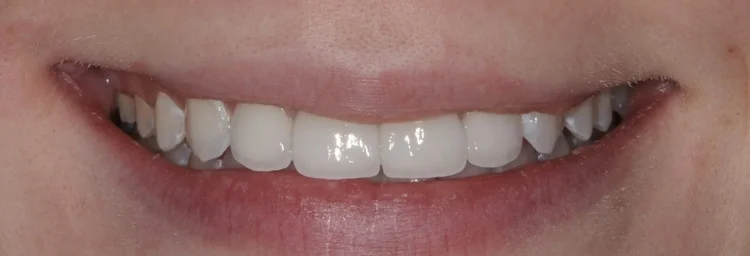
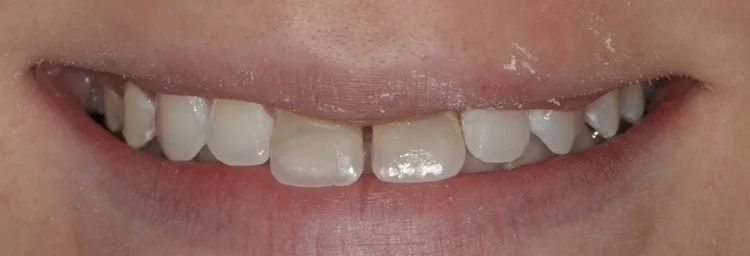
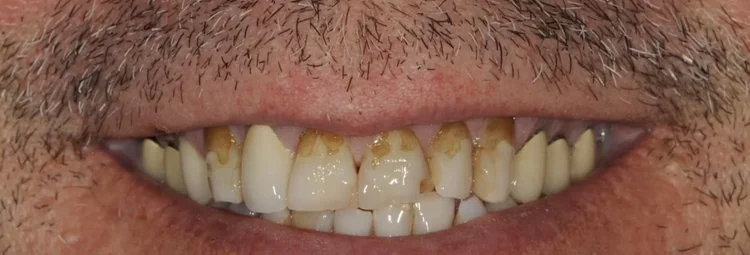
e.max veneers and crowns after childhood trauma
Front teeth darkened by a childhood injury, with a gap. The center teeth needed crowns; the teeth beside them got e.max porcelain veneers. One material keeps color and translucency consistent, and the new shapes closed the gap. Read the full case.
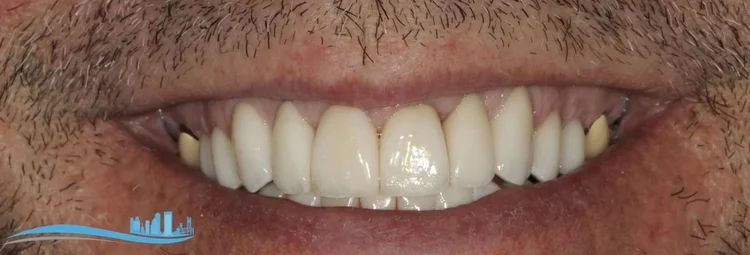
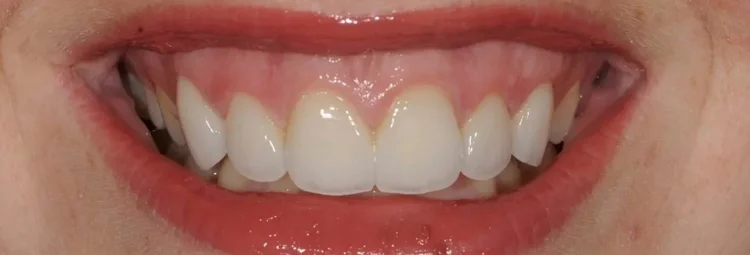
Beyond rebonding: gum contouring, then e.max veneers
She had been told to redo her composite bonding, but the real problem was short teeth. A laser reshaped the gumline, she wore temporaries while it healed, and layered e.max veneers finished the smile. Full case.
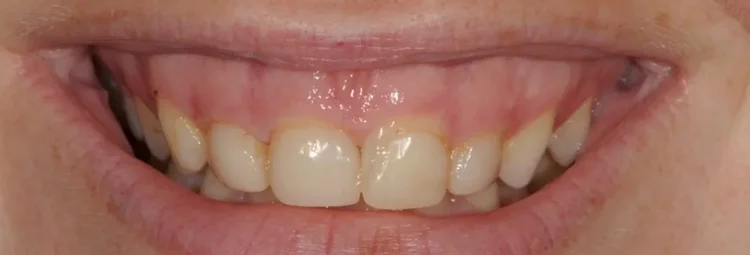
Gummy smile: laser first, then e.max veneers
Laser crown lengthening created a better frame, then layered e.max veneers improved shape, color, and proportion. The smile design was set by the face, not a template. Full case.
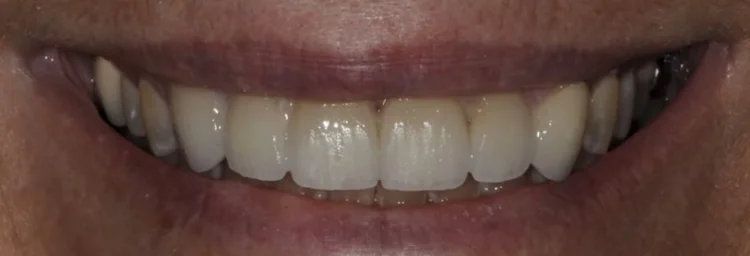
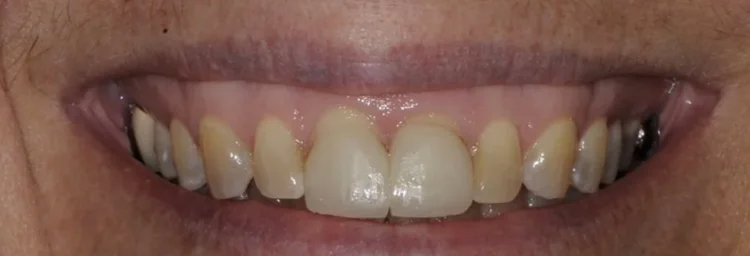
Brightening a smile with mismatched front teeth
The two front teeth were a different shade from their neighbors, and the side teeth were yellowed. Veneers gave the whole smile one even, natural shade. See the case in our gallery.
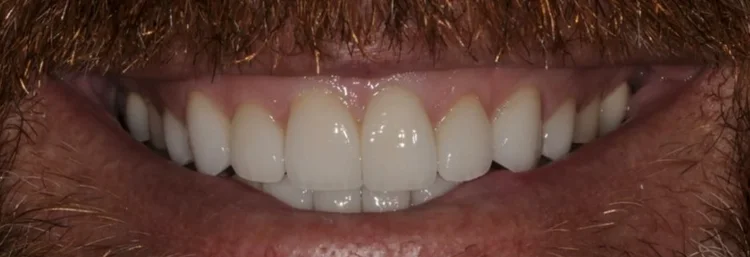
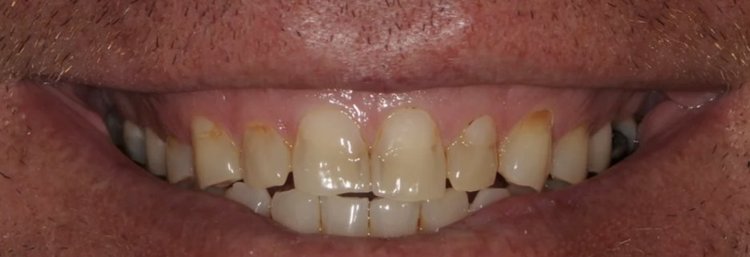
Veneers for stained, uneven front teeth
Stained edges and uneven shades made this smile look older than the patient. Veneers created a brighter, more uniform smile. See the case in our gallery.
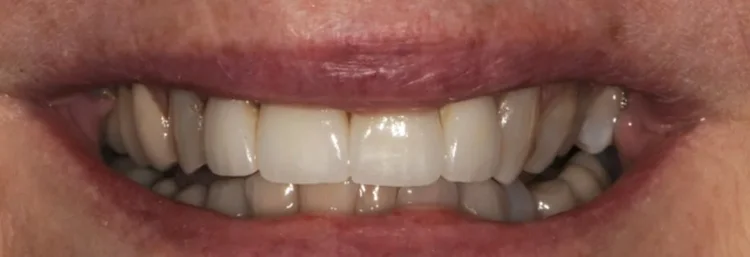
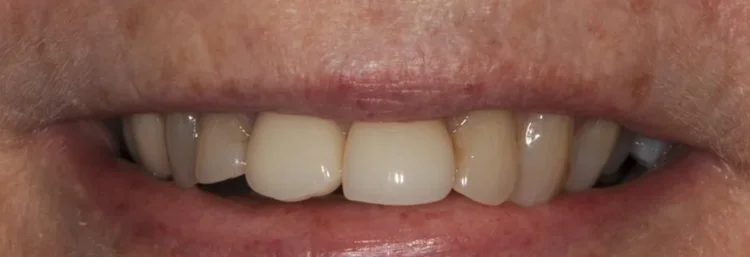
Replacing a smile of mismatched front teeth
The front teeth didn't match in shade, shape or length. Veneers brought them into one balanced, natural-looking smile. See the case in our gallery.
Each smile makeover started with a preview the patient approved. See more in our before and after gallery and case studies.
Quick self-check
Am I a candidate for veneers? Check what applies.
You are often a good candidate for veneers if your teeth and gums are healthy and you want to change color, shape, chips, or small gaps. Grinding, a deep bite, gum recession, or a dark tooth call for a closer look, and active decay, gum disease, or crowding usually need a different first step.8
This is not a diagnosis. It shows where a consultation for natural-looking veneers will likely start.
At a comprehensive exam we check enamel, gums, bite, and old restorations, and we tell you plainly if teeth whitening, bonding, or clear aligners would serve you better than veneers.
Decision chart
Veneers vs crowns vs bonding vs whitening vs aligners first.
Choose the least invasive option that gets the result you want. Whitening changes only natural tooth color; bonding fixes small chips in one visit; veneers change color and shape with little tooth removal; crowns cover a tooth that is broken or heavily filled; and aligners straighten crowded teeth so veneers, if still wanted, can stay thin.
| Feature | Porcelain veneers | Crowns | Composite bonding | Whitening | Aligners first |
|---|---|---|---|---|---|
| What it changes | Color, shape, length, small gaps | Shape, color, and strength of a damaged tooth | Small chips, edges, small gaps | Natural tooth color only | Tooth position and bite |
| Tooth removed | ✓ Little to moderate, about 3–30%; none to very little for no-prep5 | ✗ Much more, about 63–72%5 | ✓ Usually none or very little | ✓ None | ✓ None |
| Visits | About 3, over about a month | Usually 2 or more | Often 1 | Strips at home, or one office visit | Months, with checkups |
| How it holds up | ✓ 95.5% estimated 10-year survival1; stain-resistant | Durable; material chosen for the bite | Repairable; stains and wears sooner than porcelain | Fades gradually; touch-ups | Needs retainers to hold |
| Good for | Several front teeth needing color and shape change | Broken, cracked, or heavily filled teeth | One chip or a small gap | Healthy teeth that are simply yellow | Crowding or rotation |
| Not ideal for | Crowded teeth, active decay or gum disease, uncontrolled grinding | Healthy teeth needing only a cosmetic change | Large changes in color or shape | Existing veneers, crowns, or fillings | Color or chips on their own |
Order of treatment matters
Whiten first, because porcelain won’t whiten later. Treat gum disease first so the gumline is stable. Straighten crowded teeth first, so veneers can be thinner or unnecessary.
When a crown fits better than a veneer
A veneer needs healthy enamel to bond to. A broken or heavily filled tooth does better with a dental crown, made from the same e.max so they match. A missing tooth needs a dental implant.
Types of veneers
Porcelain or composite veneers, and the truth about no-prep.
Porcelain veneers are made by a lab, take about three visits, resist stain, and have the strongest long-term record. Composite veneers are sculpted in the chair, cost less, and can be repaired, but they stain and roughen sooner. Minimal-prep and no-prep veneers save enamel but only suit certain teeth.
Porcelain veneers (layered e.max)
estimated 10-year survival across 25 studies1
- How they’re made
- Hand-layered in a dental lab from your approved design, then bonded.
- Strengths
- Translucency like enamel; holds color; glass-ceramics did well in a meta-analysis (94% survival at a median 9 years).2
- Limits
- More visits; a chip usually means a new veneer.
Composite veneers
pooled survival in trials followed about 2 to 8 years6
- How they’re made
- Tooth-colored resin sculpted directly on the tooth, often in one visit.
- Strengths
- Little or no tooth removal; easy to repair or add to.
- Limits
- Surface roughness, color mismatch, and edge staining were the most common problems.6
Minimal-prep and no-prep veneers, honestly
No-prep veneers (Lumineers is one brand name) are bonded with little or no reshaping. They work well when teeth are small, worn, or set back. On full-sized teeth, added thickness can look bulky and be harder to clean at the gumline. A small 2025 review of four trials found similar or better survival for no-prep designs over 2 to 9 years, but the evidence is early and depends on choosing the right teeth.7
Are veneers reversible?
If enamel is removed, no; that tooth will always need a restoration.8 So we preview first and remove only what the design requires. Minimal-prep veneers are the middle ground: most enamel stays, with room for a natural-looking tooth instead of a thick one.
The lab, the shade, the details
What makes veneers look natural instead of fake.
Natural-looking veneers come from planning and lab work, not just a shade tab. Our porcelain veneers are hand-layered in e.max by ceramist Paul Robert at Dynamic Dental Solutions, from a design you approved in a mock-up, with translucent edges and surface texture.
A preview before any tooth is touched
A mock-up or digital smile preview shows the length, shape, and smile line on your own face before we prepare anything. The design follows facial proportion and your lower lip, not a catalog smile.
Layered e.max, made by a named ceramist
Paul Robert builds the porcelain in layers, controlling the natural body of the tooth and the translucent edge separately. You know who is making your teeth; ask any veneer dentist the same.
Shade chosen for your face
We take shade photos in more than one light and choose a natural color that suits your skin, eyes, and remaining teeth. “As white as possible” is a common reason veneers look fake.
Edges, texture, and the gumline
Natural enamel has a translucent edge, fine ridges that scatter light, and rises cleanly from the gums. Imaging and photos guide those details; our cosmetic dentistry is planned with the lab, not just sent to it.
The veneer process
How getting veneers works: three visits over about a month.
Getting porcelain veneers usually takes about three visits over about a month: one to plan and preview, one to prepare the teeth and place temporaries, and one to try in and bond the final veneers. Any whitening, gum, or orthodontic care comes before the first preparation.
Visit 1 Plan
Exam, photos, and preview
We check teeth, gums, and bite, take photos and X-rays, and show you a mock-up of the new shape.
Visit 2 Prepare
Prep and temporaries
We numb the teeth, reshape only what the design needs, record them, and place veneer temporaries.
In the lab
Layering the porcelain
Paul Robert layers the e.max veneers from your records, photos, and approved design.
Visit 3 Deliver
Try-in and bonding
You see them in place before they are bonded; then we check your bite and plan a night guard if needed.
What veneer temporaries are like
Temporaries copy your approved design, so you live with the new shape and can ask for changes before the porcelain is made. They are held on lightly: avoid hard or sticky foods, pull floss out sideways, and call if one comes loose.
Does getting veneers hurt? Comfort and sedation
Preparation is done with local anesthetic, much like a filling, and some teeth are briefly sensitive to cold. If you are anxious, tell us; oral sedation is available at our office for some patients. Read how we approach anxious patients.
Veneer redo dentist in Jacksonville
Unhappy with your veneers? How we fix or replace old veneers.
Yes, veneers can be redone. Many of our veneer patients in Jacksonville come for a second opinion because their veneers look bulky, opaque, too white, or simply fake, or because old veneers have stained at the edges or the gums have receded and they want to replace them with something natural. We repair and redo veneers placed by other dentists, and we start by finding why they look wrong.
Why veneers look fake: a six-point checklist
Our blog post why do my veneers look fake, and can they be redone? explains each one in detail.
Can you fix bad veneers without replacing them?
Sometimes. Surface stain can be polished, a small chip can be smoothed or repaired with composite, a loose veneer that is intact can sometimes be rebonded, and gum treatment can improve a gumline. Whitening won’t change porcelain, so a color problem in the ceramic means a replacement veneer, designed to look natural next to your own teeth.
What a veneer redo involves
- Find the cause first: grinding, bite, gums, or the design itself.
- Preview the change: a mock-up shows the new shape before old veneers come off.
- Remove carefully: to replace old veneers, removal usually costs a little more tooth, so we only redo what needs it.
- Remake: new layered e.max veneers, with temporaries, on the same three-visit plan.
A second opinion doesn’t commit you to anything. If you have been told your veneers can’t look better, bring them in. See our second-opinion redo of bulky, opaque front restorations (that case was a bridge, not veneers, but the same four details applied: emergence, translucency, surface texture, and the spaces between teeth).
When an expensive veneer case still goes wrong
We read what patients say about high-end veneer offices in Jacksonville and other cities, including people who paid for full-mouth veneers. The same complaints come up again and again, and price didn’t prevent them. Here is each one, and what we do differently.
“I asked for natural and got bulky, fake teeth”
Patients describe veneers that look “like dentures,” too thick to close their lips over, or flattened and narrowed. We start with a mock-up on your own teeth, so you approve the length, width, and shape before any tooth is prepared, and your ceramist works from that approved design.
“The temporaries were huge, and I was told the finals would be different”
Temporaries should preview the final result, not be an excuse. Ours are made from the approved mock-up, so you wear the planned shape and can ask for changes before the porcelain is made.
“Redone again and again”
Repeated remakes, constant grinding down, and teeth that still don’t look right usually mean the plan or the bite was never right. We find the cause before we redo anything, and we would rather tell you a redo won’t help than make one that doesn’t.
“My bite, jaw, and teeth hurt afterward”
Loose or sensitive teeth, jaw strain, and chipping often trace back to the bite or to grinding. Dr. Henley checks your bite and wear first, plans the edges around how you chew, and makes a night guard for grinders.
“A salesperson sold me the case”
Some offices use treatment coordinators to present the plan and the price. Here, Dr. Henley does your consultation, design, preparation, and delivery himself, and you get the fee in writing before anything starts.
“It was all spa, and the result was the problem”
Hand massages and warm neck pillows don’t make veneers look natural. Layered porcelain does: our veneers are layered e.max made by a named local ceramist, Paul Robert of Dynamic Dental Solutions, who shapes translucency and surface texture by hand.
Protecting your veneers
Veneers if you grind, and what to do if one chips or comes off.
You can usually have veneers if you grind or clench, but you need a plan to protect them. In a 20-year study, veneers in people who ground their teeth had a 7.7 times greater risk of failure, so we treat grinding first and make a custom night guard to wear while you sleep.3
Grinding, clenching, and veneers
The ADA notes that clenching, grinding, or a deep overbite may make veneers a poor choice without a plan.8 In a smaller study, veneers in people who ground their teeth came loose more often, and fractures were less common in those who wore a splint.4 See the signs of teeth grinding and bruxism and our custom night guards. For heavy grinders with very worn teeth, crowns can be stronger.
If a veneer chips, cracks, or comes off
Keep the veneer or the pieces in a bag and call us. Don’t use super glue. A tiny chip can often be polished or repaired with composite; an intact veneer that came off can sometimes be rebonded; a cracked or broken veneer usually needs a new one, and we can place a temporary meanwhile. If the tooth hurts or broke, see emergency dental care.
Do
- Wear your night guard every night if you grind.
- Brush twice a day, floss, and keep regular cleanings.
- Wear a sports mouthguard for contact sports.
- Tell us early if a veneer feels rough or loose.
Avoid
- Biting ice, pens, nails, or hard candy with veneered teeth.
- Opening packages or bottles with your teeth.
- Very abrasive whitening toothpastes on porcelain.
- Super glue or drugstore kits on a loose veneer.
Lifespan, with sources
How long do porcelain veneers last?
Porcelain veneers usually last many years. A 2021 review of 25 studies and about 6,500 veneers estimated 95.5% were still in place at 10 years, and one long-term study estimated about 83% at 20 years.1,3 Composite veneers wear and stain sooner. Lasting is not the same as looking right forever.
What the studies show
In the 2021 review, fracture was the most common problem, followed by debonding; veneers made from non-feldspathic ceramics such as lithium disilicate failed less often.1 A 2016 meta-analysis found 89% survival at a median of 9 years overall, 94% for glass-ceramics.2 A 20-year study estimated 93.5% at 10 years and 82.93% at 20, with higher risk for grinders and root-canal-treated teeth.3
Why veneers get replaced
Survival means the veneer is still on the tooth. Over time gums can recede and show an edge, margins can stain, or you may want a different look; that is when patients ask about replacement. Planning, a night guard if you grind, and checkups help veneers last.
Cost and insurance
What do veneers cost in Jacksonville?
The cost of veneers depends on how many teeth are treated, porcelain or composite, whether old veneers must be removed, and whether whitening, gum, or orthodontic care comes first. We give you a written plan with the fee before treatment begins.
One veneer to match a neighbor differs from eight for a smile makeover, and replacing old veneers adds a removal step. Porcelain veneers cost more than composite veneers. Our post on why crown costs vary in Jacksonville explains what goes into lab-made restorations.
We are an out-of-network practice. Some dental plans cover part of veneers when a tooth needs restoring, often with a frequency limit; purely cosmetic veneers are usually not covered.8 We can help you understand how to use your benefits; you are responsible for amounts your plan does not pay. Call our team with your plan details to ask about fees and payment arrangements. Read what patients should know about out-of-network dental insurance, or, if you are planning around retirement, see dental insurance after retirement.
Choosing a veneer dentist in Jacksonville
Questions to ask any veneer dentist, including us.
Ask to see the dentist’s own before and after photos, how you will preview the result, who makes the veneers, and the plan if you grind or one chips. Clear answers predict natural-looking veneers better than a brand name.
- Can I see your own cases? Ours are above and in our gallery.
- Will I see a mock-up and wear temporaries? Yes, both, before the porcelain is made.
- Who makes them, and from what? Paul Robert at Dynamic Dental Solutions, layered e.max.
- How much tooth will you remove, and why? Minimal-prep or no-prep when the teeth allow it.
- What’s the plan if I grind? Grinding is addressed first, and a night guard protects the veneers.
- What if one chips? We repair, rebond, or remake it.
- Will I get a written plan and fee? Yes, before any treatment begins.
Veneer dentist near you
Dental veneers in San Marco, for all of Jacksonville.
Dr. CJ Henley is a general and restorative dentist whose practice centers on cosmetic and restorative dentistry. He earned his DMD at the University of Florida, with recognition in cosmetic dentistry, and is a member of the American Academy of Cosmetic Dentistry. Much of his veneer work is replacing veneers and crowns that don’t look right.
Patients often drive across Jacksonville for natural-looking veneers, farther than they would for a cleaning, and that is reasonable: you see a mock-up before any tooth is prepared, a named ceramist layers the porcelain, and many of our veneer cases are redos of work done elsewhere. For routine checkups, a dentist near home may suit you better; for porcelain veneers or a veneer redo, three visits over about a month is a manageable trip from most of Northeast Florida. Some patients travel much farther: our office sees veneer and veneer-redo patients from across Florida and from other states, and we plan the three visits around your travel.
See what patients say in our reviews, read about our San Marco dental office, or start with our new-patient forms.
San Marco
On Hendricks Avenue, in the neighborhood
A quick adjustment to your temporaries won’t take the afternoon.
Downtown and Southbank
Southbank borders us; Downtown is across the Main Street Bridge
Easy to fit a try-in around a workday.
Riverside, Avondale, and Ortega
Across the St. Johns River on the Fuller Warren Bridge
A short trip over the river for porcelain veneers.
San Jose
San Jose Boulevard becomes Hendricks Avenue at our end of town
One road from your street to our door, which helps across three visits.
Mandarin
North on San Jose Boulevard (State Road 13)
The same straight route as San Jose for all three visits.
Southside and Baymeadows
North on I-95 from Baymeadows Road
An easy drive for a second opinion on veneers placed elsewhere.
Jacksonville Beach, Neptune Beach, and Atlantic Beach
West on Atlantic Boulevard or Beach Boulevard
The preview is what makes the drive worthwhile: you see the new shape before deciding.
Ponte Vedra and Nocatee
West on J. Turner Butler Boulevard, then north on I-95
Worth the drive when you want to know exactly who makes your veneers and from what.
Orange Park and Fleming Island
North on US-17 to I-95, then across the Fuller Warren Bridge
Visits are booked ahead to plan around work.
St. Augustine
North on I-95
The longest drive on this list, and most worthwhile for a veneer redo or smile makeover that needs careful planning.
Frequently asked questions
Questions about porcelain veneers.
What are porcelain veneers?
Porcelain veneers are thin, custom-made ceramic shells bonded to the front, and often the biting edge, of a tooth to change its color, shape, or length. Ours are layered e.max, a lithium disilicate ceramic that is strong and lets light through like enamel. They are made in a dental lab from a design you approve first.
What can veneers fix, and what can’t they?
Veneers can fix stains whitening won’t remove, chips, worn or short teeth, small gaps, and mild unevenness. They can’t treat decay, gum disease, or bite problems, and they are a poor substitute for straightening crowded teeth. A missing tooth needs an implant or bridge, not a veneer.
Are veneers permanent? Can they be removed?
Prepared veneers are not reversible: once enamel is removed, the tooth will always need a veneer or another restoration. The veneer itself is not forever, though. Dental veneers can be removed and replaced when they wear, stain at the edges, or no longer look right, which usually costs a little more tooth.
How much tooth is removed for a veneer?
Usually much less than for a crown. In a lab study, veneer preparations removed about 3 to 30 percent of a front tooth’s structure, compared with 63 to 72 percent for crowns. Minimal-prep and no-prep veneers remove little or none. We remove only what the approved design needs.
Do veneers ruin your teeth? What happens to the tooth underneath?
Well-planned veneers don’t ruin teeth, but prepared enamel doesn’t grow back. The tooth underneath stays alive and can still get decay at the edges, so brushing, flossing, and cleanings still matter. Problems usually come from overpreparation, poor fit, or untreated grinding, which is why planning comes first.
Porcelain or composite veneers: which is better for me?
Porcelain veneers resist stain, look more like enamel, and have the stronger long-term record. Composite veneers take fewer visits, cost less, remove little or no tooth, and can be repaired, but they roughen and stain sooner. We offer both porcelain and composite veneers in Jacksonville and will tell you which suits your teeth and goals.
What are no-prep or minimal-prep veneers, like Lumineers?
They are thin porcelain veneers bonded with little or no reshaping; Lumineers is one brand name. They suit teeth that are small, worn, or set back. On normal-sized teeth they can look bulky, and most still need light edge polishing. We offer minimal-prep and no-prep veneers when the teeth allow.
Should I get veneers or crowns?
Choose veneers for healthy front teeth that need a change in color or shape, because they remove far less tooth. Choose a crown when a tooth is broken, cracked, or mostly filling and needs strength. Both can be made from e.max, so crowns and veneers side by side can match.
Should I get veneers or bonding?
Bonding is usually better for one small chip or gap: it is done in one visit with little or no tooth removed. Veneers are better when several teeth need a real change in color or shape and you want stain resistance. Bonding stains and wears sooner, but it is easy to repair.
Should I whiten my teeth before veneers? Can veneers be whitened?
Yes, whiten first if you want a brighter smile, because the veneer shade is matched to your other teeth and porcelain can’t be whitened afterward. Whitening doesn’t change veneers, crowns, or fillings. Surface stain on a veneer can be polished off at a cleaning.
Can veneers fix crooked teeth, or should I straighten them first?
Veneers can hide mild unevenness. For crowded or overlapping teeth, straightening first with clear aligners is usually better: it lets veneers be thinner, keeps more enamel, and sometimes means you no longer want veneers at all. Covering crowding with veneers often makes them look bulky.
How many veneers will I need? Can I get just one?
It depends on how many teeth show when you smile, often four to eight upper teeth for a full smile makeover. A single veneer is possible and is one of the hardest things to match, so the ceramist’s skill and shade photos matter even more. The mock-up shows how many teeth the design needs.
Can I get veneers if I grind or clench my teeth?
Often yes, with a plan. Grinding raised the risk of veneer failure 7.7 times in one 20-year study, so we treat grinding first and make a custom night guard to wear at night. For heavy grinders with badly worn teeth, crowns may be the stronger choice.
Does getting veneers hurt? Is sedation available?
Preparation is done with local anesthetic, and most patients compare it to a filling. Some teeth are sensitive to cold for a short time afterward. Oral sedation is available at our office for some anxious patients; ask at your consultation whether it is appropriate for you.
How many visits does it take, and will I have temporary veneers?
Usually about three visits over about a month: plan and preview, prepare the teeth, then try in and bond the final veneers. Between the second and third visits you wear veneer temporaries made from your approved design, so you can test the shape and speech before the porcelain is finished.
Can I see what my veneers will look like before they’re made?
Yes. Before any tooth is prepared, we show you a mock-up or digital smile preview of the new length and shape on your own teeth. You can ask for changes then, and the temporaries let you live with the design before the lab makes the final veneers.
Do veneers change how I speak?
Usually only for a few days, if at all, and speech soon feels natural again. A slight lisp can happen when edges are longer or thicker than before. Temporaries help here: if a sound feels off while you wear them, we adjust the design before the final porcelain veneers are made.
Why do my veneers look fake, bulky, or too white?
Common causes are opaque porcelain with no translucency, extra thickness on teeth that were already full-sized, a shade far brighter than the rest of your face, flat uniform edges, a smooth plastic-looking surface, and stained or exposed edges at the gumline. An exam tells which apply to you.
Can old veneers be replaced or redone?
Yes. Old veneers can be removed and replaced, including veneers placed by another dentist. Removal usually costs a little more tooth, so we first find out why they look wrong, check for grinding or gum problems, and preview the new design. Sometimes polishing, a repair, or gum treatment is enough.
What should I do if a veneer chips, cracks, or comes off?
Keep the veneer or pieces and call us; don’t use super glue. Small chips can often be polished or repaired with composite, an intact veneer can sometimes be rebonded, and a cracked veneer usually needs replacing, with a temporary meanwhile. If the tooth hurts, call for an urgent visit.
How long do porcelain veneers last?
Many years for most people, and well-made porcelain keeps a natural look. A 2021 review estimated 95.5 percent of porcelain veneers were still in place after 10 years, and one study estimated about 83 percent at 20 years. Grinding, root-canal-treated teeth, and gum recession lower those odds. Composite veneers usually need repair or replacement sooner.
How do I care for veneers? Is there anything I can’t eat?
Brush twice a day, floss, and keep regular cleanings. You can eat normally, but don’t bite ice, hard candy, pens, or nails, or open packages with your teeth. Wear your night guard if you grind. Porcelain resists coffee and wine stain; composite stains more easily.
How much do veneers cost, and does insurance cover them?
It depends on the number of teeth, the material, and whether old veneers or other care come first, so we give you a written plan and fee before treatment. Some dental plans cover part of veneers when a tooth needs restoring, often with limits on how frequently they will pay; cosmetic veneers usually aren’t covered. We are an out-of-network practice and can help you understand how to use your benefits. Call our team with your plan details to ask about fees before scheduling.
Do patients come from Ponte Vedra, the Beaches, or St. Augustine for veneers?
Yes, and they are welcome. Our San Marco office sees veneer and veneer-redo patients from across Northeast Florida, including Jacksonville Beach, Neptune Beach, Atlantic Beach, Ponte Vedra, Nocatee, and St. Augustine, and from across Florida and other states. Treatment is usually three visits over about a month, and we tell you how long each visit takes so you can plan the drive.
Is your office convenient from Mandarin, the Southside, or Orange Park?
For most patients, yes. From Mandarin and San Jose it is a straight drive up San Jose Boulevard, which becomes Hendricks Avenue; from the Southside and Baymeadows it is I-95 north; and from Orange Park and Fleming Island it is US-17 to I-95. Veneer visits are scheduled ahead, so you can plan around work or school.
Where can I get porcelain veneers in Jacksonville?
CJ Henley, DMD, PA provides porcelain veneers, composite veneers, and veneer redos at 3675 Hendricks Avenue, Jacksonville, FL 32207, in San Marco. Call 904.398.1549 or request an appointment online. Bring photos of smiles you like, and any records of old veneers, to your consultation.
More reading: What makes a truly beautiful smile · Celebrity teeth before and after · Dental FAQ
Your next step
See your new smile before you commit.
Whether you are thinking about your first natural-looking veneers in Jacksonville or want old veneers redone, a consultation starts with an exam, photos, and a preview of what is possible. If a veneer has broken or come off and the tooth hurts, see emergency dental care.
CJ Henley, DMD, PA3675 Hendricks Avenue
Jacksonville, FL 32207
Prefer a nonurgent text? 904.762.5616 is our practice on-call and text line. Please don’t send sensitive health information by text, and call for anything urgent.
Related pages
Sources
- Alenezi A, Alsweed M, Alsidrani S, Chrcanovic BR. Long-term survival and complication rates of porcelain laminate veneers in clinical studies: a systematic review. J Clin Med. 2021;10(5):1074.
- Morimoto S, Albanesi RB, Sesma N, Agra CM, Braga MM. Main clinical outcomes of feldspathic porcelain and glass-ceramic laminate veneers: a systematic review and meta-analysis of survival and complication rates. Int J Prosthodont. 2016;29(1):38-49.
- Beier US, Kapferer I, Burtscher D, Dumfahrt H. Clinical performance of porcelain laminate veneers for up to 20 years. Int J Prosthodont. 2012;25(1):79-85.
- Granell-Ruíz M, Agustín-Panadero R, Fons-Font A, Román-Rodríguez JL, Solá-Ruíz MF. Influence of bruxism on survival of porcelain laminate veneers. Med Oral Patol Oral Cir Bucal. 2014;19(5):e426-32.
- Edelhoff D, Sorensen JA. Tooth structure removal associated with various preparation designs for anterior teeth. J Prosthet Dent. 2002;87(5):503-9.
- Lim TW, Tan SK, Li KY, Burrow MF. Survival and complication rates of resin composite laminate veneers: a systematic review and meta-analysis. J Evid Based Dent Pract. 2023;23(4):101911.
- Hameed FF, et al. Clinical outcomes of no-prep veneers and conventional veneers: a systematic review. J Contemp Dent Pract. 2025;26(12):1245-1251.
- American Dental Association, MouthHealthy. Veneers.