
CJ Henley, DMD, PA / San Marco, Jacksonville, Florida
Teeth whitening in Jacksonville, FL.
Honest advice on strips, custom trays, and in-office whitening.
For most people with healthy teeth, over-the-counter whitening strips work well and cost far less than professional teeth whitening. At our San Marco office, Dr. CJ Henley checks your teeth first, then tells you plainly whether strips are enough or whether custom take-home trays, in-office Opalescence Boost whitening, or bleaching of a single dark tooth will serve you better.
- 6 shadeslighter with strips, custom trays, and in-office whitening alike in one study; strips just took more days1
- 21 trialsfound no extra whitening from adding a light or laser to in-office whitening3
- 3.5×higher odds of sensitivity when a light was used with strong peroxide4
- 43%still saw their whitened color as stable about 10 years after tray whitening, in one long-term follow-up7
Top-rated on Google: 4.9 stars from more than 225 patient reviews.
What is teeth whitening?
What teeth whitening can and can’t change.
Teeth whitening uses a peroxide gel to lighten the natural color of enamel and the layer beneath it. It works best on yellow stains, more slowly on brown, and least predictably on gray. It does not change the color of crowns, veneers, bonding, or fillings.
Two kinds of products are sold as whitening. Bleaching products contain hydrogen peroxide or carbamide peroxide, which breaks down into hydrogen peroxide (about one third of its strength), and they change the tooth’s own color.19 Whitening toothpastes and rinses use mild abrasives or polishing agents to remove surface stain only; they don’t bleach.20
Stains also come in two kinds. Surface (extrinsic) stains come from coffee, tea, red wine, and tobacco, and a professional cleaning removes much of it before any bleaching. Deeper (intrinsic) discoloration comes from age, genetics, some medications, injury, or a tooth that has had a root canal, and responds to bleaching more slowly, if at all. Our tips for keeping teeth white cover the everyday kind.
| Stain or color | Common cause | How it usually responds | What we suggest |
|---|---|---|---|
| Yellow | Age, coffee, tea, natural shade | ✓ Lightens well20 | Strips, custom trays, or in-office whitening |
| Brown | Tobacco, red wine, older stain | Lightens, more slowly20 | Cleaning first, then longer whitening |
| Gray or banded (tetracycline) | Some antibiotics taken while teeth formed | Months of nightly tray wear, and may not even out15,19 | Custom trays for an extended course, or porcelain veneers |
| White spots (fluorosis, early decay) | Extra fluoride in childhood, plaque at the gumline | Can look more obvious at first, then blend | An exam, then whitening, bonding, or both |
| One dark front tooth | Injury or a past root canal | ✗ Outside whitening barely helps | Internal bleaching, a veneer, or a crown |
| Crowns, veneers, bonding, fillings | Restorations made to match your old shade | ✗ Don’t change color20 | Whiten first, then replace to match |
Who teeth whitening suits
Teeth whitening options
Teeth whitening options compared: in-office, custom trays, and strips.
In-office whitening, custom take-home trays, and over-the-counter strips use the same peroxide chemistry and can reach a similar shade. The differences are speed, how much sensitivity you feel, how well the gel covers your teeth, and how easy touch-ups are.
In one study that compared all three directly, each method lightened teeth by about six shade tabs. It took about three in-office applications, about seven nights of custom trays, or about 32 half-hour sessions of strips to get there.1 A 2025 review of 32 studies found at-home whitening caused milder sensitivity than in-office whitening, with no difference in the final shade.6
| Feature | In-office (Opalescence Boost) | Custom take-home trays | Over-the-counter strips |
|---|---|---|---|
| Peroxide strength | High: about 40% hydrogen peroxide, with your gums protected | Lower, prescribed for you | Lowest |
| Time to a visible change | ✓ One visit | About one to two weeks of daily or nightly wear | Two weeks or more of daily use |
| Sensitivity | Most likely of the three5 | Milder, and you control wear time6 | ✓ Usually the mildest2 |
| Fit and coverage | ✓ Applied tooth by tooth by our team | ✓ Made from a digital scan of your teeth | One shape for everyone; may miss back or crowded teeth |
| Light or laser needed | ✓ No; it’s chemically activated | No | No |
| Touch-ups later | Another visit, or trays at home | ✓ Reuse the same trays with fresh gel | Buy another box |
| Exam first? | Yes, always | Yes, always | Strongly recommended |
| Good fit for | A deadline: a wedding, photos, an interview | Sensitive teeth, tetracycline stain, long-term upkeep | Most healthy teeth with yellow stain, on a budget |
For context, the European Union limits over-the-counter whitening products to 0.1% hydrogen peroxide and allows up to 6% only through a dentist. Carbamide peroxide releases about a third of its strength as hydrogen peroxide.19
Over-the-counter whitening
Are over-the-counter whitening strips enough?
For most people with healthy teeth and yellow stain, yes. A review of the research found dentist-supervised trays measured slightly whiter than strips on instruments, but the difference couldn’t be seen by eye, and strips caused less sensitivity.
That review pooled the studies comparing whitening strips with supervised at-home whitening.2 A 2024 analysis of 37 studies and almost 2,000 people reached a similar conclusion: over-the-counter whitening gave satisfactory short-term results with little effect on sensitivity or gum irritation, although the evidence quality was low.23
That’s why our usual advice surprises people. If your teeth are healthy, strips such as Crest Whitestrips give excellent results for a fraction of the cost of professional teeth whitening, and there is no reason to pay us for the same outcome. They are what Dr. Henley uses on his own teeth. Follow the package directions and don’t leave strips on longer than recommended.
Strips are a poor fit when you have crowding (they miss teeth that sit back), front crowns or veneers, gray or banded stains, very sensitive teeth, or gum recession. Our toothpaste guide covers which whitening toothpastes are gentle enough to use alongside them.
Our honest-recommendation policy: if over-the-counter strips will get you the shade you want, we’ll tell you, even though in-office whitening is something we sell. We recommend professional whitening when it actually changes your result, your comfort, or your timeline.
In-office teeth whitening
In-office whitening: when it’s worth paying for speed.
In-office teeth whitening gets you a visible change in a single visit. We use Opalescence Boost, a strong hydrogen peroxide gel that is chemically activated, so it needs no light or laser. It’s the right choice when you have a deadline or simply don’t want to whiten at home.
The stronger the peroxide, the faster the change, and the more likely you are to feel some sensitivity.5,14 In-office whitening manages that strength safely: a protective barrier covers your gums, the gel goes on tooth by tooth, and we check how your teeth feel between applications. Most of the visit is spent sitting back with the gel on.
Shade record
We record your starting shade with a shade guide and photos, so you can see the change.
Gum protection
A light-cured resin barrier seals the gumline, and cheek retractors keep the gel off your lips.
Whitening applications
Opalescence Boost goes on in a few timed applications, rinsed off and refreshed in between.
Aftercare plan
We go over sensitivity, what to avoid for the first day or two, and whether trays make sense for touch-ups.
Pairing an in-office visit with take-home trays helped whitening last longer than in-office whitening alone in a two-year trial.16
Take-home whitening
Custom take-home whitening trays.
Custom whitening trays are thin, clear trays made from a scan of your teeth. You wear them at home with a lower-strength professional gel for a set time each day or overnight, usually for one to two weeks. They give you control over sensitivity and make touch-ups easy for years.
Tray-based teeth whitening is the original dentist-supervised method, first described as “nightguard vital bleaching” in 1989.22 Because the trays follow your own teeth, the gel reaches every visible tooth, including crowded or rotated ones that strips miss, and stays off your gums.
- Scan, not putty. We make the trays from a digital scan of your teeth.
- Your schedule. If a tooth gets sensitive, you skip a day or shorten wear time and keep going.
- Tough stains. Gray and banded tetracycline stains need months of nightly tray wear, not one appointment.15,19
- Touch-ups. Keep the trays; a few nights with fresh gel refreshes your color.
Trays also suit patients who live farther away, from Ponte Vedra to St. Augustine to Orange Park, because the whitening itself happens at home.
Lights, lasers, and LED kits
Do whitening lights, lasers, and LED kits work better?
No. A review of 21 clinical trials found that adding a light to in-office whitening didn’t improve the color change. The peroxide does the whitening; the light mostly adds heat, and with strong gels it has been linked to more sensitivity.
The 2018 review found no difference in color or sensitivity with or without a light, regardless of peroxide strength.3 An earlier review found that a light raised the odds of sensitivity about 3.5 times with strong peroxide gels, and its authors advised using lights with caution or not at all.4 That’s one reason we chose a chemically activated in-office gel.
The same logic applies to the LED mouthpiece kits sold online: what lightens teeth is the gel, and many kits contain little peroxide. If a kit has the ADA Seal of Acceptance or clear peroxide labeling, it may work about as well as strips; the blue light is mostly marketing.
Internal bleaching
Whitening one dark tooth after a root canal or injury.
A single front tooth that turned gray or brown after an injury or a root canal darkens from the inside, so outside whitening barely changes it. Internal bleaching places the whitening gel inside the tooth instead, and it removes much less tooth than a veneer or crown.
Internal (“walking”) bleaching is done on a tooth that already has a sound root canal filling.10 It keeps your natural tooth intact, which matters for a front tooth you may want to keep for decades.11
Exam and X-ray
We confirm the root canal is sealed and healthy and find the cause of the darkening.
Protective seal
A barrier is placed over the root canal filling, just below the gumline.
Bleach inside the tooth
Whitening material is sealed inside the tooth and changed every few days until the color matches.
Final filling
The opening is closed with a tooth-colored bonded filling.
The main risk to discuss is a rare kind of root resorption, which modern protocols and the seal step are designed to prevent.11 If the tooth hasn’t had a root canal, or the color doesn’t respond, a porcelain veneer or a crown is the next option.
Whitening and cosmetic dentistry
Whitening before veneers, bonding, or crowns.
If you plan veneers, bonding, or front crowns and want a lighter smile, whiten first. New work is matched to your whitened shade, and we usually wait about two weeks after whitening before bonding, because peroxide temporarily weakens the bond to enamel.
Lab studies found the bond to freshly whitened enamel was weaker for the first two weeks and back to normal by three.8 Another suggested waiting at least a day after a mild gel and a week after a strong one.9 The color also settles for a week or two after whitening, so the shade we match to is the one you’ll keep.
01 Check
Exam and plan
We check the teeth and note which crowns, veneers, or fillings will need to match.
02 Whiten
Reach your shade
In-office whitening, custom trays, or both, until you like the color.
03 Wait
Let it settle
Usually about two weeks, so the shade stabilizes and the enamel bonds normally.
04 Match
Restore to match
Old crowns and veneers that no longer match
Whitening the teeth around an old crown, veneer, or bonding can make it stand out. We plan for that before you start, so a replacement is part of the plan, not a surprise. Our post on why veneers can look fake explains what makes a match look natural.
Whitening as part of a smile makeover
Whitening is often the first and least invasive step in cosmetic dentistry. Sometimes it’s the only step needed. For crowding, clear aligners usually come before whitening; see smile design: cosmetic dentistry vs orthodontics.
Your visit
Your teeth whitening visit, step by step.
Professional teeth whitening at our Jacksonville office starts with an exam and cleaning, not with gel. Once we know why your teeth are discolored and which restorations won’t change, we recommend the simplest method that will reach the shade you want.
Exam and cleaning
We check for cavities, cracks, gum disease, and exposed roots, and a cleaning removes surface stain. Some patients like the result enough to stop there.
Shade and photos
We record your starting shade and note any crowns, veneers, or fillings on the front teeth.
Choose the method
Strips, custom trays, in-office Opalescence Boost, internal bleaching, or a combination, matched to your stain, sensitivity, and timeline.
Whiten and follow up
We check the result and your comfort, and set a touch-up plan.
Is teeth whitening safe?
Whitening sensitivity, enamel, and safety.
Teeth whitening that follows the directions is safe for healthy enamel. The most common side effect is temporary sensitivity: in pooled trials, about half of at-home patients and close to two thirds of in-office patients felt some, and it usually fades within a few days.
How common sensitivity is
Across 11 trials, 51% of at-home patients and 62.9% of in-office patients reported some sensitivity.5 A Cochrane review of 71 trials described side effects as mild and transient, and more frequent with stronger gels.13 The ADA notes it usually resolves within about four days.19
How we prevent it
Brushing with a potassium nitrate and fluoride toothpaste for a week or two before and during whitening reduced the share of people with sensitivity in a review of trials.12 Lower peroxide strengths cut the risk of sensitivity by about a third without a meaningful loss of color.14 Shorter wear and skipped days help too.
Does whitening damage enamel?
Not when used as directed. Microscope studies found no meaningful enamel surface changes after whitening, including about 10 years after tray whitening.1,7 Overuse, homemade acids, and abrasive powders are what wear enamel. If your teeth are already sensitive, read the 10 biggest causes of tooth sensitivity.
Gums and receding gums
Peroxide can irritate gums briefly, usually from strips or trays that overlap the gumline. Exposed root surfaces are more sensitive and don’t lighten like enamel, so with receding gums, often from brushing too hard, we use a gentler gel and shorter wear. See foods to avoid with sensitive teeth.
Who should wait
Who should wait or skip teeth whitening.
Wait to whiten if you have untreated cavities or gum disease, are pregnant or breastfeeding, still have baby teeth, or are healing from head and neck radiation. Whitening over these problems can hide them, make sensitivity worse, or simply not work.
What to skip
Charcoal, DIY whitening, and whitening kiosks.
Charcoal toothpaste and home remedies such as baking soda, strawberries, or lemon don’t bleach teeth, and some wear enamel. Mall and salon kiosks may use real peroxide, but without an exam they can whiten over a cavity or gum disease.
Charcoal toothpaste
A review in the Journal of the American Dental Association found insufficient evidence that charcoal toothpastes are safe or effective, and advised caution.17 Charcoal can be abrasive, and it doesn’t bleach. Whitening toothpastes in general remove surface stain better than regular toothpaste but less than whitening strips.18
DIY hacks
Lemon juice, vinegar, and fruit acids soften enamel; scrubbing with baking soda or salt adds abrasion. None changes the tooth’s inner color.19 If you want something cheap, an ADA-Seal whitening strip or toothpaste is safer.
Whitening kiosks and salons
In North Carolina State Board of Dental Examiners v. FTC (2015), the U.S. Supreme Court ruled that a board controlled by practicing dentists is not immune from antitrust law unless the state actively supervises it, which limited boards’ power to shut down non-dentist whitening. Rules vary by state. The clinical problem remains: no one checks your teeth first.
“FDA-approved” claims
Be wary of products that claim FDA approval for whitening. Look instead for the ADA Seal of Acceptance on over-the-counter products, and clear labeling of the peroxide type.20
Results and upkeep
How long teeth whitening lasts, and how to keep it.
Teeth whitening results commonly last from several months to a few years, and every method needs touch-ups eventually. How fast color returns depends on coffee, tea, wine, tobacco, and how often your teeth are cleaned.
What the long-term studies show
In one follow-up about 10 years after tray whitening, 43% of patients still saw their color as stable, and no harm to the teeth or gums was found.7 Tetracycline-stained teeth whitened with six months of trays had not returned to their original shade seven years later.15
Touch-ups
Custom trays make touch-ups simple: a few nights with fresh gel when you notice the color fading. With strips, a short course works the same way. Don’t whiten continuously; more isn’t whiter after a point.
Keeping teeth white
Rinse with water or brush after coffee, tea, red wine, cola, and dark berries. Use a straw for iced coffee and tea when practical. Avoid tobacco. Use a fluoride toothpaste; see our post on fluoride toothpaste and Jacksonville water.
Cleanings
Professional cleanings at least every six months remove the surface stain that makes whitened teeth look dull. Our home care instructions cover the rest.
Cost and insurance
What does teeth whitening cost in Jacksonville?
The cost of teeth whitening depends on the method: over-the-counter strips, custom trays, in-office whitening, or internal bleaching of one tooth. Whether you need a cleaning or fillings first matters too. We give you the fee before any whitening begins.
Over-the-counter strips cost a fraction of professional teeth whitening, which is why we suggest them when they’ll do the job. In-office whitening costs more because of chair time and the stronger gel. Custom trays include the scan, the trays, and the gel, and the trays are reusable for touch-ups. Internal bleaching is planned around one tooth. If old front crowns or veneers need replacing to match, we include that in the plan up front.
We are an out-of-network practice. Most dental plans treat whitening as cosmetic and don’t cover it, though the exam and cleaning beforehand often are. We can help you understand how to use your benefits; you are responsible for amounts your plan does not pay. Call our team with your plan details to ask about fees and payment arrangements. Read what patients should know about out-of-network dental insurance.
Teeth whitening near you
Teeth whitening in San Marco, for all of Northeast Florida.
Dr. CJ Henley is a general and restorative dentist whose practice centers on cosmetic and restorative dentistry. He earned his DMD at the University of Florida, with recognition in cosmetic dentistry, and is a member of the American Academy of Cosmetic Dentistry. Patients choose our San Marco office for teeth whitening in Jacksonville because the advice is honest: a whitening plan that fits your teeth, including telling you when strips are enough.
For many patients in Jacksonville, whitening is the first step toward veneers or bonding, and having one dentist plan both keeps the shades matched. See real results in our before and after gallery, read our reviews, learn about our San Marco dental office, or start with our new-patient forms.
San Marco
On Hendricks Avenue, in the neighborhood
An in-office whitening visit fits into a morning.
Downtown and Southbank
Southbank borders us; Downtown is across the Main Street Bridge
Easy to fit a tray scan around a workday.
Riverside, Avondale, and Ortega
Across the St. Johns River on the Fuller Warren Bridge
A short trip over the river for professional whitening.
San Jose and Mandarin
North on San Jose Boulevard, which becomes Hendricks Avenue
One road from Mandarin to our door.
Southside and Baymeadows
North on I-95 from Baymeadows Road
A quick drive for an exam and a whitening plan.
Jacksonville Beach, Neptune Beach, and Atlantic Beach
West on Atlantic Boulevard or Beach Boulevard
Custom trays mean one visit for the scan and the rest at home.
Ponte Vedra and Nocatee
West on J. Turner Butler Boulevard, then north on I-95
Whiten before a wedding or event at home, on your own schedule.
Orange Park and Fleming Island
North on US-17 to I-95, then across the Fuller Warren Bridge
Visits booked ahead to plan around work.
St. Augustine
North on I-95
Worth the drive when whitening is part of a veneer or bonding plan.
Frequently asked questions
Questions about teeth whitening.
Do over-the-counter whitening strips really work?
Yes. For most people with healthy teeth and yellow stain, whitening strips work well. Studies found they reach a similar shade to professional whitening, just over more days, with less sensitivity. They are a poor fit if you have crowding, front crowns or veneers, gray stains, or very sensitive teeth. Get an exam first so you aren’t whitening over a cavity.
Is professional teeth whitening better than strips?
It’s faster and more controlled, not always whiter. In-office whitening gives a visible change in one visit, and custom trays cover every tooth and make touch-ups easy. For healthy teeth with ordinary stain, strips often give a result you can’t tell apart by eye. Professional whitening is worth it for deadlines, tough stains, sensitivity, or uneven teeth.
In-office whitening or take-home trays: which is better for me?
Choose in-office whitening if you need results fast, such as before a wedding or photos. Choose custom take-home trays if your teeth are sensitive, your stains are stubborn, or you want easy touch-ups. Research shows both reach a similar shade, with milder sensitivity at home. Many patients do both: one in-office visit, then trays.
What in-office whitening do you use, and does it need a light?
We use Opalescence Boost, a professional hydrogen peroxide gel that is chemically activated, so no light or laser is needed. Your gums are protected with a barrier, the gel is applied in a few timed applications, and you see a change in one visit. Research shows lights don’t add whitening and can increase sensitivity.
Do whitening lights, lasers, or LED kits make whitening work better?
No. A review of 21 clinical trials found adding a light to in-office whitening didn’t improve the color, and an earlier review linked lights to more sensitivity with strong gels. LED home kits work only as well as the peroxide gel inside them. The gel does the whitening.
Is Zoom whitening better than other in-office whitening?
Not necessarily. Zoom is a well-known in-office system that uses hydrogen peroxide with a light. Studies show the light itself doesn’t add whitening, so results depend mainly on the peroxide and how it’s applied. We use Opalescence Boost, which needs no light. Any well-run in-office whitening should give a similar change.
Does teeth whitening work on gray, brown, or tetracycline stains?
Partly. Yellow stains whiten best, brown stains more slowly, and gray or banded tetracycline stains least predictably. Tetracycline stain often needs several months of nightly custom-tray whitening, and the bands may not fully even out. When whitening can’t get there, porcelain veneers or bonding can.
Will whitening change the color of my crowns, veneers, bonding, or fillings?
No. Whitening only lightens natural tooth structure. Crowns, veneers, bonding, and tooth-colored fillings stay the same shade, so after whitening they may look darker than the teeth around them. We plan for that before you start, and replace restorations to match your new shade if needed.
Can you whiten one dark tooth after a root canal?
Yes, usually. A tooth that darkened after a root canal or injury can often be lightened with internal bleaching: the whitening gel is sealed inside the tooth and changed every few days until it matches. It keeps much more of your tooth than a veneer or crown. We check the root canal on an X-ray first.
Should I whiten before getting veneers or bonding, and how long should I wait?
Yes, whiten first, so your new veneers or bonding are matched to the lighter shade. We usually wait about two weeks after whitening before bonding or cementing veneers. Lab studies show peroxide weakens the bond to enamel for a short time, and the color needs a week or two to settle.
Does teeth whitening damage enamel?
Not when used as directed. Studies, including one that followed patients about 10 years after tray whitening, found no meaningful damage to enamel, gums, or tooth nerves. Damage comes from overuse, acidic home remedies, and abrasive powders. Follow the directions, and don’t whiten continuously.
Will whitening make my teeth sensitive, and how can I prevent it?
It might, for a few days. About half of people whitening at home and nearly two thirds whitening in the office feel some sensitivity, and it usually fades within about four days. Brushing with a potassium nitrate toothpaste beforehand, using a lower-strength gel, shortening wear time, and skipping days all help.
Can I whiten if I already have sensitive teeth or receding gums?
Often, yes, with a gentler plan. Custom trays with a lower-strength gel let you control wear time, and a desensitizing toothpaste helps. Exposed roots are sensitive and don’t lighten like enamel, so we check the cause of your sensitivity first. Sometimes treating it comes before whitening.
Can I whiten my teeth while pregnant or breastfeeding?
We recommend waiting. There is little research on whitening during pregnancy, and the American Academy of Pediatric Dentistry discourages it. Most dentists also suggest waiting until you finish breastfeeding. Cleanings and routine dental care during pregnancy are safe and important.
What age is safe for teens to whiten their teeth?
There is no single age. Whitening is discouraged while baby teeth remain. For teens whose permanent front teeth are fully in, we decide case by case, with a parent involved, after an exam. Overuse is the main concern in teenagers, so we prefer a supervised plan to unsupervised products.
Does charcoal toothpaste whiten teeth?
Not really. Charcoal can remove some surface stain, but it doesn’t bleach, and a review in the Journal of the American Dental Association found too little evidence that it is safe or effective. Some charcoal products are abrasive. An ADA-Seal whitening toothpaste or whitening strips are better choices.
Are mall or salon whitening kiosks safe?
They may whiten, but no one checks your teeth first. Whitening over an untreated cavity, crack, or gum disease can hurt and can hide a problem, and it won’t change crowns or veneers. Rules on non-dentist whitening vary by state. If you’re going to whiten, start with an exam.
How many shades whiter will my teeth get?
It depends on your starting shade, your age, and the stain. Darker, yellower teeth and younger patients tend to change more. In one study, strips, custom trays, and in-office whitening each lightened teeth by about six shade tabs. We record your starting shade so you can see the real change.
How long does teeth whitening last, and how often can I touch up?
Results commonly last from several months to a few years, depending on coffee, tea, wine, tobacco, and cleanings. In one 10-year follow-up, 43% of tray-whitening patients still saw their color as stable. A few nights with your custom trays, or a short course of strips, touches up the color when it fades.
Do I need a cleaning or exam before whitening?
Yes, we strongly recommend one. A cleaning removes surface stain, which sometimes is all you needed. An exam finds cavities, cracks, gum disease, and old restorations that won’t change color, so you don’t whiten over a problem or end up with mismatched front teeth.
How much does teeth whitening cost, and does insurance cover it?
The cost depends on the method: strips, custom trays, in-office whitening, or internal bleaching. Strips cost the least, and we’ll tell you when they’re enough. Most dental plans treat whitening as cosmetic, though the exam and cleaning are often covered. We are an out-of-network practice and can help you understand how to use your benefits. Call our team with your plan details to ask about fees before scheduling.
Where can I get teeth whitening in Jacksonville?
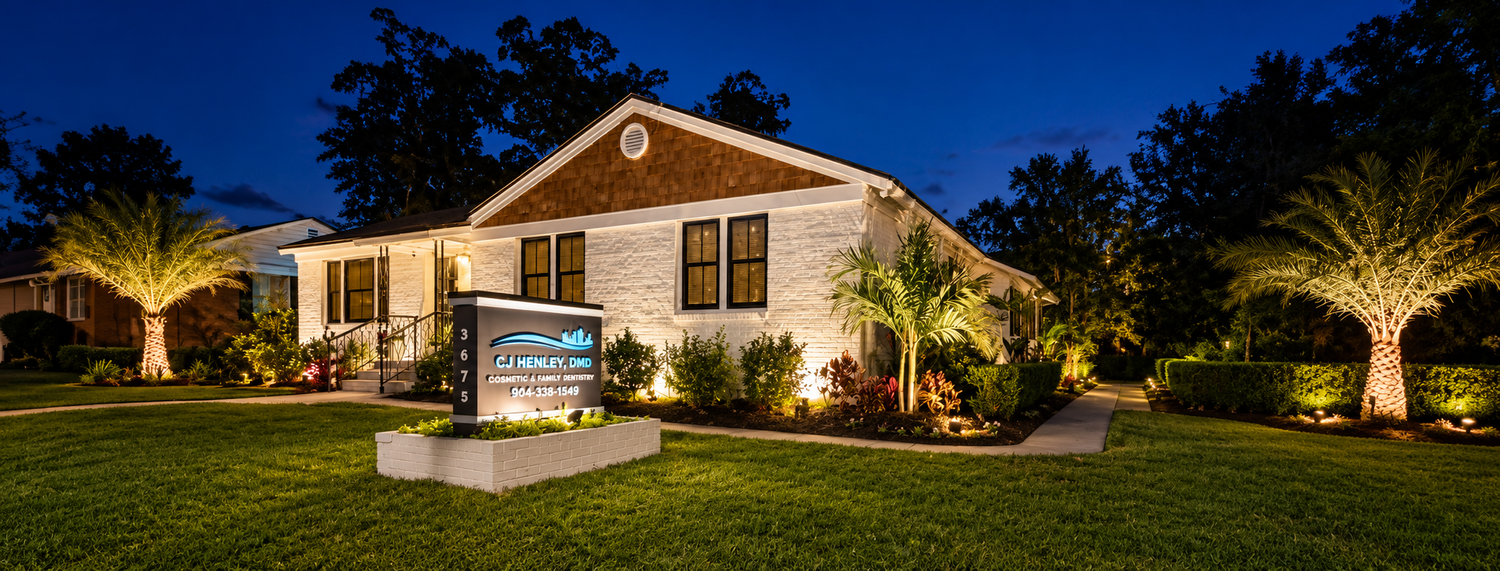
CJ Henley, DMD, PA provides teeth whitening at 3675 Hendricks Avenue, Jacksonville, FL 32207, in San Marco. Patients come from Mandarin, Southside, Riverside, the Beaches, Ponte Vedra, Orange Park, and St. Augustine. Call 904.398.1549 or request an appointment online, and bring a list of any crowns or veneers on your front teeth.
More reading: The ultimate toothpaste guide · Celebrity teeth before and after · Dental FAQ
Your next step
Get an honest whitening plan before you buy anything.
Wherever you live in Jacksonville, and whether you want a brighter smile for an event, one dark tooth to match, or a lighter shade before veneers or bonding, start with an exam and cleaning. We’ll tell you whether strips will do, or which professional teeth whitening option will. If a tooth has cracked or a crown has come off, see emergency dental care.
CJ Henley, DMD, PA3675 Hendricks Avenue
Jacksonville, FL 32207
Prefer a nonurgent text? 904.762.5616 is our practice on-call and text line. Please don’t send sensitive health information by text, and call for anything urgent.
Related pages
Sources
- Auschill TM, Hellwig E, Schmidale S, Sculean A, Arweiler NB. Efficacy, side-effects and patients’ acceptance of different bleaching techniques (OTC, in-office, at-home). Oper Dent. 2005;30(2):156-63.
- da Rosa GM, et al. Effectiveness of whitening strips use compared with supervised dental bleaching: a systematic review and meta-analysis. Oper Dent. 2020;45(6):E289-E307.
- Maran BM, et al. In-office dental bleaching with light vs. without light: a systematic review and meta-analysis. J Dent. 2018;70:1-13.
- He LB, Shao MY, Tan K, Xu X, Li JY. The effects of light on bleaching and tooth sensitivity during in-office vital bleaching: a systematic review and meta-analysis. J Dent. 2012;40(8):644-53.
- Rezende M, Loguercio AD, Kossatz S, Reis A. Predictive factors on the efficacy and risk/intensity of tooth sensitivity of dental bleaching: a multi regression and logistic analysis. J Dent. 2016;45:1-6.
- de Geus JL, Martins A, Reis A, Rezende M. At-home versus in-office bleaching: an updated systematic review and meta-analysis. Oper Dent. 2025;50(4):E47-E69.
- Ritter AV, Leonard RH Jr, St Georges AJ, Caplan DJ, Haywood VB. Safety and stability of nightguard vital bleaching: 9 to 12 years post-treatment. J Esthet Restor Dent. 2002;14(5):275-85.
- Cavalli V, Reis AF, Giannini M, Ambrosano GM. The effect of elapsed time following bleaching on enamel bond strength of resin composite. Oper Dent. 2001;26(6):597-602.
- Unlu N, Cobankara FK, Ozer F. Effect of elapsed time following bleaching on the shear bond strength of composite resin to enamel. J Biomed Mater Res B Appl Biomater. 2008;84(2):363-8.
- Plotino G, Buono L, Grande NM, Pameijer CH, Somma F. Nonvital tooth bleaching: a review of the literature and clinical procedures. J Endod. 2008;34(4):394-407.
- Newton R, Hayes J. The association of external cervical resorption with modern internal bleaching protocols: what is the current evidence? Br Dent J. 2020;228(5):333-7.
- Wang Y, Gao J, Jiang T, Liang S, Zhou Y, Matis BA. Evaluation of the efficacy of potassium nitrate and sodium fluoride as desensitizing agents during tooth bleaching treatment: a systematic review and meta-analysis. J Dent. 2015;43(8):913-23.
- Eachempati P, Kumbargere Nagraj S, Kiran Kumar Krishanappa S, Gupta P, Yaylali IE. Home-based chemically-induced whitening (bleaching) of teeth in adults. Cochrane Database Syst Rev. 2018;12:CD006202.
- Maran BM, et al. In-office bleaching with low/medium vs. high concentrate hydrogen peroxide: a systematic review and meta-analysis. J Dent. 2020;103:103499.
- Leonard RH Jr, Haywood VB, Caplan DJ, Tart ND. Nightguard vital bleaching of tetracycline-stained teeth: 90 months post treatment. J Esthet Restor Dent. 2003;15(3):142-52.
- Takamizawa T, et al. Long-term whitening stability in combined in-office and at-home whitening protocols: a randomized controlled trial. J Esthet Restor Dent. 2025;37(7):1681-91.
- Brooks JK, Bashirelahi N, Reynolds MA. Charcoal and charcoal-based dentifrices: a literature review. J Am Dent Assoc. 2017;148(9):661-70.
- Devila A, et al. Efficacy and adverse effects of whitening dentifrices compared with other products: a systematic review and meta-analysis. Oper Dent. 2020;45(2):E77-E90.
- American Dental Association. Oral Health Topics: Whitening.
- American Dental Association, MouthHealthy. Teeth whitening.
- American Academy of Pediatric Dentistry. Policy on the use of dental bleaching for child and adolescent patients.
- Haywood VB, Heymann HO. Nightguard vital bleaching. Quintessence Int. 1989;20(3):173-6.
- de Oliveira MN, et al. Assessment of color changes and adverse effects of over-the-counter bleaching protocols: a systematic review and network meta-analysis. Clin Oral Investig. 2024;28(3):189.
- Lee SS, Zhang W, Lee DH, Li Y. Tooth whitening in children and adolescents: a literature review. Pediatr Dent. 2005;27(5):362-8.