
Cold Sores (Oral Herpes)
A cold sore usually announces itself before you can see it. Your lip tingles, itches, or feels tight in one spot, and by the next day there's a small cluster of blisters right on the edge of the lip. They're common and annoying, and for healthy adults they aren't dangerous. A little know-how makes them shorter and keeps you from passing them on.
A cold sore is a cluster of blisters on or around the lip caused by the herpes simplex virus, usually HSV-1. It's contagious until fully healed and lasts 7 to 12 days. For most healthy people it isn't serious. An antiviral works best started at the first tingle. Get care quickly for sores near the eye or on a newborn, and see us if one hasn't healed in 2 weeks.
Not sure this is what you have? Answer five quick questions in our mouth spot checker. It compares what you see with more than 40 common conditions and tells you how soon to have it looked at.

- What a cold sore looks like
- Lips, gums, and roof of the mouth
- Cold sore vs. canker sore vs. fever blister
- Other look-alikes
- What causes cold sores
- Are cold sores contagious?
- Stages and how long they last
- How to get rid of a cold sore fast
- Cold sore medicine
- Cold sores and your dental visits
- Preventing outbreaks
- Babies, kids, and higher-risk groups
- When to get help
- FAQ
What does a cold sore look like?
A classic cold sore on the lip goes through a few looks over about a week. Early on you'll see a red, puffy spot. Then a tight group of tiny blisters appears, usually right where the colored part of the lip meets the skin. The blisters are filled with clear or cloudy fluid. They break, weep, and dry into a yellow-brown crust that can crack when you smile or eat.
- Most cold sores show up in the same general spot each time.
- They're often on one side of the mouth, not both.
- They usually heal without a scar.


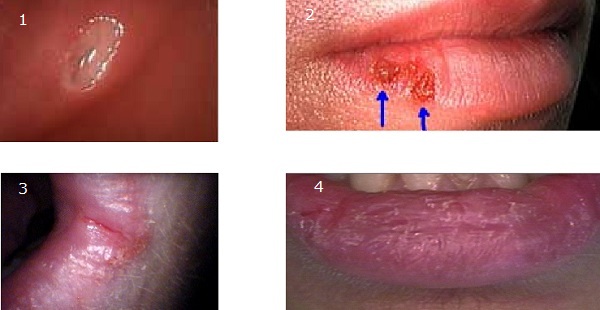
Cold sore on the lip, inside the mouth, or on the tongue
Most recurring cold sores show up on the outer edge of the lip or the skin just around it. Some land under the nose or on the chin.
The virus can also flare inside the mouth. In healthy adults this happens on tissue that's tightly bound to bone: the gums and the hard roof of the mouth. It looks like a cluster of pinpoint sores that can run together into one irregular sore. People often notice it a few days after a dental visit, because stretching the lips and the pressure of an injection can wake the virus up.
A cold sore on the tongue is unusual in healthy adults. Herpes on the tongue is more typical of a child's first infection or of someone with a weakened immune system. A single sore on the side or underside of the tongue is much more likely to be a canker sore.
Cold sore vs. canker sore vs. fever blister
First, the easy part: a fever blister and a cold sore are the same thing. Both names come from the fact that a fever or a cold can trigger an outbreak. Neither one is caused by the common cold.
A canker sore is a different problem altogether. It isn't a virus, it isn't contagious, and it forms inside the mouth. Our canker sore guide covers those in detail.
| Cold sore (fever blister) | Canker sore | |
|---|---|---|
| Where | Usually outside, on or around the lip. Inside, on the gums or hard palate. | Inside the mouth, on soft moveable tissue (inner lip, cheek, tongue) |
| Starts as | Tingle, then a cluster of tiny fluid-filled blisters | An open, round sore with a red border |
| Cause | Herpes simplex virus (HSV-1, sometimes HSV-2) | Not fully understood. Immune reaction plus triggers. |
| Contagious? | Yes, until fully healed | No |
| Crusts over? | Yes, on the lip | No |
| Heals in | 7–12 days | 7–14 days (minor) |
| What helps | Antiviral medicine, best at the first tingle | Protective pastes, numbing gels, steroid gels |
Other things that look like a cold sore
- Angular cheilitis. Red, cracked, sore skin right at the corners of the mouth, often on both sides. No blisters and no tingle beforehand. Read about angular cheilitis.
- Chapped lips. Dry, peeling skin across much of the lip rather than one tender cluster.
- Impetigo. A bacterial skin infection, common in kids, with honey-colored crusts that spread around the nose and mouth. It needs a visit to your physician or pediatrician, since it's treated differently.
- A pimple. A single bump with a white head, usually on the skin rather than the lip itself, without the warning tingle.
- A sore or scaly patch that won't heal. A lip spot that crusts, heals partway, and comes back in the same place for weeks isn't acting like a cold sore. Sun damage and, rarely, skin cancer can do this. Have it looked at. Learn about oral cancer screening.
What causes cold sores? Oral herpes and HSV-1
Cold sores are caused by the herpes simplex virus. So yes, a cold sore is a form of herpes, called oral herpes or herpes labialis. That word carries a lot of stigma it doesn't deserve. The World Health Organization estimates that about two-thirds of people under 50 worldwide carry HSV-1, and most of them picked it up as children from a kiss or a shared cup.
After the first infection, the virus settles into a nerve cluster deep in the side of the face (the trigeminal ganglion) and stays there for life. Most of the time it's quiet. Every so often something wakes it up, it travels back down the nerve, and a cold sore appears in the same area. Some people carry the virus and never get a sore. Others get several a year.
HSV-1 vs. HSV-2
HSV-1 causes most cold sores. HSV-2 is the type more often linked to genital herpes, but either type can infect either area. Oral sex can spread HSV-1 to the genitals or HSV-2 to the mouth. A cold sore on the lip is very rarely HSV-2, and recurring oral outbreaks from HSV-2 are less common.
Common triggers
- Sun on the lips, including a day on the boat, the beach, or the slopes
- Stress and poor sleep
- Illness, especially colds, flu, or anything with a fever
- Lip injury or stretching, such as dental work, a split lip, or cosmetic lip procedures
- Hormonal changes around a menstrual period
- Wind and cold, dry air
- Anything that weakens the immune system, like chemotherapy or transplant medicines
Are cold sores contagious? How you get them and pass them on
Yes. Cold sores spread through direct contact with the virus, mostly through saliva and the sore itself. That's how most people contract cold sores in the first place, usually in childhood.
- Kissing is the most common way it spreads.
- Sharing cups, utensils, lip balm, razors, or towels during an outbreak can pass it along.
- Oral sex can spread it from the mouth to the genitals.
- Your own fingers can carry it from the sore to your eyes or to a cut on your skin. Wash your hands after touching it.
A cold sore is most contagious when the blisters are fresh or weeping, and it stays contagious until the scab falls off and the skin underneath has healed. The virus can also be shed in saliva when there's no sore at all. This is called asymptomatic shedding, and it's why people sometimes catch HSV-1 from someone who has never had a visible cold sore. It isn't anyone's fault, and it can't be fully prevented.
Please don't kiss babies while you have a cold sore
A newborn's immune system can't handle herpes the way an adult's can. A herpes infection in a baby in the first weeks of life can be life-threatening. If you have a cold sore, skip kissing any baby, wash your hands before holding one, and consider a mask. Breastfeeding parents with a sore on the breast should talk to their doctor right away.
Cold sore stages and how long cold sores last
Most cold sores last 7 to 12 days from the first tingle to healed skin. They tend to follow the same five stages.
Symptoms of a first outbreak vs. a repeat
Repeat cold sores are usually small and stay put. You might feel a little run down, but that's about it. A first herpes infection can be much rougher, especially in young children: fever, swollen neck glands, sore throat, and many painful sores across the gums, tongue, and lips. That's covered in the kids section below.
A cold sore that lasts longer than 2 weeks, keeps growing, or shows up in a new pattern deserves a closer look.
How to get rid of a cold sore fast
Nothing kills a cold sore instantly. Ads that say otherwise are overselling. What you can do is shorten it by a day or two and make it more comfortable, and timing is everything. The best moment to act is the tingle, before a blister forms.
At the first tingle
- Start an antiviral right away. If your doctor or dentist has given you a prescription for outbreaks, take it now. Otherwise, start docosanol (Abreva) cream, which works best before blisters appear.
- Ice it. Hold an ice cube wrapped in a thin cloth against the spot for a few minutes at a time. It eases the burning and swelling.
- Keep your hands off it and wash them after applying anything.
Blister and weeping stage
- Keep using your antiviral as directed.
- Don't pop the blisters. The fluid is full of virus. Popping spreads it and can lead to a bacterial infection.
- Cover it if you like. Hydrocolloid cold sore patches hide it, protect it, and keep your fingers off it.
- Ease the pain. Acetaminophen or ibuprofen as the label directs. A lip product with benzocaine or lidocaine can numb it for a while.
- Use your own everything. Separate towel, cup, utensils, and lip balm until it's healed.
Crust stage
- Keep the scab soft with a thin layer of plain petroleum jelly or a zinc oxide lip product so it doesn't crack.
- Let it fall off on its own. Picking restarts the clock and can leave a mark.
- Toss the lip balm you used during the outbreak.
Cold sore treatment: over-the-counter and prescription medicine
Here's how the common cold sore remedies stack up. None of them cure herpes, because the virus stays in the nerve, but several really do help.
| Option | What it does | Things to know |
|---|---|---|
| Docosanol 10% cream (Abreva) | The only FDA-approved over-the-counter cold sore medicine. Helps block the virus from entering skin cells. | Start at the tingle and use as the label directs. In the main trial it shortened healing by about 18 hours on average. Modest, but real. |
| Numbing lip products (benzocaine, lidocaine) | Temporary pain relief | Don't speed healing. Do not use benzocaine in children under 2. |
| Zinc oxide or petroleum jelly | Protects and softens the sore so it cracks less | Cheap and safe. Use a clean cotton swab, not your finger. |
| Hydrocolloid patches | Cover and protect the sore | Good for work or school. Helps keep fingers off it. |
| Pain relievers (acetaminophen, ibuprofen) | Overall pain relief | Follow the label. Use children's versions and doses for kids. |
| Prescription antiviral pills: valacyclovir (Valtrex), acyclovir, famciclovir (Famvir) | Slow the virus's copying so the outbreak is shorter and milder | Work best started at the very first tingle, ideally within hours. Many people keep a prescription on hand. |
| Prescription antiviral creams (acyclovir, penciclovir) | Applied to the sore | Help a little if started early. Pills usually work better for people with frequent outbreaks. |
Acyclovir and valacyclovir for cold sores
For people who get cold sores often, prescription antiviral pills are the most effective tool we have. They're used two ways. Episodic treatment means a short course started at the first tingle. Some regimens take just one day. Suppressive treatment means a daily pill to cut down how often outbreaks happen, which can make sense for people with frequent or severe cold sores. Your dentist or physician will decide which fits and what dose, based on your health and kidney function.
What about lysine and other home remedies?
Lysine is one of the most popular cold sore supplements, so we'll be honest: the evidence that it helps is weak. A large Cochrane review of prevention studies found no good evidence that lysine prevents cold sores. Some people swear by it, and at usual supplement doses it's low-risk for most healthy adults. If you want to try it, check with your physician first, especially if you have kidney problems. Don't count on it in place of an antiviral.
Toothpaste, rubbing alcohol, and essential oils dabbed on the sore can irritate it more than they help. Skip them.
Cold sores and your dental visits
If you have an active cold sore before an appointment
Please call us. For cleanings and other elective dental work, we'll usually reschedule until the sore has crusted and healed. Stretching an active sore can make it worse and spread the virus to other spots on your lip or to your fingers. It's also just uncomfortable. If you have a toothache, swelling, or a broken tooth, we'll still see you and take extra care around the sore. See our emergency dental care page.
If you tend to get cold sores after dental work
Tell us. Stretching the lips and the pressure of an injection are well-known triggers. For people who reliably break out after appointments, an antiviral taken before the visit is an option to discuss with your doctor, and we're glad to coordinate. Lip balm and short breaks to rest your jaw during longer visits help too.
What a dentist can do
- Confirm what it is. We can tell a cold sore apart from a canker sore, angular cheilitis, or something that needs a closer look, especially sores inside the mouth.
- Prescribe antiviral medicine for outbreaks when it's appropriate, and talk with you about having it on hand.
- Coordinate with your physician if you have frequent, severe, or unusual outbreaks, or if your immune system is weakened.
- Look at sores that don't heal. If a sore doesn't act like a cold sore, we may swab it or biopsy it, or refer you, so we know exactly what it is. Our oral medicine and diagnosis page explains how that works.
How to prevent cold sores
You can't get rid of the virus, but you can cut down on outbreaks.
- Wear SPF lip balm. Use SPF 30 or higher on boat days, at the beach, and outdoors, and reapply often. In studies, sunscreen prevented sores triggered by lab ultraviolet light. Results in real-world sunlight were mixed, but it's cheap and protects your lips from sun damage anyway.
- Know your triggers. If stress, illness, or sun sets you off, have your antiviral ready before the trip or the big week.
- Ask about suppressive treatment if you get frequent outbreaks. Long-term daily antivirals do reduce recurrences, though the benefit is modest for people with only occasional sores.
- Don't share lip balm, cups, or utensils, even when you feel fine.
- Replace your toothbrush after an outbreak if it makes you feel better. There's little evidence it matters, but it does no harm.
Cold sores in babies, kids, and people at higher risk
Herpetic gingivostomatitis: a child's first infection
The first time a child catches HSV-1, usually between about 6 months and 5 years old, it often doesn't look like a cold sore at all. Many kids have no symptoms. Others get primary herpetic gingivostomatitis: a fever, fussiness, and drooling, then swollen, red, bleeding gums and many small sores on the gums, tongue, lips, and roof of the mouth. It hurts, and kids often refuse to eat or drink. It typically lasts 10 to 14 days.
- Call your pediatrician. An antiviral can help if it's started early in the illness.
- Fluids matter most. Cold water, milk, popsicles, and smoothies without citrus. Watch for signs of dehydration: few wet diapers, no tears, very sleepy.
- Children's acetaminophen or ibuprofen, dosed for their weight as the label or your doctor directs.
- Keep your child's hands away from their eyes, and keep them from sucking their fingers if you can. The virus can spread to the fingers too.
We see children too. Learn about family dentistry at our office.
Newborns
Babies in the first 6 weeks or so are at the highest risk of serious herpes infection. Any blisters on a newborn, or a baby who has a fever, is unusually sleepy, or isn't feeding well after contact with someone who has a cold sore, needs to be seen by a doctor right away.
Pregnancy
A recurring cold sore on your lip during pregnancy is generally low-risk for the baby. Tell your OB about it anyway, and be especially careful with hand washing and kissing after the baby arrives. Ask your OB before starting any medicine, including Abreva. A first-ever herpes infection late in pregnancy is a bigger concern, so call your OB promptly if that happens.
Eczema (atopic dermatitis)
In people with eczema, the herpes virus can spread across broken skin and cause eczema herpeticum: clusters of painful, punched-out sores, often with fever. This is a medical emergency. Get same-day care.
Weakened immune systems
Cancer treatment, organ transplant medicines, HIV, and some autoimmune drugs can make cold sores larger, slower to heal, and more likely to show up inside the mouth. People in head and neck cancer treatment are especially prone to mouth sores of many kinds, and herpes can hide among them. Read about dental care during head and neck cancer treatment, or see how we approach care for medically complex patients.
When to see a doctor or dentist about a cold sore
Make an appointment if:
- A sore hasn't healed in 2 weeks
- You get cold sores often and want a prescription to keep on hand
- You have sores inside your mouth and aren't sure what they are
- A lip sore keeps coming back in exactly the same spot and never fully heals
- You get cold sores after dental visits and want to plan ahead
Get care quickly or today if:
- You have eye pain, redness, light sensitivity, or blurry vision during or after a cold sore. Herpes in the eye can damage vision. See an eye doctor or urgent care the same day.
- A newborn has blisters, fever, poor feeding, or unusual sleepiness
- You have eczema and sores are spreading across your skin
- A child with mouth sores isn't drinking enough or seems dehydrated
- You have a high fever, feel very sick, or sores are spreading quickly
- Your immune system is weakened and you have a new outbreak
Cold sore FAQ
What is a cold sore?
A cold sore is a small cluster of blisters, usually on the edge of the lip, caused by the herpes simplex virus. After the first infection the virus stays in a nearby nerve for life and can reactivate from time to time. Each outbreak blisters, crusts, and heals in about 7 to 12 days.
Are cold sores always herpes?
Yes. A true cold sore is caused by the herpes simplex virus, almost always HSV-1. Oral herpes is extremely common, and most adults carry the virus whether or not they ever get a sore. Plenty of other lip and mouth sores aren't herpes, though, including canker sores, angular cheilitis, and chapped lips, so not every sore near your mouth is a cold sore.
Are cold sores contagious?
Yes. Cold sores spread through kissing, sharing cups or lip balm, and oral sex. They're contagious from the first tingle until the scab is completely gone, and most contagious when the blisters are open and weeping. The virus can also spread when no sore is visible, which is called asymptomatic shedding.
How do you get cold sores in the first place?
Most people catch HSV-1 in childhood through a kiss from a family member or friend, or by sharing utensils or cups. The first infection may cause no symptoms, or it may cause fever and many mouth sores. After that, the virus stays dormant and can cause cold sores later when something triggers it.
What causes cold sores on the lips to come back?
Common triggers include sun on the lips, stress, poor sleep, colds or flu, fever, hormonal changes, and injury or stretching of the lips, including dental work. A weakened immune system also makes outbreaks more likely. Many people notice the same one or two triggers each time.
How long do cold sores last?
Most cold sores last about 7 to 12 days from the first tingle until the skin is healed. Starting an antiviral at the tingle can shorten that by a day or more. A sore that's still there after 2 weeks should be checked by a doctor or dentist.
What kills cold sores instantly?
Nothing does. The herpes virus stays in the nerve, and no cream or pill makes a sore disappear overnight. The fastest approach is to start a prescription antiviral such as valacyclovir, or over-the-counter docosanol (Abreva), at the very first tingle. That can shorten the outbreak and sometimes keep blisters from forming.
How do I get rid of a cold sore fast?
Act at the first tingle. Start your antiviral or docosanol right away, ice the spot, and keep your hands off it. Once it blisters, don't pop it, keep it covered or moist with petroleum jelly, and let the scab fall off on its own.
Does Abreva work on cold sores?
Docosanol (Abreva) helps a little. In its main clinical trial, people who started it early healed about 18 hours sooner on average than people using a placebo cream. It works best when started at the tingle, before blisters appear, and used as the label directs.
Does lysine help cold sores?
The evidence is weak. A Cochrane review of prevention studies found no good evidence that lysine prevents cold sores. It's low-risk for most healthy adults at usual supplement doses, so some people try it, but check with your physician first and don't use it in place of an antiviral.
Can you get a cold sore inside your mouth?
Yes. In healthy adults, herpes inside the mouth usually shows up as a cluster of tiny sores on the gums or the hard roof of the mouth, often a few days after dental work. Sores on the soft lining of the cheeks, inner lips, or tongue are much more likely to be canker sores, which aren't contagious.
Is a fever blister the same as a cold sore?
Yes. Fever blister and cold sore are two names for the same thing, a herpes simplex outbreak on or near the lip. The names come from the fact that a fever or a cold can trigger one. A canker sore is a different, non-contagious sore inside the mouth.
Should I go to the dentist with a cold sore?
Call first. For routine cleanings and elective work, we'll usually reschedule until the sore heals, since stretching the lip can make it worse and spread the virus. For a dental emergency, we'll still see you. If dental visits tend to trigger your cold sores, let us know so an antiviral before your appointment can be discussed.
Can a cold sore spread to my eye?
It can, usually from touching the sore and then your eye. Herpes in the eye can cause pain, redness, light sensitivity, and blurry vision, and it can damage vision if it isn't treated. If you have any of those symptoms, see an eye doctor or urgent care the same day.
Cold sores that won't quit?
If you're in the Jacksonville area and get cold sores often, have sores inside your mouth you can't identify, or just want a plan before your next dental visit, we're glad to help. Dr. Henley sees patients with all kinds of lip and mouth sores, from everyday cold sores to ones that are harder to pin down.
Related conditions
Sources
- Arduino PG, Porter SR. Herpes simplex virus type 1 infection: overview on relevant clinico-pathological features. J Oral Pathol Med. 2008;37(2):107–121.
- Chi CC, Wang SH, Delamere FM, et al. Interventions for prevention of herpes simplex labialis (cold sores on the lips). Cochrane Database Syst Rev. 2015;(8):CD010095.
- Sacks SL, Thisted RA, Jones TM, et al. Clinical efficacy of topical docosanol 10% cream for herpes simplex labialis: a multicenter, randomized, placebo-controlled trial. J Am Acad Dermatol. 2001;45(2):222–230.
- Opstelten W, Neven AK, Eekhof J. Treatment and prevention of herpes labialis. Can Fam Physician. 2008;54(12):1683–1687.
- World Health Organization. Globally, an estimated two-thirds of the population under 50 are infected with herpes simplex virus type 1. 2015.
This page is for general education and isn't a diagnosis. Every mouth is different. If you have a sore you're worried about, see your dentist or physician. Photos marked Wikimedia Commons are used under their listed licenses and may have been cropped or resized.