
CJ Henley, DMD, PA / San Marco, Jacksonville, Florida
Dental crowns and bridges in Jacksonville, FL.
Every crown handcrafted. Every type, chosen for you.
A dental crown (often called a cap) covers and protects a damaged tooth; a dental bridge replaces one or more missing teeth by anchoring to the teeth or implants beside the gap. At our San Marco office, Dr. CJ Henley offers every type of crown and bridge, chooses the material for your tooth and your bite, and has every crown and bridge handcrafted by a local dental laboratory, Dynamic Dental Solutions.
- 96.6%estimated 5-year survival of glass-ceramic single crowns, including lithium disilicate, in a 2015 systematic review1
- 94.4%estimated 5-year survival of metal-ceramic tooth-supported bridges in a 2015 systematic review2
- 5–15 yrstypical lifespan of a crown or bridge; some last longer3
- Every onehandcrafted by a local lab; we don’t mill same-day crowns
Top-rated on Google: 4.9 stars from more than 225 patient reviews.
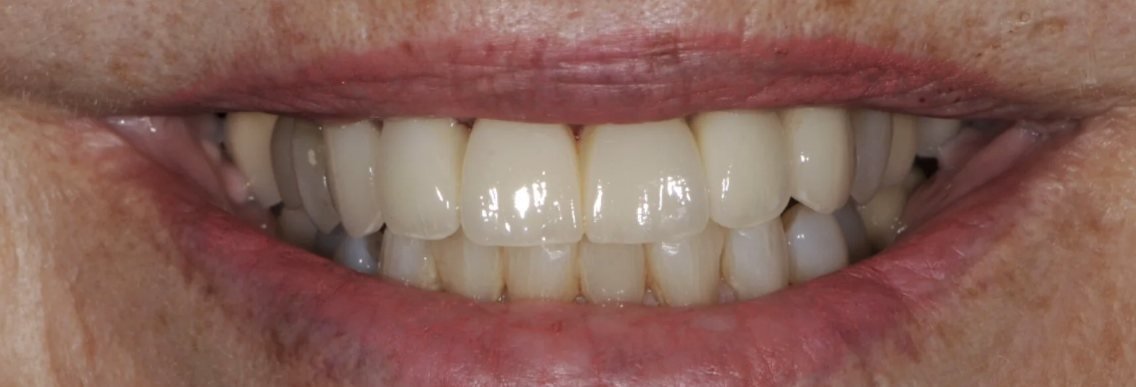
What is a dental crown?
When a tooth needs a dental crown, and when it doesn’t.
A dental crown is a custom cover that fits over the whole visible part of a tooth to hold it together, protect it, and restore its shape. It is the right choice when a tooth is cracked, heavily filled, worn down, or weakened after a root canal, and when a filling, bonding, or an onlay would not be strong enough. A crown and a cap are the same thing.
Crown, onlay, filling, bonding, or veneer?
We use the smallest restoration that will last. A crown is not always the answer: a small cavity gets a filling, a chipped edge often gets composite bonding, and a tooth that has lost one or two cusps can often get an onlay or a three-quarter crown that keeps the healthy part of the tooth. For why we sometimes recommend a crown before a tooth hurts, read why do I need a crown?
| Situation | Dental crown | Onlay or three-quarter crown | Filling or bonding |
|---|---|---|---|
| Small cavity or chip | ✗ Removes more tooth than needed | Rarely needed | ✓ Usually the right choice |
| One or two cusps broken | Works | ✓ Often best: keeps healthy tooth | ✗ Often too weak |
| Cracked tooth or very large filling | ✓ Holds the whole tooth together | Sometimes, if the crack is limited | ✗ Doesn’t protect against splitting |
| Back tooth after a root canal | ✓ Usually recommended | Sometimes | ✗ Usually not enough |
| Front tooth color or shape only | When a veneer isn’t enough | Not used | Bonding or a porcelain veneer first |
Who makes your crown
Every crown handcrafted by a local lab you can name.
Every crown and bridge from our office is handcrafted by Dynamic Dental Solutions, a local dental laboratory, and our crowns and veneers come from the same lab. We don’t offer same-day crowns milled in the office. Instead, we take the time to send detailed records, photos, and a shade map so the lab can match the tooth to you.
Dynamic Dental Solutions makes our crowns, bridges, and porcelain veneers, and ceramist Paul Robert layers and characterizes our front-tooth porcelain by hand. Because Dr. Henley works with the same lab case after case, the lab knows exactly how he wants margins, contacts, and bite surfaces finished.
Why we don’t do same-day crowns
Several Jacksonville offices offer same-day crowns, milled from a block of ceramic while you wait, and for some teeth that is a reasonable option. We made a different choice: every crown here is handcrafted by a lab technician. That takes a second visit and a temporary crown in between, usually for about two to three weeks. In return, the lab can choose the material for your tooth, layer and stain porcelain for a front tooth, and check fit and bite on a model before the crown ever reaches your mouth.
Records that help the lab
- Scan or impression: a 3Shape TRIOS digital scan or a traditional impression, whichever gives the most accurate result for your tooth.
- Shade photos: close-up photos of the neighboring teeth, especially for a front tooth.
- Bite records: how your teeth meet and slide, so the crown fits your bite in every movement.
Types of dental crowns
Zirconia, e.max, porcelain, or gold: chosen for the tooth and the bite.
We offer every type of dental crown: porcelain-fused-to-zirconia, solid (full-contour) zirconia, e.max lithium disilicate, porcelain-fused-to-metal, and gold, plus onlays and three-quarter crowns. No single material is best for everyone. Dr. Henley chooses based on where the tooth is, how hard you bite or grind, how much room there is, and the color of the tooth underneath.
| Material | Where it shines | Look | Strength and wear |
|---|---|---|---|
| Porcelain-fused-to-zirconia (PFZ) | Front and back teeth, bridges, heavy bites that still need to look natural | Layered porcelain over a tooth-colored core; no dark metal line | Strong zirconia core; the porcelain layer can chip under heavy grinding |
| Full-contour zirconia | Molars, grinders, limited space | Tooth-colored, less translucent than layered porcelain | Very strong, resists chipping; why we use it for heavy bites |
| e.max (lithium disilicate) | Front teeth and premolars; single crowns | Natural-looking translucency | Strong for its thickness |
| Porcelain-fused-to-metal (PFM) | Back teeth and some bridges | Porcelain over metal; can show a gray line if gums recede | Long track record |
| Gold | Back teeth, grinders who don’t mind the color | Gold-colored | Works in thin sections, so it can be conservative of tooth structure |
| Onlay or three-quarter crown | Teeth that are partly healthy | Any of the materials above | Keeps the healthy part of the tooth |
Zirconia vs e.max: which is better?
Neither is better everywhere. In a 2015 review of single crowns, glass-ceramic (including lithium disilicate) and metal-ceramic crowns had similar five-year survival, while zirconia-based crowns with layered porcelain had lower survival in the back of the mouth and more losses from fractures of the porcelain layer1. Full-contour zirconia has no separate porcelain layer, though any crown can still fracture. e.max can give the translucency front teeth need. That is why material is a case-by-case decision.
What about the tooth underneath?
A dark tooth, a metal post, or an implant abutment shows through a thin, translucent crown. Those teeth often need a more opaque core, such as zirconia, with porcelain layered on top to look natural. The color of the tooth underneath is part of choosing the material.
Dental crowns on front teeth
A front tooth crown that matches the teeth beside it.
Matching a single front tooth crown to natural teeth is one of the hardest jobs in dentistry, because every natural tooth has its own translucency, texture, and color shifts. We send shade photos to the lab, the ceramist layers the porcelain by hand, and we try the crown in before it is cemented. If it doesn’t match, it goes back.
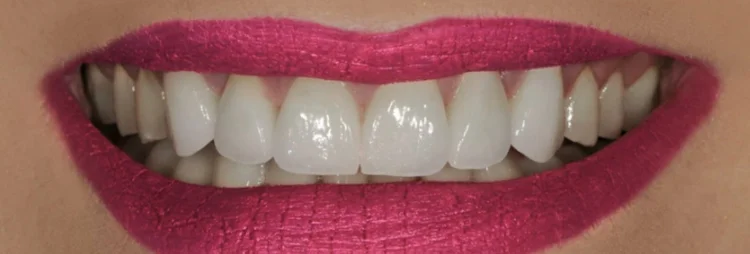
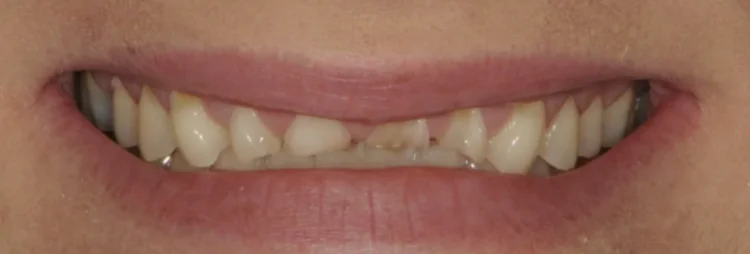
Saving severely eroded front teeth with e.max crowns
Acid erosion had worn these front teeth so far that implants were discussed. Instead, the teeth were first moved into better position with orthodontics, then restored with e.max (lithium disilicate) crowns. Every tooth was saved.
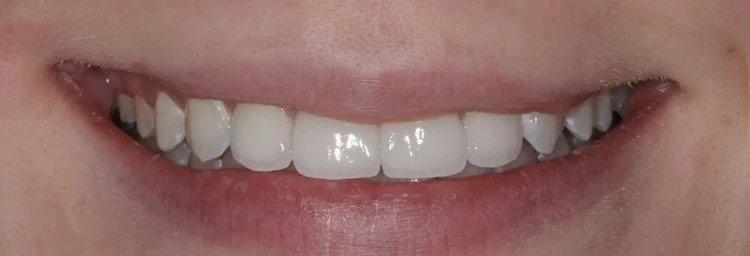
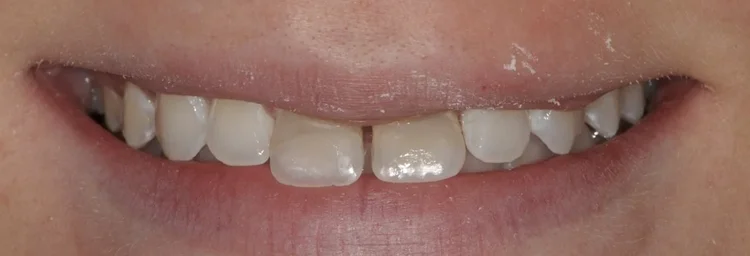
Crowns and veneers working together
Childhood trauma left gaps and mismatched teeth. Some teeth needed full crowns and others only veneers, all in e.max so they read as one smile. Mixing crowns and veneers is common; the skill is making them match.
The dental crown procedure
Getting dental crowns in Jacksonville, visit by visit.
A crown usually takes two visits about two to three weeks apart. At the first, the tooth is numbed, shaped, recorded with a scan or impression, and fitted with a temporary crown. At the second, the handcrafted crown is tried in, adjusted, cemented, and checked with an X-ray. Dr. Henley does each step himself.
Exam and diagnosis
A comprehensive exam and X-rays. When a crack or the tooth’s roots need a closer look for a proper diagnosis, we use 3D cone beam (CBCT) imaging. If the gumline needs reshaping for the crown to look and fit right, gum contouring is done first.
Preparation
The tooth is numbed and shaped, removing only what the chosen material needs. Old filling material and decay come out, and the tooth is built back up if needed. Nervous? We offer nitrous oxide and minimal oral sedation when appropriate.
Scan or impression, then a temporary crown
We record the tooth with a digital scan or a traditional impression, whichever suits the case, and take shade photos. Dr. Henley makes your temporary crown chairside so you leave with a natural-looking tooth.
Handcrafted at the lab
Dynamic Dental Solutions builds the crown over about two to three weeks.
Try-in, cementation, and X-ray
The crown is checked for fit, contacts, color, and bite in every direction, then cemented. An X-ray helps confirm it is fully seated with a closed edge.
See each step in clinical photos in why do I need a crown?
Dental bridges in Jacksonville
Dental bridges in Jacksonville: every type, for one missing tooth or several.
A dental bridge replaces missing teeth with artificial teeth (pontics) supported by the natural teeth or implants beside the gap, and it is cemented, bonded, or screwed in place, so there is nothing to take out. We make every type of bridge: traditional, Maryland (resin-bonded), cantilever, and implant-supported. The right one depends on the health of the neighboring teeth, your bone, your bite, and your medical history.
Traditional bridge
Crowns on the teeth on both sides of the gap hold the replacement tooth between them. It is the most common dental bridge, and a good choice when those neighboring teeth already need crowns.
Maryland bridge (resin-bonded)
A replacement tooth supported by thin retainers bonded to the backs of the neighboring teeth. It needs little or no shaping of those teeth, so it suits a single front tooth in the right bite.
Cantilever bridge
The replacement tooth is supported from one side only. It is used in specific situations, usually for a front tooth, where the bite forces are light.
Implant crowns and implant bridges
Dental implants hold an implant bridge, so the neighboring teeth aren’t touched. For a full arch, implants can support a fixed implant bridge. See dental implants.
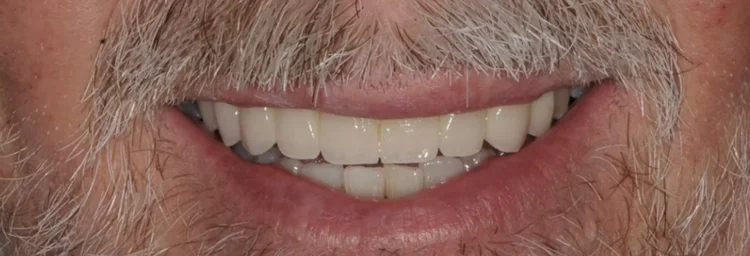
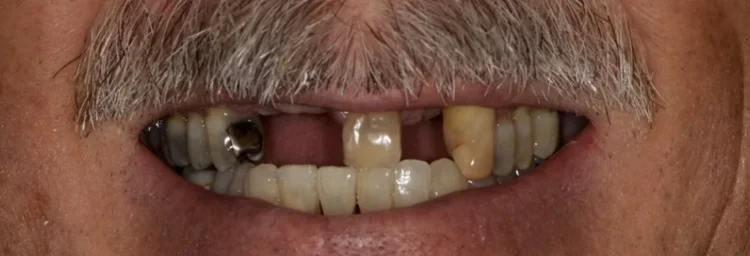
A fixed bridge after head and neck radiation: 10 years later
For this cancer survivor, the radiation history made extractions and implants a higher-risk choice, so his treatment was planned around avoiding both. A long-span porcelain-fused-to-zirconia bridge replaced the missing teeth. Ten years later it is still in excellent condition.
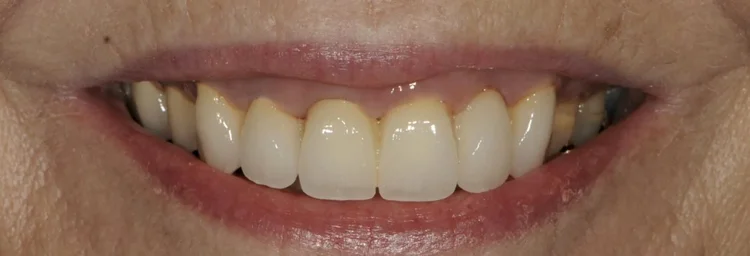
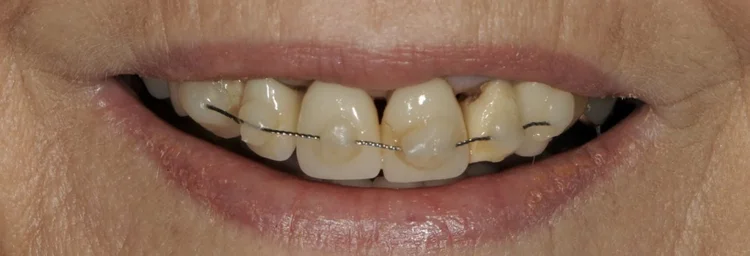
Rebuilding the front teeth after a fall
A fall damaged four upper front teeth beyond repair. They were removed and replaced with a fixed porcelain-fused-to-zirconia dental bridge supported by the neighboring teeth: nothing to take in and out.
Bridge vs implant
Bridge or implant: which is better for a missing tooth?
Neither is better for everyone. An implant leaves the neighboring teeth untouched and replaces the root, but it needs healthy bone, surgery, and several months. A tooth-supported bridge is usually faster and avoids implant surgery, and it makes the most sense when the neighboring teeth already need crowns or when your medical history makes surgery riskier. We offer both; the recommendation depends on your teeth, bite, and medical history.
| Factor | Tooth-supported bridge | Dental implant | Partial denture |
|---|---|---|---|
| Neighboring teeth | Shaped for crowns (little or none for a Maryland bridge) | ✓ Untouched | Clasps rest on them |
| Surgery | ✓ None | Yes, plus healing time | ✓ None |
| Typical timeline | A few weeks | Usually several months | A few weeks |
| Fixed or removable | ✓ Fixed | ✓ Fixed | Removable |
| Cleaning | Floss threader or water flosser under it | Like a natural tooth | Take out to clean |
| Medical factors | Avoids surgery, which can matter after head and neck radiation or on some bone medications; assessed individually | Needs medical review for radiation, bone medications, uncontrolled diabetes, smoking | Easy to adjust |
For more on dental bridges vs implants, read dental bridge vs implant. If you take bisphosphonates or denosumab, see osteoporosis medications and your dental health.
Signs dental crowns or dental bridges are failing
How to tell a crown or bridge needs attention.
The most common signs are a dark line at the gum, floss that catches or shreds at the edge, a bad taste or smell, pain when you bite, a crown that feels loose, and chipped porcelain. These are clues, not a diagnosis: some problems can be repaired, and some mean the crown should be replaced. An exam and X-rays help determine which.
| What you notice | Possible explanations | What we check |
|---|---|---|
| Dark or gray line at the gum | Metal under porcelain showing after gum recession, or decay at the edge | Gum health, X-ray of the edge |
| Bad taste or smell around a crown | Food or bacteria trapped under a bridge, or leakage at the edge | The seal, the gums, the bridge underside |
| Floss catches or shreds | An open or rough edge, a chip, or decay | The margin with an explorer and X-ray |
| Pain when biting, even months later | A high spot, a crack in the tooth underneath, or a nerve problem | The bite, the tooth, and the nerve; CBCT when needed |
| Crown feels loose or comes off | Washed-out cement or decay underneath | Whether the tooth is sound enough to recement |
| Chipped porcelain | Grinding, a hard bite, or a thin layer | Whether to polish, repair, or replace |
Can a crown get a cavity? The crown itself can’t decay, but the tooth underneath can, right at the edge where crown meets tooth. That is why checkups still matter for teeth that have crowns.
Crown replacement and second opinions
Crowns or bridges that look fake, bulky, or wrong? We redo them.
A large part of Dr. Henley’s restorative work is replacing crowns and bridges that look bulky, opaque, too white, or obviously artificial, or that keep failing. If you were told your crowns can’t look any better, a second opinion costs you one visit. Bring your old X-rays and photos if you have them.
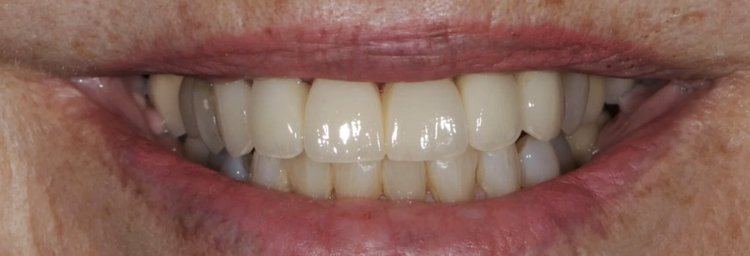
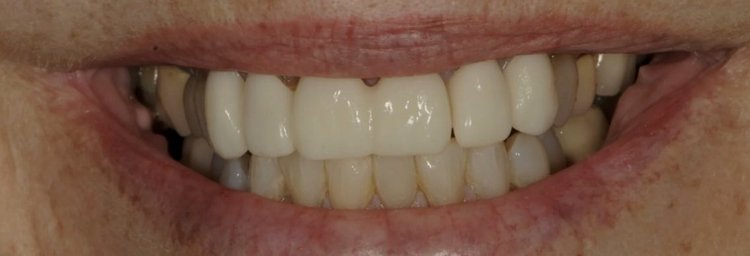
Told it couldn’t look better: a second-opinion redo
Her front restorations looked bulky and flat, and she had been told no one could improve them. The new porcelain-fused-to-zirconia bridge changed four things: how each tooth rises out of the gum, translucency at the edges, surface texture, and the shape of the spaces between teeth.
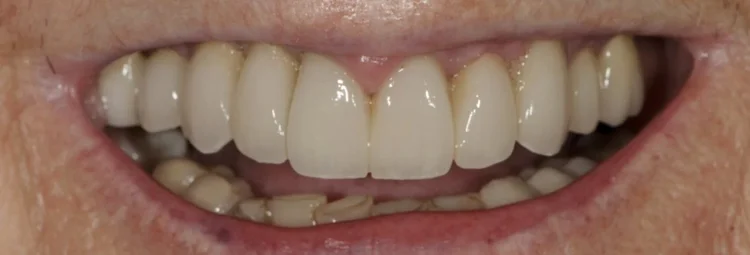
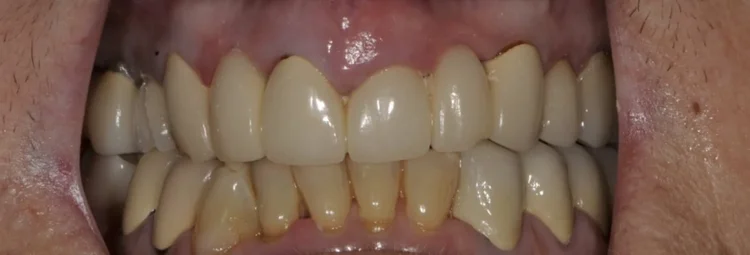
Replacing failed crowns and bridges
Several crowns and bridges were breaking down. The failing work was removed, implants replaced teeth that couldn’t be saved, the gumline was contoured first, and the arch was rebuilt with new crowns and bridges.
Unhappy with veneers instead? Read why veneers look fake, and whether they can be redone. Results vary from patient to patient; your exam determines what is possible for your teeth.
Dental crowns if you grind
Dental crowns and dental bridges for people who clench and grind.
Grinding is one of the most common reasons crowns chip and bridges come loose. For grinders, we lean toward stronger materials such as full-contour zirconia, check the bite in every jaw movement, and protect the work with a custom night guard.
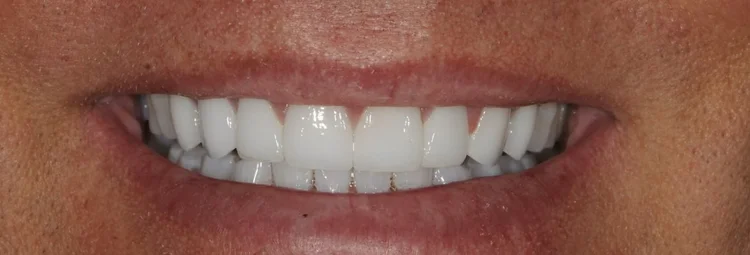
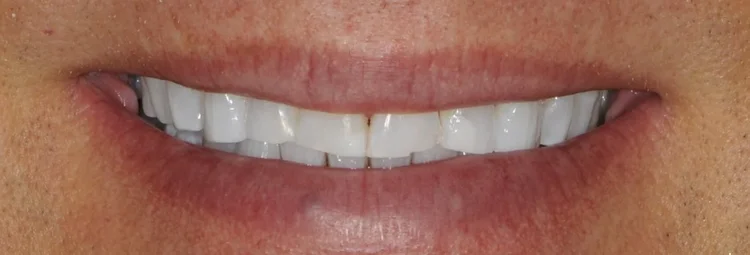
Restoring an upper arch worn down by grinding
Grinding had worn every upper tooth flat. Full crowns and three-quarter crowns in porcelain-fused-to-zirconia rebuilt length and shape, removing only as much tooth as each one needed, and a night guard now protects them. Learn more about teeth grinding (bruxism) and TMJ treatment.
Complex medical histories
Crowns and bridges after radiation, with dry mouth, or with a complex medical history.
For Jacksonville patients treated for cancer, radiation to the head and neck and many medications reduce saliva, and a dry mouth raises the risk of decay at the edges of crowns4. Radiation and some bone medications also change the risks of extractions and implants, so the choice between a bridge, an implant, or keeping a tooth is made individually, with your medical team.
Dry mouth and crowns
With less saliva, decay can start where a crown meets the tooth. We add prescription fluoride and closer checkups for patients with dry mouth, and we design crown edges that are easy to keep clean.
After head and neck cancer
Dr. Henley serves on the Head & Neck Tumor Board at Baptist MD Anderson and treats many head and neck cancer survivors. Planning is individual: sometimes a bridge, like the 10-year case above, avoids a riskier procedure.
Blood thinners, bone medications, diabetes
Crowns and bridges rarely need surgery, which helps. When surgery is part of the plan, we coordinate with your physician. Read about our complex and medically involved care.
Limited opening after radiation
If radiation has tightened the jaw muscles, longer treatment visits can be hard. We plan around it; see radiation-induced trismus.
How long do dental crowns last?
How long crowns and bridges last, and how to make them last longer.
Cleveland Clinic gives a typical lifespan of 5 to 15 years for crowns and bridges, and some last longer3. In 2015 systematic reviews, about 95 of 100 metal-ceramic single crowns and about 94 of 100 metal-ceramic bridges were still in place after five years1,2; individual results vary. Grinding, decay at the edges, and gum disease are the usual reasons they fail.
- Clean the edges: brush along the gumline and floss every day. Under a bridge, use a floss threader, super floss, or a water flosser.
- Keep your checkups: exams and X-rays help find decay at a crown edge early.
- Wear your night guard if you grind or clench.
- Don’t use teeth as tools: no ice chewing, bottle opening, or biting thread.
- Use fluoride if you have dry mouth or a history of cavities; see our fluoride toothpaste guide.
Crown problems in Jacksonville
Crown fell off, temporary came off, or crown hurts? What to do.
If a crown or temporary crown comes off, keep it, call us, and avoid chewing on that side. Don’t glue it back with household glue. Most crowns that come off whole can be recemented if the tooth underneath is sound; pain, swelling, or a broken tooth needs to be seen promptly.
Do
- Save the crown in a bag or container and bring it with you.
- Call 904.398.1549; existing patients can reach our on-call line after hours.
- Keep the tooth clean and brush gently.
- Call us before trying to put a temporary crown back; don’t force it into place or wear it loose.
Avoid
- Super glue or other household adhesives.
- Chewing hard or sticky food on that side.
- Waiting weeks: an uncovered tooth can shift, decay, or break.
- Throwing the crown away, even if it looks damaged.
Swelling, severe pain, or a broken tooth? See emergency dental care. Sensitivity after new dental work is common for a short time; read tooth pain after a filling or crown.
Cost and insurance
What do dental crowns and bridges cost in Jacksonville?
The fee for a crown or bridge depends on the material, the number of teeth, whether the tooth needs a buildup or gum contouring first, and whether an implant is involved. We give you the fee before anything is made. For a deeper look, read why dental crown costs vary in Jacksonville.
We are an out-of-network practice. Some dental plans cover part of a crown or bridge, often with a frequency limit such as once every five years per tooth. We can help you understand how to use your benefits; you are responsible for amounts your plan does not pay. Dental insurance benefits vary widely from plan to plan. Call our team with your plan details to ask about fees and payment arrangements. In select cases we can arrange an in-office payment plan. If you are planning around retirement, see dental insurance after retirement.
Why patients choose our office
Why Jacksonville patients come to Dr. Henley for dental crowns and bridges.
The same dentist at every visit, a local lab you can name, every crown and bridge type available, and real before-and-after cases you can compare. Patients across Jacksonville also come to us for second opinions on crowns and bridges placed elsewhere.
Crown and bridge dentist near you
Dental crowns and bridges in San Marco, for all of Jacksonville.
Dr. CJ Henley is a general dentist in Jacksonville whose practice centers on cosmetic and restorative dentistry, dental implants, and care for medically complex patients. He earned his DMD at the University of Florida. Much of his crown and bridge work is replacing restorations that failed or never looked right.
Our office on Hendricks Avenue is easy to reach from San Marco, Southbank, San Jose, Riverside, Avondale, Ortega, St. Nicholas, Downtown, and Mandarin. Patients with complex medical histories, including head and neck cancer survivors, are welcome; read about our complex and medically involved care.
See what patients say in our reviews, or learn more about our San Marco dental office.
San Marco
On Hendricks Avenue, in the neighborhood
A temporary crown check or a quick adjustment fits into a lunch break.
Downtown and Southbank
Southbank borders us; Downtown is across the Main Street Bridge
Two crown visits are easy to fit around a workday.
Riverside, Avondale, and Ortega
Across the St. Johns River on the Fuller Warren Bridge
A short trip over the river; see our Riverside and Avondale dentist page.
San Jose and Mandarin
North on San Jose Boulevard, which becomes Hendricks Avenue
One road to our door; see our Mandarin dentist page.
Southside and Baymeadows
North on I-95 from Baymeadows Road
An easy drive for a crown redo or second opinion; see our Southside dentist page.
Jacksonville Beach, Neptune Beach, and Atlantic Beach
West on Atlantic Boulevard or Beach Boulevard
Visits are booked ahead; see our Jacksonville Beach dentist page.
Ponte Vedra and Nocatee
West on J. Turner Butler Boulevard, then north on I-95
Worth the drive to know who makes your crown; see our Ponte Vedra dentist page.
Orange Park, Fleming Island, and St. Augustine
North on US-17 or I-95
Two planned visits; see our Orange Park and St. Augustine pages.
Frequently asked questions
Questions about dental crowns and bridges.
Is a cap the same as a crown?
Yes. “Cap” is the everyday word for a dental crown: a custom restoration that covers the whole visible part of a tooth. Dentists use “crown”; the treatment is the same.
Do you do same-day crowns?
No. Every crown and bridge from our office is handcrafted by Dynamic Dental Solutions, a local dental laboratory, so a crown takes two visits about two to three weeks apart, with a temporary crown in between. That lets the lab choose and layer the material for your tooth and check fit and bite before delivery.
Does getting a crown hurt?
The tooth is numbed with local anesthesia, so most patients feel pressure and vibration rather than pain, and we adjust if you feel discomfort. Mild gum soreness or temperature sensitivity for a few days is common. For anxious adults we offer nitrous oxide and minimal oral sedation when appropriate.
How many visits does a crown take?
Usually two: one to prepare the tooth, record it, and place a temporary crown, and one about two to three weeks later to try in, adjust, and cement the final crown. Front teeth that need careful shade matching sometimes take an extra try-in.
Does every crown need a root canal?
No. Most crowns are placed on teeth with healthy nerves. A root canal is needed when the nerve inside the tooth is irreversibly inflamed, infected, or dead. We refer root canals to an endodontist and place the crown afterward.
Which is better, a zirconia or an e.max crown?
It depends on the tooth. e.max (lithium disilicate) offers natural-looking translucency and often suits front teeth and premolars. Zirconia, solid or with porcelain layered on top, often suits molars, bridges, heavy bites, and teeth with a dark core. Dr. Henley chooses the material for your tooth and bite.
Can you match one front crown to my natural teeth?
That is the goal of every single front crown we make. We take shade photos, the ceramist layers and stains the porcelain by hand, and we try the crown in before cementing it. If it doesn’t match, it goes back to the lab.
My crown looks fake or too white. Can it be replaced?
Usually, yes. Crowns that look bulky, opaque, or too white, or show a dark line at the gum, can be removed and replaced. Many of our crown and bridge cases are redos of work done elsewhere. Start with an exam and bring your old X-rays if you have them.
Can a tooth with a crown get a cavity?
The crown can’t decay, but the tooth underneath can, at the edge where the crown meets the tooth. Brushing along the gumline, daily flossing, fluoride, and regular checkups lower that risk.
Why does my crown smell or taste bad?
A bad smell or taste usually means food and bacteria are collecting under a bridge or at a crown edge that has opened up or decayed. It is worth an exam soon, because the problem underneath is easier to fix early.
My crown fell off. What should I do?
Keep the crown, avoid chewing on that side, and call 904.398.1549. Don’t use household glue. If the tooth underneath is sound, the crown can often be recemented; if not, we’ll talk about a new one.
Why does my crown hurt when I bite, months later?
Common causes are a high spot in the bite, grinding, a crack in the tooth under the crown, or an irritated nerve. An exam, a bite check, and X-rays, with a 3D scan when needed, sort out which. Don’t wait if the pain is getting worse.
Can a crown be whitened?
No. Whitening gel lightens natural enamel but not porcelain or zirconia. If you plan to whiten, tell us before a front crown is made: whitening first, then letting the shade settle, lets the crown match your new color. See teeth whitening.
How many teeth can a bridge replace?
Most tooth-supported bridges replace one to three teeth in a row. Longer spans are possible in the right situation, as in our 10-year radiation case, and implants can support a bridge for a whole arch.
How do I clean under a dental bridge?
Thread floss under the false tooth with a floss threader or super floss once a day, or use a water flosser. Brush along the gumline around the supporting teeth. We’ll show you at your delivery visit.
Is a bridge or an implant better?
Neither is better for everyone. An implant leaves the neighboring teeth alone but needs surgery and healthy bone; a bridge avoids surgery and is faster. Medical history, the health of the neighboring teeth, and your bite decide. We offer both.
Does insurance cover crowns and bridges?
Many dental plans cover part of a crown or bridge, often with limits on how frequently they will pay. We are an out-of-network practice and can help you understand how to use your benefits. Call our team with your plan details to ask about fees before scheduling.
Where can I get dental crowns and bridges in Jacksonville?
CJ Henley, DMD, PA provides dental crowns and bridges at 3675 Hendricks Avenue, Jacksonville, FL 32207, in San Marco. Call 904.398.1549 or request an appointment online. Bring any old X-rays and a list of your medications.
More reading: Why do I need a crown? · Dental bridge vs implant · Dental FAQ
Your next step
Find out what your tooth needs.
Whether you have a cracked tooth, a missing tooth, or a crown that never looked right, start with an exam. You’ll see your X-rays, hear every option, including the smaller ones, and get the fee before anything is made. If a tooth has broken or a crown has come off and it hurts, see emergency dental care.
CJ Henley, DMD, PA3675 Hendricks Avenue
Jacksonville, FL 32207
Prefer a nonurgent text? 904.762.5616 is our practice on-call and text line. Please don’t send sensitive health information by text, and call for anything urgent.
Related pages
Sources
- Sailer I, Makarov NA, Thoma DS, Zwahlen M, Pjetursson BE. All-ceramic or metal-ceramic tooth-supported fixed dental prostheses (FDPs)? A systematic review of the survival and complication rates. Part I: Single crowns (SCs). Dent Mater. 2015;31(6):603-623.
- Pjetursson BE, Sailer I, Makarov NA, Zwahlen M, Thoma DS. All-ceramic or metal-ceramic tooth-supported fixed dental prostheses (FDPs)? A systematic review of the survival and complication rates. Part II: Multiple-unit FDPs. Dent Mater. 2015;31(6):624-639.
- Cleveland Clinic. Dental crowns and Dental bridges. Accessed October 2026.
- National Cancer Institute. Oral complications of cancer therapies (PDQ®), health professional version. Accessed October 2026.