
CJ Henley, DMD, PA / San Marco, Jacksonville, Florida
Dentures and implant dentures in Jacksonville, FL.
Every type, from the dentist who sees you every visit.
We offer every kind of denture at our San Marco office, made with a local dental laboratory: complete dentures, partial dentures, immediate (same-day) dentures, snap-on implant dentures, and fixed full-arch teeth (All-on-X). Dr. CJ Henley handles your care from the first exam through extractions, implants, delivery, and relines, working with a local dental laboratory, and he plans around dry mouth, cancer treatment, and the medications you take.
- 7–10 yrsaverage lifespan of a removable denture; individual results vary1
- 1–2 yrstypical interval between denture relines, sooner if the fit changes1
- 2 implantsfor a lower overdenture: first-choice care in the 2002 McGill consensus2
- Every typecomplete, partial, immediate, snap-on, and fixed full-arch
Top-rated on Google: 4.9 stars from more than 225 patient reviews.
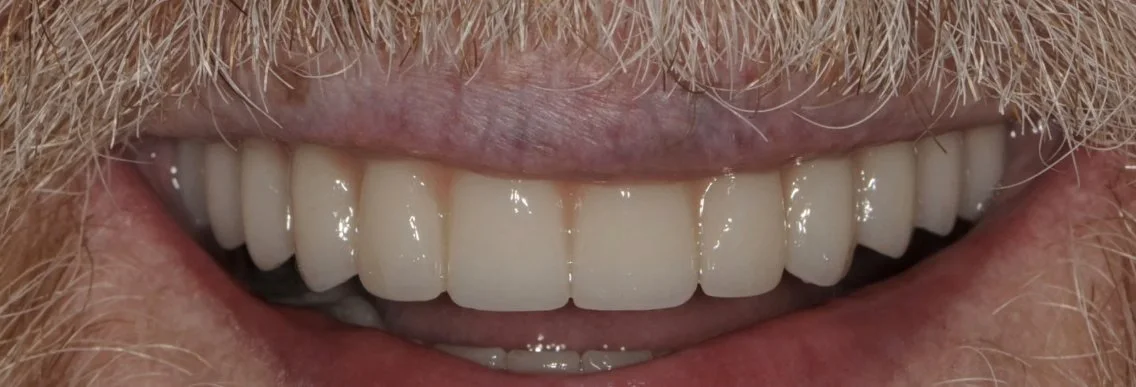
Types of dentures
Types of dentures, and who each one may suit.
Dentures are removable or fixed replacement teeth. Complete dentures, also called full dentures, replace all the teeth in a jaw; partial dentures fill gaps when some natural teeth remain; immediate dentures go in the day teeth are removed; snap-on implant dentures click onto implants; and fixed full-arch teeth are attached to implants and stay in. We make all five.
Dentures vs implants
Dentures, snap-on dentures, or fixed teeth: which fits you?
Regular dentures cost the least and need no surgery, but they rest on the gums and can move, especially on the bottom. Snap-on implant dentures add a few implants for much better stability. Fixed full-arch teeth stay attached to implants and are the closest to natural teeth in daily use, but they need more implants, enough bone, and the largest investment; the details depend on your case. The right choice depends on your bone, your health, and what bothers you most.
| Factor | Regular dentures | Snap-on implant dentures | Fixed full-arch (All-on-X) |
|---|---|---|---|
| Surgery | ✓ None beyond any extractions | Two or more implants | Several implants per jaw |
| Stability when eating | Can move, especially lower dentures | ✓ Much steadier | ✓ Fixed to implants; needs ongoing maintenance |
| Covers the palate | Upper: yes | Upper: often less | ✓ No |
| Removable | Yes | Yes, by you | No, only by the dentist |
| Denture adhesive | Sometimes needed | ✓ Usually not | ✓ Never |
| Jawbone | ✗ Bone keeps shrinking | Implants help preserve bone where they sit | Implants help preserve bone where they sit |
| Upkeep | Relines as the gums change | Attachment parts replaced over time | Professional cleanings around the implants |
| Relative cost | Lowest | Middle | Highest |
An implant can also replace a single missing tooth or anchor a bridge; see dental implants and dental crowns and bridges.
Immediate (same-day) dentures
Immediate dentures: teeth out and new teeth in, the same day.
An immediate denture is made before your remaining teeth are removed and placed right after the extractions, so you leave with teeth. That is what most people mean by same-day dentures: the denture is made in advance, not in a single visit. Because the gums and bone shrink as they heal, an immediate denture needs adjustments and relines over the following months, and it is usually relined or remade once healing settles.
Before extraction day
Records and planning
Impressions or a digital scan, bite records, and tooth selection, so the local lab can make your denture in advance.
Day 0
Extractions and placement
The teeth are removed and the denture goes in. It acts like a bandage; we’ll tell you exactly when to take it out the first time.
First days to weeks
Adjustments
Sore spots are adjusted as the gums heal. A soft reline may be added to keep the fit snug.
After healing settles
Reline or new denture
Once the ridge stabilizes, usually a matter of months, the denture is relined or a new one is made. Your schedule depends on your healing and your health.
Worried about the extractions? We offer nitrous oxide and minimal oral sedation for anxious adults when appropriate.
Partial dentures
Partial dentures: flexible or metal-framework.
A partial denture replaces some teeth and clips to the natural teeth that remain. We make flexible, metal-free partials that blend with the gums and metal-framework partials that are thinner, stronger, and easier to repair or add to. Keeping your remaining teeth healthy is part of the plan, because they hold the partial.
Flexible vs metal partial dentures
- Flexible (metal-free): no metal clasps, and often comfortable; suitability depends on your remaining teeth and bite.
- Metal-framework: a cast metal base that is thin and rigid and rests firmly on the teeth; depending on the design, teeth can often be added later.
- Alternatives: a fixed dental bridge or implants may suit a short gap better. We go through all of them.
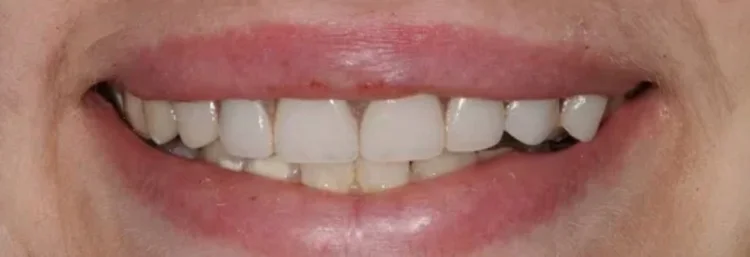
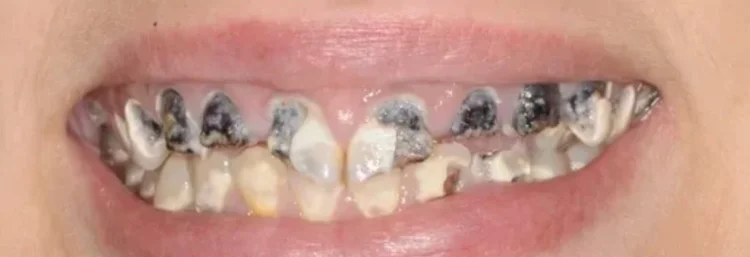
Ready for the Navy: a flexible partial on a budget
Decay was keeping this patient from enlisting. In about four visits, teeth that couldn’t be saved were removed, the rest were rebuilt, and a flexible partial denture replaced the missing teeth. She has since completed boot camp.
Implant dentures in Jacksonville
Implant dentures: snap-on dentures and fixed full-arch teeth.
Implant dentures use dental implants placed in the jawbone to hold the teeth steady. Snap-on dentures, also called snap-in dentures, click onto implants and come out for cleaning; two implants can hold a lower denture, while an upper usually needs more. Fixed full-arch teeth, often called All-on-X or hybrid dentures, attach to several implants and stay in. Dr. Henley places and restores the implants himself, and he plans each case with 3D imaging.
Snap-on dentures (implant overdentures)
A lower denture is the hardest to wear because nothing holds it but the tongue and cheeks. A 2002 international consensus statement concluded that a lower denture held by two implants should be the first-choice standard for people with no lower teeth2. The attachments wear and are replaced over time, which is routine upkeep.
Fixed full-arch teeth (All-on-X)
Several implants support a full arch of teeth that is screwed in place. There is no plate over the palate and no adhesive. Some people search for these as “permanent dentures”; they are fixed, not permanent, and they still need professional care and eventual replacement of parts.
Who is a candidate?
Enough healthy bone, or bone that can be grafted, and health that allows minor surgery. Smoking, uncontrolled diabetes, head and neck radiation, and bone medications change the risks and are reviewed before we plan. We use 3D cone beam (CBCT) imaging when it is needed for proper planning.
Bone grafting and mini implants
When the jawbone is thin, grafting can rebuild it before or during implant placement. We use standard-size implants and do not place mini implants.
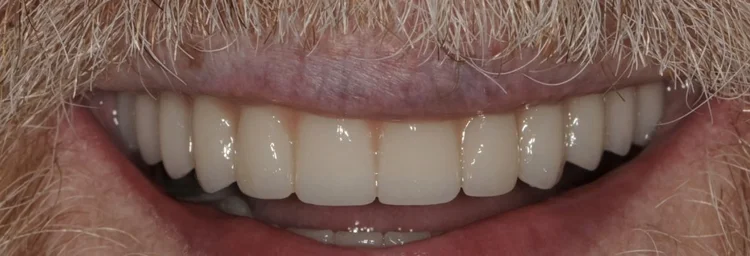
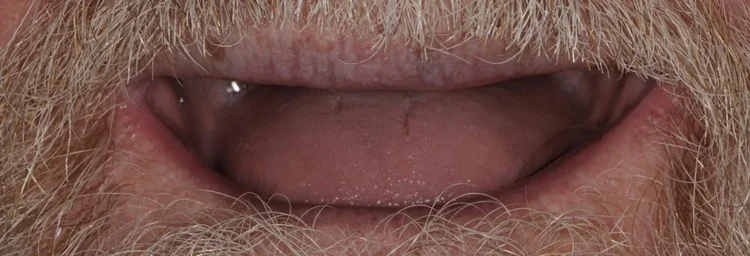
All-on-X fixed full-arch teeth with zirconia hybrids
This patient had no upper teeth. Six implants were placed in each jaw, guided by 3D cone beam planning and a surgical guide, to support fixed full-zirconia hybrid bridges. There is no adhesive and no plate over the palate, and the teeth don’t move when he eats.
The denture process
How your dentures are made, step by step.
New dentures usually take several visits: an exam, records, a bite and tooth try-in, and delivery, followed by adjustment visits. Each step lets you see and approve the teeth before the denture is finished by our local dental laboratory. Dr. Henley sees you at every visit.
Exam and plan
Medical history, X-rays, and a look at which teeth can be saved. 3D imaging when implants or a closer diagnosis call for it.
Impressions or digital scan
We record your mouth with traditional impressions or a 3Shape TRIOS scan, whichever suits the case.
Bite and tooth selection
We record how your jaws meet and choose tooth shape, size, and shade with you, including what makes dentures look natural rather than too big or too white.
Try-in
When the case allows, you see and feel the teeth set in wax before the denture is finished, and we change what you don’t like. Immediate dentures may not allow a full try-in before extractions.
Delivery and adjustments
The finished denture is fitted, sore spots are adjusted, and we check it again over the following weeks.
Why dentures get loose
Why dentures loosen: bone loss, dry mouth, and sore spots.
After teeth are removed, the jawbone under the gums slowly shrinks, and a denture resting on it gradually loses its fit. That bone loss, along with dry mouth and changes in the gums, is why dentures loosen and why they need relines. Needing more and more adhesive is a sign the fit has changed; an exam shows whether an adjustment, reline, or new denture is the answer.
Bone loss under dentures
Bone needs the pressure of tooth roots to stay full. Dentures sit on top and don’t replace that, so the ridge keeps changing for years, fastest after extractions. Implants load the bone where they are placed, which is one reason implant dentures stay steadier.
Weight changes
Some patients notice looser dentures after losing weight, including on GLP-1 medications. The evidence that weight loss itself changes denture fit is limited; ridge changes and dry mouth are more common causes. Either way, a fit check beats extra adhesive. See GLP-1 medications and your teeth.
Sore spots that don’t heal
A denture sore usually heals within days of an adjustment. Any sore, lump, or red or white patch that lasts more than two weeks needs to be examined3, whether or not you wear dentures. Yearly exams include an oral cancer screening, even with no natural teeth.
Bony bumps (tori)
A bony bump on the palate or under the tongue can keep a denture from seating. Most tori are harmless; sometimes one has to be reduced first. Read about torus palatinus.
Denture relines and repairs in Jacksonville
Denture relines, adjustments, and repairs.
A reline reshapes the fitting surface of your denture to match your gums as they change. Most dentures need a reline every one to two years, and sooner if the fit changes1. We do relines in our office, and denture repairs are handled in the office or at the lab, depending on the break.
- Soft reline: a cushioned lining, often used while gums heal after extractions or for tender tissue.
- Hard reline: a durable acrylic lining that restores a snug fit for the long term.
- Adjustments: small changes to relieve sore spots or improve the bite.
- Denture repair: cracked bases, broken or lost teeth, and broken clasps. Simple repairs can be quick; complex ones go to the lab.
- When to replace instead: worn-down teeth, repeated breaks, or a bite that has collapsed usually mean a new denture is the better value.
Broken a denture and in pain? Call 904.398.1549 or see emergency dental care.
Dentures and dry mouth
Dentures and dry mouth: why fit and comfort suffer, and what helps.
A thin film of saliva helps an upper denture seal and cushions the gums. When the mouth is dry, dentures can feel loose, rub, and cause sore spots, and dry mouth raises the risk of oral fungal infections4. Hundreds of medicines, diabetes, and radiation to the head and neck can all reduce saliva. Treating the dry mouth and adjusting the denture together works better than either alone.
Do
- Sip water through the day and use saliva substitutes we recommend.
- Take dentures out at night and clean them daily.
- Tell us every medication you take; many cause dry mouth.
- Come in when a denture starts rubbing, before a sore forms.
Avoid
- Layering on more adhesive to fix a loose fit.
- Alcohol-based mouthwashes, which dry the mouth further.
- Sleeping in dentures every night.
- Ignoring a burning or red palate under the denture, which can be a fungal infection.
Read about dry mouth treatment and dry mouth caused by diabetes. When suction alone can’t hold an upper denture in a dry mouth, implant support is worth discussing.
Complex medical histories
Dentures after radiation, on blood thinners, or on bone medications.
Extractions, denture sores, and implants carry different risks for people treated with head and neck radiation or bone-strengthening medications, and healing can be slower with diabetes. Dr. Henley serves on the Head & Neck Tumor Board at Baptist MD Anderson and plans these cases individually, with your physicians.
After head and neck radiation
Radiation involving the jaws can impair healing, so extractions and implants are weighed carefully and denture sore spots are treated promptly. Limited mouth opening can make impressions harder; we plan around it. See head and neck cancer dental care and radiation-induced trismus.
Bone medications
Bisphosphonates and denosumab can rarely lead to jawbone injury after extractions or from a rubbing denture; the risk depends on the drug, dose, and duration. Have a sore denture adjusted promptly5. See osteoporosis medications and your dental health.
Blood thinners and diabetes
Many extractions can be done without stopping blood thinners, but several extractions at once need an individual bleeding-risk plan. Never change a blood thinner yourself; any change is your prescribing physician’s decision. Diabetes control affects healing and implant planning.
Coordinated care
We write consult and clearance letters to your medical team. Read about our complex and medically involved care.
Getting used to dentures in Jacksonville
Getting used to new dentures: eating, speaking, and cleaning.
New dentures take weeks, sometimes months, to feel normal1. Start with soft foods cut into small pieces, chew on both sides, and read aloud to retrain your speech. Most people sleep without their dentures to rest the gums, and clean them every day.
Eating
Begin with soft foods, then add firmer ones. With complete dentures, chew slowly on both sides at once to keep the denture stable. Very sticky or hard foods are harder with regular dentures than with implant dentures.
Speaking
Some words may whistle or sound different at first. Reading aloud helps your tongue and lips adapt within days to weeks. Clicking usually means a fit or bite issue worth checking.
Cleaning
Brush removable dentures daily with a soft denture brush and a non-abrasive cleaner, soak them as directed, and rinse before wearing. Fixed full-arch teeth are cleaned in place, including underneath, with tools we show you. Brush your gums, tongue, and any natural teeth too.
Denture adhesive
A well-fitting denture shouldn’t need much adhesive. If you need more and more, the fit has changed and it is time for a reline or adjustment.
Cost and insurance
What do dentures cost in Jacksonville?
The cost of dentures depends on the type, whether extractions are needed first, the materials, and whether implants are part of the plan. Regular dentures cost the least, snap-on implant dentures more, and fixed full-arch teeth the most. We give you the fee before anything is made.
We are an out-of-network practice. Some dental plans cover part of dentures, subject to the plan’s replacement limits. Original Medicare doesn’t cover dentures6, though some Medicare Advantage plans include dental insurance benefits. We can help you understand how to use your benefits; you are responsible for amounts your plan does not pay. Call our team with your plan details to ask about fees and payment arrangements. We don’t offer third-party financing; in select cases we can arrange an in-office payment plan. If you are planning around retirement, see dental insurance after retirement.
Why patients choose our office
Why patients across Jacksonville choose Dr. Henley for dentures.
The same dentist from the first exam through extractions, implants, delivery, and relines; every type of denture under one roof; and real experience with dry mouth, cancer survivors, and complex medical histories. We see patients from age 2 to 102, and we refer when a case is better handled elsewhere.
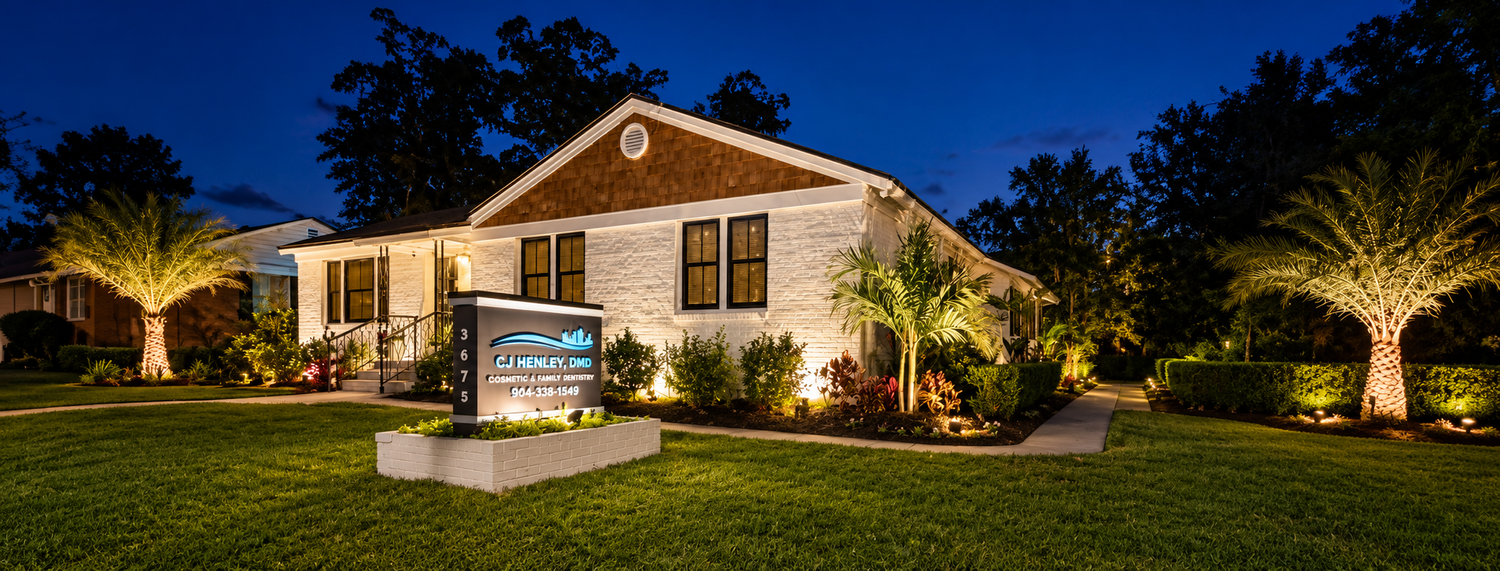
Denture dentist near you
Dentures in San Marco, for all of Jacksonville.
Dr. CJ Henley is a general dentist in Jacksonville whose practice centers on restorative and cosmetic dentistry, dental implants, and care for medically complex patients. He earned his DMD at the University of Florida.
Our office on Hendricks Avenue is easy to reach from San Marco, Southbank, San Jose, Riverside, Avondale, Ortega, St. Nicholas, Downtown, and Mandarin, with plenty of parking. Patients with complex medical histories, including head and neck cancer survivors, are welcome; read about our complex and medically involved care.
See what patients say in our reviews, or learn more about our San Marco dental office.
San Marco
On Hendricks Avenue, in the neighborhood
Quick denture adjustments without a long drive.
Downtown and Southbank
Southbank borders us; Downtown is across the Main Street Bridge
Easy to fit fitting visits around a workday.
Riverside, Avondale, and Ortega
Across the St. Johns River on the Fuller Warren Bridge
A short trip over the river; see our Riverside and Avondale dentist page.
San Jose and Mandarin
North on San Jose Boulevard, which becomes Hendricks Avenue
One road to our door; see our Mandarin dentist page.
Southside and Baymeadows
North on I-95 from Baymeadows Road
Implant dentures and relines; see our Southside dentist page.
Jax Beach, Neptune Beach, and Atlantic Beach
West on Atlantic Boulevard or Beach Boulevard
Dentures for Jacksonville Beach patients; see our Jacksonville Beach dentist page.
Ponte Vedra and Nocatee
West on J. Turner Butler Boulevard, then north on I-95
Fixed full-arch planning; see our Ponte Vedra dentist page.
Orange Park, Fleming Island, and St. Augustine
North on US-17 or I-95
Visits planned ahead; see our Orange Park and St. Augustine pages.
Frequently asked questions
Questions about dentures and implant dentures.
Is it better to get dentures or implants?
It depends on your bone, your health, and your goals. Regular dentures need no surgery and cost the least but can move. Implant dentures are far steadier and help preserve bone where the implants sit, but need surgery and healthy bone. Many people choose a middle path: a snap-on denture on two or more implants.
What is the difference between snap-on dentures and All-on-X?
Snap-on dentures click onto two or more implants and you remove them to clean. All-on-X fixed full-arch teeth attach to several implants and stay in; only the dentist removes them. Fixed teeth feel more like natural teeth and need more implants and more bone.
What are “permanent dentures”?
“Permanent dentures” is the search phrase many people use for fixed full-arch teeth on implants. They are fixed, not permanent. They don’t come out at home, but they still need professional cleanings, and parts wear and are replaced over the years.
Can I get dentures the same day my teeth are pulled?
Yes, with immediate dentures. They are made before the extractions and placed right after, so you leave with teeth. Because the gums shrink as they heal, they need adjustments and relines, and usually a reline or new denture once healing settles.
Do I have to lose all my teeth to get dentures?
No. A partial denture replaces only the missing teeth and clips to the ones that remain. We keep every natural tooth that can be kept healthy.
Can I get dentures with bone loss?
Usually, yes. Regular dentures can be made on a shrunken ridge, though they may be less stable. For implant dentures, 3D imaging shows how much bone is available, and grafting can sometimes rebuild it.
How long do dentures last?
Removable dentures last about seven to ten years on average, with a reline every one to two years or whenever the fit changes. Fixed full-arch teeth have different maintenance needs. The teeth wear down over time and the fit changes, so dentures don’t last forever.
How long does it take to get used to dentures?
A few weeks for most people, sometimes a few months. Eating and speaking improve with practice. Sore spots should be adjusted rather than endured.
Can I sleep in my dentures?
We recommend taking removable dentures out at night, unless we tell you otherwise right after extractions. Fixed full-arch teeth stay in. Giving the gums several hours a day without dentures lowers the risk of sore spots and fungal infection under the denture.
Why are my dentures loose?
Most often, the bone and gums under the denture have changed. Dry mouth, worn teeth, and sometimes weight changes also play a part. A reline or new denture fixes the cause; more adhesive only hides it.
Can dentures cause dry mouth?
Dentures don’t usually cause dry mouth, but dry mouth makes dentures harder to wear: less suction, more rubbing, and more fungal infections. Medications are the most common cause. We treat both the dryness and the fit.
Can I get dentures after radiation for head and neck cancer?
Often, yes, with careful planning. Irradiated tissue heals slowly, so timing, fit, and sore spots matter more, and implants are decided case by case with your cancer team. Dr. Henley treats many head and neck cancer survivors.
Do you repair dentures?
Yes. Depending on the break, we repair dentures in the office or send them to our lab. We also reline dentures in the office.
Do you offer mini implants for dentures?
No. We use standard-size dental implants for snap-on and fixed implant dentures.
Does Medicare cover dentures?
Original Medicare doesn’t cover dentures. Some Medicare Advantage plans include dental benefits; check your plan. We are an out-of-network practice and can help you understand how to use your benefits. Call our team with your plan details to ask about fees before scheduling.
Does dental insurance cover dentures?
Many dental plans cover part of dentures, often with limits on how frequently they will pay. We are an out-of-network practice and can help you understand how to use your benefits. Call our team with your plan details to ask about fees before scheduling.
Where can I get dentures in Jacksonville?
CJ Henley, DMD, PA makes complete, partial, immediate, snap-on, and fixed full-arch dentures at 3675 Hendricks Avenue, Jacksonville, FL 32207, in San Marco. Call 904.398.1549 or request an appointment online. Bring your current denture and a list of your medications.
More reading: Dental implants · Dry mouth · Dental FAQ
Your next step
Find out which dentures fit your life.
Whether you are facing your first denture, struggling with a loose one, or ready to ask about implant dentures, start with an exam. You’ll see your X-rays, hear every option, and get the fee before anything is made. If a denture has broken or a tooth is causing pain, see emergency dental care.
CJ Henley, DMD, PA3675 Hendricks Avenue
Jacksonville, FL 32207
Prefer a nonurgent text? 904.762.5616 is our practice on-call and text line. Please don’t send sensitive health information by text, and call for anything urgent.
Related pages
Sources
- Cleveland Clinic. Dentures: types, care and benefits. Accessed October 2026.
- Feine JS, Carlsson GE, Awad MA, et al. The McGill consensus statement on overdentures. Mandibular two-implant overdentures as first choice standard of care for edentulous patients. Int J Oral Maxillofac Implants. 2002;17(4):601-602.
- National Institute of Dental and Craniofacial Research. Oral cancer. Accessed October 2026.
- National Institute of Dental and Craniofacial Research. Dry mouth and Dry mouth: questions and answers. Accessed October 2026.
- American Dental Association. Antiresorptive agents (osteoporosis medications). Accessed October 2026.
- Medicare.gov. What’s not covered by Original Medicare. Accessed October 2026.