
Black Hairy Tongue (Lingua Villosa Nigra)
Black hairy tongue is exactly what it sounds like: the top of your tongue turns dark and looks fuzzy, almost like a short carpet. It's alarming to see in the mirror. It's also harmless, it isn't contagious, and it nearly always clears up once you start brushing or scraping your tongue every day.
Black hairy tongue is a harmless condition where the tiny bumps on top of the tongue grow long and trap stains, bacteria, and debris, so the tongue looks dark and furry. It's not contagious and not dangerous. Daily tongue brushing or scraping usually clears it in days to weeks. See a dentist if it hasn't improved after 2 weeks, or for any flat dark spot that won't brush off.
Not sure this is what you have? Answer five quick questions in our mouth spot checker. It compares what you see with more than 40 common conditions and tells you how soon to have it looked at.
- What black hairy tongue looks like
- Why the tongue looks hairy
- Black in the back, on the sides, or underneath
- Black tongue after Pepto-Bismol
- Black hairy tongue vs. look-alikes
- What causes black hairy tongue?
- Why is my tongue black in the morning?
- Symptoms
- How long it lasts
- How to get rid of black hairy tongue
- Over-the-counter options
- Black hairy tongue treatment at the dentist
- Keeping it from coming back
- Kids, hospital stays, and cancer treatment
- When to see a dentist
- FAQ
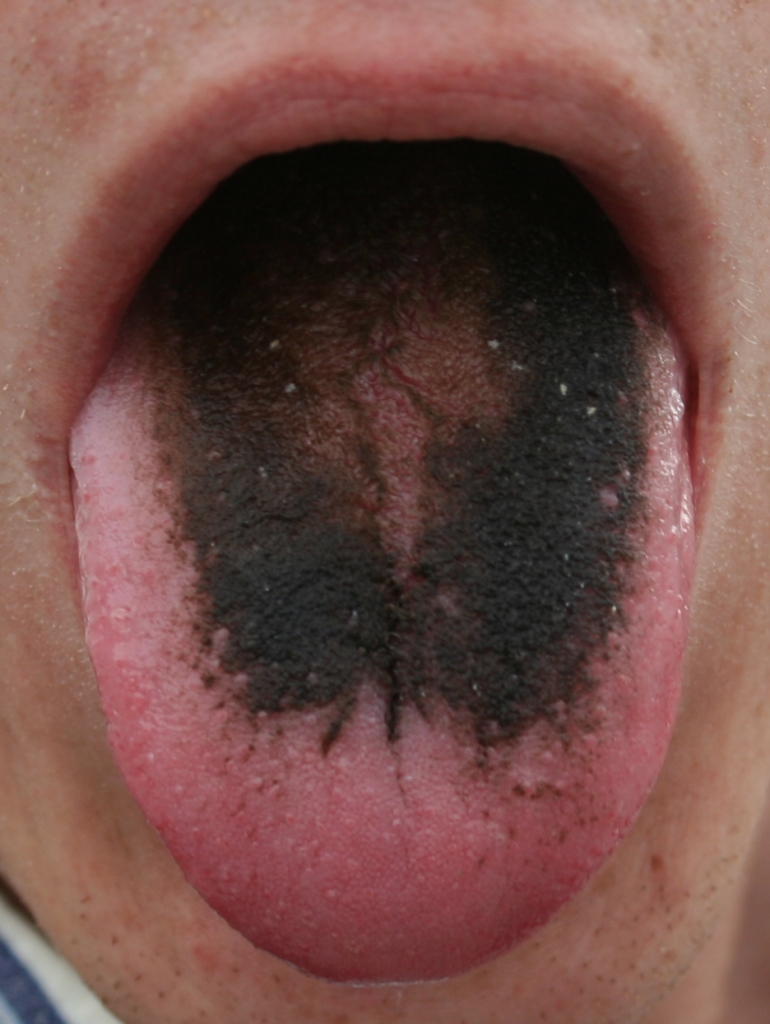
What black hairy tongue looks like
Most people spot it while brushing their teeth or checking their throat in the mirror. Typical features:
- A dark patch on the top of the tongue, usually starting toward the back and spreading forward along the middle.
- A furry or hairy texture. Up close it looks like short fibers all lying in the same direction.
- Color that isn't always black. It can be brown, yellow, green, or even light-colored. Doctors still call it "black hairy tongue" or just "hairy tongue."
- The tip and the sides of the tongue usually stay pink.
It usually doesn't hurt. The most common complaint is simply the way it looks, followed by bad breath or a strange taste.
Why the tongue looks hairy
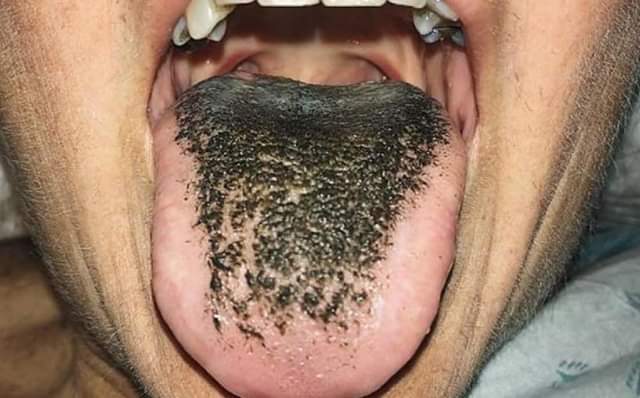
The top of your tongue is covered with thousands of tiny, cone-shaped bumps called filiform papillae. They're normally less than 1 mm long. Like skin, their surface layer keeps growing and wears off, helped along by chewing, eating rough foods, and saliva washing over them.
When that shedding slows down, the papillae keep growing. They can get many times longer than normal and start to look like hair. Those long strands catch everything that passes through your mouth: coffee, tea, tobacco, food pigments, and bacteria and yeast that produce dark colors of their own. That's where the color comes from.
This is why brushing works. You aren't treating a disease. You're helping the tongue shed the extra length it would normally lose on its own.
Why is my tongue black in the back, on the sides, or underneath?
Where the color shows up says a lot about what it is.
- In the back and middle of the top. This is the classic spot for black hairy tongue. It usually starts just in front of the V-shaped row of large bumps near the back of the tongue, where the tongue moves least against the roof of the mouth, and spreads forward.
- On the sides. Hairy tongue rarely reaches the edges. A dark color along the sides is more often a stain, and a single dark spot that doesn't brush off should be looked at. The sides of the tongue are also where we pay closest attention during an oral cancer screening.
- Underneath. The underside of the tongue has no hair-like papillae, so it can't get "hairy." Purple, blue, or black lines under the tongue are often just veins, which become more visible with age. A new flat dark spot there is worth a check.
Why is my tongue black after Pepto-Bismol?
If your tongue turned black within hours of taking Pepto-Bismol, Kaopectate, or a store-brand version, the bismuth in it is almost certainly why. Bismuth subsalicylate reacts with tiny amounts of sulfur in your saliva and forms a black compound that coats the tongue. It can darken your stool too. The label mentions both.
This isn't the same thing as black hairy tongue. The papillae aren't overgrown, and the surface stays smooth rather than furry. It's harmless, and the color usually fades within a day or a few days after the last dose. Brushing your tongue speeds it up.
A few cautions about the medicine itself:
- Bismuth subsalicylate contains a salicylate, a relative of aspirin. The label warns not to give it to children or teens who have or are recovering from chickenpox or flu-like symptoms because of the risk of Reye's syndrome. Regular-strength products are labeled for ages 12 and up.
- If you're pregnant or breastfeeding, ask your physician or pharmacist before taking it.
- Black stool when you haven't taken bismuth or iron, or a black tongue together with vomit that looks like coffee grounds, can mean bleeding in the stomach. That needs medical care the same day.
Black hairy tongue vs. other dark or coated tongues
Most dark tongues are either hairy tongue or a stain. The question that matters most is whether the color sits on the surface and brushes away, or sits in the tissue and doesn't.
| Black hairy tongue | Bismuth (Pepto-Bismol) stain | Food, drink, or tobacco stain | Pigmented spot | |
|---|---|---|---|---|
| Looks like | Dark, furry patch on the middle and back of the top | Black coating, often the whole top of the tongue | Brown, black, blue, or other color matching what you had | Flat brown, blue, or black spot with a defined edge |
| Texture | Hairy or carpet-like | Smooth | Smooth | Smooth, part of the tissue |
| Comes on | Gradually, over days to weeks | Within hours of a dose | Right after eating, drinking, or smoking | Slowly, or present for years |
| Brushes off? | Lightens with days of brushing or scraping | Fades in a day or a few days after stopping | Yes, mostly right away | No |
| What to do | Daily tongue cleaning; fix the trigger | Nothing. It goes away. | Brush and rinse | Have it examined. Most are harmless, but a biopsy is the only way to be sure. |
Flat dark spots in the mouth have many harmless causes, like freckle-type spots, amalgam filling particles, and certain medicines. Rarely, a dark spot is an oral melanoma. Our page on dark spots in the mouth walks through them. The key difference from black hairy tongue is texture: a melanoma isn't furry, and brushing does nothing to it.
Black hairy tongue vs. white tongue, thrush, and hairy leukoplakia
| Black hairy tongue | White tongue coating | Oral thrush | Oral hairy leukoplakia | |
|---|---|---|---|---|
| Color | Black, brown, yellow, or green | White to off-white | Creamy white patches | White |
| Where | Middle and back of the top | Top of the tongue, thickest in back | Tongue, cheeks, palate, throat | Sides of the tongue |
| Texture | Long, hair-like strands | Thin film | Cottage-cheese plaques | Ridged or corrugated, sometimes with hair-like folds |
| Wipes or brushes off? | Gradually, with daily cleaning | Yes | Yes, leaving a red, sore spot | No |
| Cause | Papillae not shedding, plus stains | Debris trapped on normal papillae | Candida yeast overgrowth | Epstein-Barr virus, usually with a weakened immune system |
A white tongue and black hairy tongue are really two ends of the same spectrum. Both come from debris building up on the papillae, and both respond to tongue cleaning. Oral thrush is an infection that needs antifungal medicine. Hairy leukoplakia, despite the similar name, is a different condition that's tied to immune problems, and it's covered on our page about HIV and the mouth.
What causes black hairy tongue?
Nobody has pinned down a single cause. Black hairy tongue happens when something slows the normal shedding of the papillae, something else adds color, or both. Common black hairy tongue causes include:
- Smoking and other tobacco. This is one of the strongest links. Tobacco both stains the papillae and seems to encourage them to overgrow.
- Lots of coffee or black tea. These are classic stains, especially in people who sip all day.
- Antibiotics. Black tongue from antibiotics has been reported with many kinds, including penicillins, doxycycline, erythromycin, and linezolid. They shift the normal balance of bacteria and yeast in the mouth. It typically shows up during or after a course and clears with brushing once the course is done.
- Dry mouth. Saliva washes the tongue. Less saliva means more buildup. Many medicines dry the mouth, including some antipsychotics (olanzapine has been reported), antidepressants, and antihistamines.
- Not cleaning the tongue. Brushing the teeth alone leaves the tongue untouched.
- A soft diet, or not eating by mouth. Crunchy, fibrous foods naturally rub the tongue clean. People on liquid diets, feeding tubes, or very soft foods lose that scrubbing.
- Long-term use of oxidizing mouthwashes with hydrogen peroxide. Short-term peroxide rinses can help clear hairy tongue, but daily use for weeks or months is itself linked to it.
- Illness, hospital stays, and radiation to the head and neck, where mouth care tends to slip and saliva drops.
Men get it more often than women, and it becomes more common with age. It's uncommon in children.
Why is my tongue black in the morning?
Saliva flow drops a lot while you sleep, and many people breathe through their mouths at night. Debris builds up on the tongue overnight, so a mild hairy tongue tends to look worst when you first wake up and better after breakfast and brushing.
If your tongue went from pink to black overnight, think about what you took the evening before. A true hairy tongue builds up over days to weeks. A tongue that's suddenly black in the morning is usually a stain, and bismuth (Pepto-Bismol) taken the night before is the most common culprit. Activated charcoal, black licorice, dark berries, and some liquid medicines can do it too.
Black hairy tongue symptoms
Many people have no symptoms other than the color. When there are symptoms, they're usually mild:
- A furry or thick feeling on the tongue
- Bad breath
- A metallic or off taste, or food tasting different
- A tickling or gagging feeling if the strands are long enough to touch the roof of the mouth
- Occasionally a burning feeling, which can mean yeast is involved too
Real pain, sores, bleeding, or a lump isn't part of black hairy tongue. Those need a look. Ongoing burning without any visible change may be burning mouth syndrome, which is a separate problem.
How long does black hairy tongue last?
With daily brushing or scraping and the trigger removed, most people see a clear change within a few days and a normal-looking tongue within a few weeks. Antibiotic-related hairy tongue usually clears after the course ends. Bismuth staining is faster still, often a day or two.
Does black hairy tongue go away on its own? Sometimes, if the trigger goes away, like a finished antibiotic or a return to normal eating. If the cause is ongoing, such as smoking or dry mouth, it tends to stick around or come back until you add tongue cleaning to your routine. If you've cleaned your tongue faithfully for 2 weeks and see no improvement, come see us.
How to get rid of black hairy tongue at home
This is the part that does the real work. Black hairy tongue treatment starts with mechanically cleaning the tongue so the overgrown papillae can shed.
Daily routine
- Clean your tongue twice a day. Use a soft toothbrush or a tongue scraper after brushing your teeth. Work from back to front, with light pressure. If it bleeds or hurts, you're pressing too hard.
- Use a little baking soda on the brush a few times a week if you like. It's mildly abrasive and helps with odor.
- Rinse well with water afterward, and rinse the scraper or brush under the tap.
- Drink water through the day, especially if your mouth runs dry. Sip water after coffee or tea.
- Cut back on the trigger. Smoking is the big one. Less coffee and tea, or rinsing after them, helps too.
- Eat some crunchy, fibrous foods if you can, like raw carrots, apples, and celery. They help scrub the tongue naturally.
- Don't stop a prescribed medicine on your own. If you think a drug is involved, talk with the doctor who prescribed it. Usually tongue cleaning alone is enough.
What about hydrogen peroxide?
- Short-term, diluted rinses can help. Mix drugstore 3% hydrogen peroxide half and half with water, swish for about 30 seconds, and spit. Don't swallow it.
- Don't make it a daily habit. Using peroxide mouthwash every day for weeks is one of the things linked to causing hairy tongue in the first place. A few days to a week alongside brushing is enough.
- Skip it for young children who can't reliably spit.
Over-the-counter options for hairy tongue
You don't need anything fancy. Hairy tongue treatment at home is mostly a matter of tools and habits.
| Product | What it does | Things to know |
|---|---|---|
| Tongue scraper (metal or plastic) | Removes the coating and helps the papillae shed | Inexpensive. Rinse after each use. Light pressure only. |
| Soft toothbrush | Same job as a scraper | Works fine if a scraper makes you gag. Use the toothbrush you already have. |
| Baking soda | Mild scrub and odor control | A pinch on the brush. Don't swallow large amounts. |
| Hydrogen peroxide, diluted to about 1.5% | Loosens debris and lightens stain | Short-term only. Swish and spit. Not for young children. |
| Alcohol-free mouthwash | Freshens breath | Alcohol can dry the mouth further, so choose alcohol-free. |
| Dry mouth products (saliva substitutes, xylitol gum or mints) | Keep the mouth moist so the tongue stays cleaner | Helpful if medicines or mouth breathing dry you out. See our dry mouth page. |
Skip "tongue whitening" gimmicks and essential-oil concoctions. Plain mechanical cleaning is what the medical literature supports. Our home care instructions cover brushing and tongue cleaning basics.
Black hairy tongue treatment: what a dentist can do
Most people clear this up on their own. It's worth a visit when it isn't improving, keeps coming back, or you're not sure it's hairy tongue at all.
- Confirm what it is. We look at the color, the texture, and exactly where it sits, and rule out stains, thrush, and pigmented spots. It's usually obvious on exam.
- Clean it. We can gently debride the tongue during a visit and show you a scraping technique that doesn't trigger your gag reflex.
- Find the driver. We'll go over your medicines, smoking, diet, and dry mouth. If a medicine looks like a factor, we coordinate with the prescribing physician rather than having you stop it.
- Treat dry mouth. Saliva substitutes, practical changes, and prescription-strength fluoride to protect the teeth if your mouth stays dry.
- Treat yeast with a prescription antifungal if burning or a white overlay suggests Candida is part of the picture.
- Check a spot that doesn't fit. A dark area that's flat, doesn't brush off, or has changed gets a closer look. We can biopsy it or refer you for one. Our oral medicine and diagnosis visits are set up for exactly this kind of question.
- Refer for stubborn cases. Rarely, overgrown papillae need to be trimmed by a specialist. We'd refer you if it ever came to that.
A routine dental exam is also a good time to mention it, even if it doesn't bother you.
Keeping black hairy tongue from coming back
- Clean your tongue every day, not just when it looks bad.
- Quit or cut down on tobacco. It's the most common reason hairy tongue keeps returning.
- Rinse with water after coffee or tea.
- Stay hydrated and manage dry mouth.
- Clean the tongue extra carefully during and after antibiotics.
- Don't use peroxide mouthwash long term.
- Keep dentures clean and out overnight, if you wear them. See our dentures page for care tips.
- Keep up regular cleanings so we can spot changes early.
Black tongue in babies and kids, hospital stays, and cancer treatment
Babies and children
True black hairy tongue is uncommon in children, though it has been reported in kids after antibiotics. In a baby, a white tongue is usually milk residue or thrush. A dark tongue in a baby or toddler is far more often a stain from a dark liquid medicine, food, or drink. A dark spot that's been there since birth, or one that doesn't brush away, should be checked by your pediatrician or dentist. Don't give Pepto-Bismol or other bismuth subsalicylate products to children unless their doctor says to.
Older adults, hospital stays, and tube feeding
People who are sick, bedbound, eating very soft foods, or fed by tube are much more likely to develop hairy tongue. They don't chew much, their saliva is often low, and mouth care tends to slip. Gentle daily tongue cleaning by a caregiver makes a real difference. We care for many medically complex patients. Read more about our care for medically involved patients.
Chemotherapy and radiation
Radiation to the head and neck can permanently reduce saliva, and treatment often brings antibiotics, soft diets, and mouth sores that make cleaning hard. All of that sets the stage for hairy tongue. Clean gently with a soft brush, and tell your care team if your tongue is sore or bleeds. Our head and neck cancer dental care page explains how we support patients before, during, and after treatment.
Weakened immune system
People with a weakened immune system are more prone to hairy tongue and to thrush. Because thrush and hairy leukoplakia can look similar at a glance, it's worth having a new tongue change checked rather than guessing.
When to see a dentist about a black tongue
Make an appointment if:
- It hasn't improved after 2 weeks of daily tongue brushing or scraping
- It keeps coming back and you can't find the trigger
- Your tongue burns, or you also see white patches that wipe off
- It's bothering you because of gagging, taste changes, or bad breath
- You notice a flat dark spot that doesn't brush off, especially on the sides or underneath
- You'd simply like it confirmed
Get care today if:
- A dark or discolored area is growing, raised, bleeding, or sore, or there's a lump or ulcer that won't heal
- You have black stool and haven't taken bismuth or iron, or vomit that looks like coffee grounds (go to urgent care or the ER)
- Your tongue or throat is swelling, or you're having trouble swallowing or breathing (call 911)
- You're on chemotherapy or have a weakened immune system and develop fever or painful mouth changes
Black hairy tongue FAQ
What causes black hairy tongue?
Black hairy tongue happens when the tiny papillae on top of the tongue stop shedding normally and grow long enough to trap stains, bacteria, and yeast. The most common triggers are smoking, heavy coffee or tea, antibiotics, dry mouth, a soft diet, and not cleaning the tongue. Long-term peroxide mouthwash use is also linked to it.
Is black hairy tongue serious?
No. Black hairy tongue is harmless and fully reversible. It isn't cancer and doesn't turn into cancer. The only reason to have it checked is to make sure it really is hairy tongue and not a flat pigmented spot, which looks and feels different.
Is black hairy tongue contagious?
No. You can't catch black hairy tongue from kissing or sharing drinks, and you can't give it to anyone. It comes from changes on your own tongue, not from an infection you pass along.
How do you get rid of black tongue?
Brush or scrape your tongue gently, back to front, once or twice a day, and cut back on whatever is staining it, like tobacco, coffee, or tea. Drink plenty of water. Most people see a clear difference in a few days. If it's from Pepto-Bismol, it fades on its own within a day or a few days after you stop taking it.
Can Pepto-Bismol turn your tongue black?
Yes. Bismuth subsalicylate, the active ingredient in Pepto-Bismol and similar products, reacts with sulfur in saliva and forms a black compound on the tongue. It's harmless and temporary, and it usually fades within a day or a few days after the last dose. It can darken stool too.
Can antibiotics cause black tongue?
Yes. Black hairy tongue has been reported with many antibiotics, including penicillins, doxycycline, erythromycin, and linezolid. They change the balance of bacteria and yeast in the mouth. Keep taking the antibiotic as prescribed, clean your tongue daily, and it usually clears after the course is done.
Why is my tongue black when I wake up?
Saliva drops during sleep, so debris and stain collect on the tongue overnight, especially if you breathe through your mouth. A mild hairy tongue often looks worst first thing in the morning. If it turned black suddenly overnight, the usual cause is something you took the night before, most often Pepto-Bismol.
Why is my tongue black after throwing up?
Vomiting itself doesn't usually turn the tongue black. More often the color comes from something swallowed, like Pepto-Bismol taken for an upset stomach, activated charcoal, or dark food or drink. If the vomit looked like coffee grounds or had blood in it, that can mean bleeding in the stomach. Get medical care right away.
Does hydrogen peroxide help black hairy tongue?
A diluted rinse (3% drugstore peroxide mixed half and half with water) can help loosen the coating for a few days alongside brushing. Swish and spit, and don't swallow it. Don't use peroxide rinses long term, because daily use over weeks is itself linked to hairy tongue.
How long does black hairy tongue last?
With daily tongue cleaning and the trigger removed, most people improve within days and look normal within a few weeks. If you've cleaned your tongue every day for 2 weeks and it hasn't changed, have a dentist take a look.
Does black hairy tongue go away on its own?
Sometimes, if the cause goes away on its own, like finishing a course of antibiotics. If the cause is ongoing, such as smoking or dry mouth, it usually lingers until you start cleaning your tongue every day. Brushing or scraping is much faster than waiting.
Can babies get black hairy tongue?
It's uncommon in babies and young children. A dark tongue in a baby is more often a stain from a dark liquid medicine, food, or drink. A dark spot that has been there since birth or doesn't brush away should be checked by a pediatrician or dentist.
Is black hairy tongue a sign of cancer?
No. Black hairy tongue is a harmless surface change. Oral melanoma, a rare cancer, can show up as a dark spot, but it's flat, smooth, and part of the tissue, and it doesn't brush off. Any dark spot that doesn't fade with brushing should be examined, and a biopsy is the only way to know for sure what it is.
Tongue still dark after two weeks?
If you're in the Jacksonville area and your tongue isn't clearing up with brushing, keeps coming back, or has a spot that just doesn't look right to you, we're glad to take a look. Most of the time it's a quick visit and a reassuring answer.
Related conditions
Sources
- Gurvits GE, Tan A. Black hairy tongue syndrome. World J Gastroenterol. 2014;20(31):10845–10850.
- Schlager E, St Claire C, Ashack K, Khachemoune A. Black hairy tongue: predisposing factors, diagnosis, and treatment. Am J Clin Dermatol. 2017;18(4):563–569.
- Thompson DF, Kessler TL. Drug-induced black hairy tongue. Pharmacotherapy. 2010;30(6):585–593.
- Ren J, Zheng Y, Du H, et al. Antibiotic-induced black hairy tongue: two case reports and a review of the literature. J Int Med Res. 2020;48(10):300060520961279.
- Cohen PR. Black tongue secondary to bismuth subsalicylate: case report and review of exogenous causes of macular lingual pigmentation. J Drugs Dermatol. 2009;8(12):1132–1135.
- MedlinePlus, National Library of Medicine. Bismuth subsalicylate. Accessed October 2026.
This page is for general education and isn't a diagnosis. Every mouth is different. If you have a sore you're worried about, see your dentist or physician. Photos marked Wikimedia Commons are used under their listed licenses and may have been cropped or resized.