
Scalloped Tongue (Crenated Tongue)
A scalloped tongue has wavy, rippled edges along the sides, almost like a pie crust. Most people spot it by accident in the bathroom mirror, often first thing in the morning, and the little dents line up exactly with their teeth. It usually doesn't hurt. It's a clue about how your tongue is sitting in your mouth, and sometimes about how you're sleeping, so it's worth understanding.
A scalloped tongue has wavy dents along its edges where the tongue presses against the teeth. It's not contagious, usually painless, and harmless on its own. Common causes are clenching, a tongue that's large for the space, and swelling. Because it's linked to sleep apnea and thyroid problems, see a dentist or doctor if it's new or comes with snoring, daytime sleepiness, or a swollen tongue.
Not sure this is what you have? Answer five quick questions in our mouth spot checker. It compares what you see with more than 40 common conditions and tells you how soon to have it looked at.
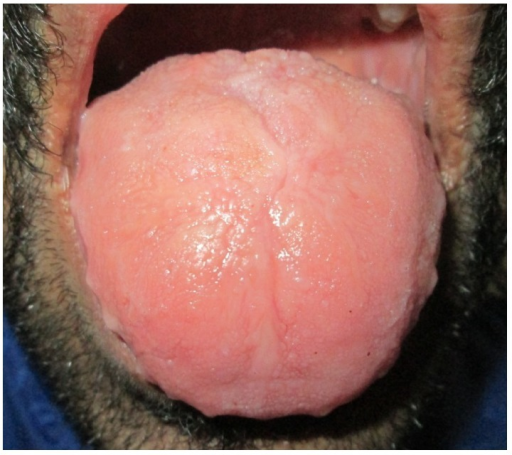
- What a scalloped tongue looks like
- Why the edges get scalloped
- What does a scalloped tongue mean?
- Teeth marks on tongue when you wake up
- Scalloped tongue and sleep apnea
- Scalloped tongue, thyroid and other medical causes
- Scalloped tongue vs. look-alikes
- Scalloped tongue causes at a glance
- Symptoms that can come with it
- Does a scalloped tongue go away?
- How to fix a scalloped tongue at home
- Over-the-counter options
- What a dentist can do
- Prevention
- Kids, pregnancy, dentures and cancer care
- When to see a dentist or doctor
- FAQ
What a scalloped tongue looks like
Stick your tongue out and relax it. With a scalloped tongue you'll see:
- A row of shallow, rounded dents along one or both sides of the tongue, sometimes reaching around toward the tip.
- Small bulges between the dents, where the tongue pushed into the gaps between your teeth.
- A pattern that matches your teeth. Put your tongue back where it rests and the dents line up with your lower teeth, or with both rows.
- Normal color in most cases. The edges may look a bit paler or whiter where they press hardest.
Some people have a faint ripple you'd only notice if you were looking for it. Others have deep, obvious indentations. They can be more noticeable in the morning and softer by afternoon.
We have only one good photo to share here, and it's a dramatic example of an enlarged tongue. Most scalloped tongues we see in the office look like an ordinary, normal-sized tongue with a wavy border. The diagrams below show what's going on. If you're comparing your own tongue to pictures online, focus on two things: is the whole tongue bigger or puffier than it used to be, and is the color or surface changing? Those matter more than the scallops themselves.
Why the edges get scalloped
Your tongue is a soft muscle sitting inside a horseshoe of teeth. When it rests against the inner surfaces of those teeth with steady pressure for hours at a time, the soft edges take the shape of what they're pressed against, the same way a pillow takes the shape of your hand. The tongue doesn't get cut or injured. It just molds.
So the real question is always why the tongue is pressing that hard or that long. There are two broad answers. Either the tongue is pushing (clenching, bracing, a tongue thrust habit, a tongue working to hold the airway open at night), or there's simply more tongue than room (a tongue that's naturally broad, a narrow dental arch, or a tongue that's swollen or enlarged for a medical reason). Research backs up the second idea. A study from Tokyo Dental College measured tongue pressure against the teeth and found that the width of the tongue at rest mattered more than how hard people pressed.
What does a scalloped tongue mean?
It means your tongue has been resting against your teeth with enough pressure, for long enough, to leave a mark. That's all it tells us for certain. It's a sign, not a diagnosis.
For a lot of people it means nothing more than a broad tongue in a snug mouth. For others it's a nudge to look at clenching or grinding, or at sleep. In a smaller group, a tongue that's actually getting bigger or puffier points to a medical cause like an underactive thyroid. Context is what sorts these out: how long you've had it, whether your tongue looks enlarged, and what else is going on with your sleep and health.
You may also see "tooth-marked tongue" described in traditional Chinese medicine, where it's read as a sign of fluid or energy imbalance. That's a different framework from the one we use. In mainstream dentistry and medicine, we look for the physical reasons the tongue is pressing.
Teeth marks on tongue when I wake up: what's going on overnight
This is one of the most common versions we hear about. You wake up, notice teeth marks on your tongue after sleeping, and by lunch they've mostly faded. That pattern points to something happening while you sleep.
- Clenching or grinding at night. Many people clench in their sleep without knowing it. The tongue gets squeezed against the teeth and braced in place. A sore jaw, morning headaches, or flattened, worn teeth are other clues. Our page on tooth grinding and bruxism goes into this in more detail.
- The tongue working to keep your airway open. When you're asleep, the tongue relaxes and tends to fall back toward the throat. Some people push the tongue forward against the teeth to hold the airway open. That's one theory for why scalloping shows up more in people with snoring and sleep apnea.
- Sleep position and mouth breathing. Sleeping on your back lets the tongue sag back. Breathing through your mouth can change where the tongue rests and dries out the mouth, too. If you wake with a parched mouth, our dry mouth page is worth a read.
- Overnight puffiness. Soft tissues can be a little fuller in the morning after lying flat, especially after a salty dinner or alcohol.
If the marks fade during the day, that's reassuring in one sense: your tongue isn't permanently enlarged. It still makes sense to pay attention to the other overnight clues, especially snoring.
Is scalloped tongue a sign of sleep apnea?
It can be one. It can't diagnose it.
Obstructive sleep apnea happens when the airway behind the tongue and soft palate repeatedly narrows or closes during sleep. Breathing drops off, oxygen dips, and the brain briefly wakes you to reopen the airway, sometimes dozens of times an hour, usually without you remembering.
The research is useful but limited. In a 2005 study of 61 ear, nose and throat patients, a scalloped tongue was more common in people with sleep apnea and abnormal overnight oxygen levels, and it went along with a more crowded-looking throat. But it was far from perfect. About half of the people with apnea didn't have a scalloped tongue at all. A larger 2017 study of more than 1,100 adults in Japan found that people with moderate to severe scalloping were about twice as likely to have repeated oxygen drops at night, and the link was strongest in people who were overweight.
So a scalloped tongue raises the question, and the rest of your story answers it. The pattern that worries us is scalloping plus some of these:
- Loud snoring, or a partner who notices you stop breathing, choke, or gasp
- Feeling unrefreshed after a full night, or nodding off during the day or while driving
- Morning headaches or a very dry mouth on waking
- Getting up often at night to urinate
- High blood pressure, a large neck size, or extra weight
Only a sleep study can confirm sleep apnea. That's either a home sleep test or an overnight study in a sleep lab, and it's ordered by a physician. If you have these signs, we'll tell you so and encourage you to talk with your primary care doctor or a sleep physician. Treatment options such as CPAP or a custom oral appliance are decided after that diagnosis, not before.
Scalloped tongue and thyroid problems (and other medical causes)
When the tongue itself gets larger, the teeth leave deeper marks. Doctors call an enlarged tongue macroglossia. Most scalloped tongues aren't macroglossia, but these are the medical causes a physician thinks about when the tongue looks genuinely big or keeps getting bigger:
- Underactive thyroid (hypothyroidism). Low thyroid hormone lets certain substances build up in soft tissues, which can make the tongue thicker. Other hints include tiredness, feeling cold, weight gain, constipation, dry skin, and a hoarse voice. A simple blood test checks thyroid function.
- Amyloidosis. A rare condition where abnormal proteins deposit in tissues. In adults it's one of the more common causes of true tongue enlargement, and a big, firm tongue with scalloped edges can be an early sign. It needs a physician's workup.
- Allergic swelling and angioedema. Allergies can make the tongue puffy. Sudden swelling of the tongue or lips is different. It can come from a reaction to food or medicine, including blood pressure drugs called ACE inhibitors (like lisinopril), and it's an emergency if it affects breathing or swallowing.
- Acromegaly. Too much growth hormone, usually from a benign pituitary tumor, slowly enlarges the tongue, jaw, hands and feet.
- Conditions present from birth, such as Down syndrome or Beckwith-Wiedemann syndrome, where a child's care team is usually already involved.
Some articles online also list vitamin deficiencies. Low B vitamins or iron more often cause a smooth, red, sore tongue called glossitis, which can make the tongue look puffy. That's a separate problem, but the two can show up together.
To be clear about roles: we can notice that your tongue looks enlarged and point it out. Diagnosing thyroid disease, amyloidosis, or any other medical condition is your physician's job, using blood tests, imaging, or a biopsy as needed. We coordinate with your doctor, and our care for medically complex patients is set up for exactly that kind of teamwork.
Scalloped tongue vs. swollen tongue, geographic tongue and other look-alikes
A few other tongue changes get mixed up with scalloping. The table sorts out the common ones.
| Scalloped tongue | Enlarged or swollen tongue | Geographic tongue | Lie bumps | |
|---|---|---|---|---|
| What you see | Wavy dents along the edges that match your teeth | The whole tongue looks big, thick, or puffy. Often scalloped too. | Smooth red patches with white or yellow wavy borders, on the top and sides | One or a few small red or white bumps, often near the tip or side |
| Color change? | No, or slightly paler edges | Usually not, unless an allergy or infection | Yes. Red, map-like patches that move around | Yes. A small red or white dot |
| Pain | Usually none | Varies. Sudden swelling can feel tight. | Usually none. Some people sting with spicy or acidic food. | Sharp, pinpoint soreness |
| Changes over time | Can fade if the pressure or swelling goes away | Depends on the cause | Patches shift over days or weeks | Gone in a few days |
| Who sorts it out | Dentist first, physician if sleep or medical signs | Physician. Emergency care if breathing is affected. | Dentist | Usually nobody. See a dentist if it lasts 2 weeks. |
A few more worth knowing:
- Geographic tongue also has wavy borders, which is why people confuse them. The difference is color: geographic tongue has red, smooth patches outlined in white, and the "map" changes shape. Read more about geographic tongue.
- A white line on the inside of the cheek (linea alba) is the cheek's version of the same thing. It's a raised white ridge right where the upper and lower teeth meet, and it often shows up in the same people who have a scalloped tongue.
- Fissured tongue has grooves and cracks across the top of the tongue, not dents on the edges. It's harmless and common. See fissured tongue.
- Lie bumps are inflamed taste buds that can sit right on the edge of the tongue. They're small, tender, and short-lived. See lie bumps on the tongue.
- A single lump, sore, or rough patch on one side of the tongue is not scalloping. The side of the tongue is a spot where we pay close attention to anything that doesn't heal. Learn the signs of oral cancer, and get any spot that lasts more than 2 weeks checked. Most turn out to be harmless, but a biopsy is the only way to know.
Scalloped tongue causes at a glance
Most people have more than one of these going on.
The tongue is pressing
- Clenching or grinding, day or night
- Tongue thrust, a habit of pushing the tongue forward against or between the teeth when swallowing, speaking, or resting
- Stress and anxiety, which make many people clench their jaw or press the tongue against their teeth without noticing
- Sleep-disordered breathing, including snoring and sleep apnea
There's more tongue than room
- A naturally broad tongue, or a narrow or crowded dental arch
- A tongue that spreads into spaces from missing teeth, then gets crowded again by new dentures or a bridge
- Swelling from allergies or a reaction
- Medical causes of tongue enlargement, such as an underactive thyroid or amyloidosis
One that comes up a lot online is dehydration. We haven't found good evidence that ordinary dehydration causes scalloping, so don't panic if you've read that. Drinking enough water is still a good idea.
Symptoms that can come with a scalloped tongue
The scallops themselves usually don't cause symptoms. When people do have discomfort, it's typically from the cause rather than the dents:
- Tongue soreness or tenderness along the edges, usually from heavy clenching or a sharp tooth edge
- Jaw ache, tight chewing muscles, or clicking, which point toward clenching or a jaw joint problem. Our TMJ and TMD treatment page covers that side.
- Worn, chipped, or sensitive teeth from grinding
- Snoring, daytime sleepiness, or morning headaches if sleep apnea is part of the picture
- A tongue that feels too big, gets bitten often, or makes speech or swallowing awkward
Tongue pain without an obvious reason, or a tongue that burns all day, is worth a visit. That's not typical for scalloping and usually has another explanation.
Does a scalloped tongue go away?
Often it does, at least partly. Tongue tissue is soft and responsive, so when the pressure eases or the swelling comes down, the edges tend to smooth out.
- Morning-only marks usually fade within hours of waking.
- Scalloping from clenching or a tongue habit may soften over weeks to months once the habit is managed. It doesn't always disappear completely.
- Scalloping from swelling improves as the underlying problem is treated, for example once allergies are controlled or a thyroid condition is treated by your physician.
- A naturally broad tongue in a snug arch may stay scalloped for life. That's not a problem by itself.
The goal isn't really a perfectly smooth tongue edge. It's making sure whatever's causing it is either harmless or being handled.
How to fix a scalloped tongue: what you can do at home
You can't massage or brush the scallops away. What you can do is figure out the cause and take pressure off the tongue. Try this over two weeks.
- Check it morning and evening. Look in the mirror right after you wake up and again before bed. Morning-only marks point to something overnight. All-day scalloping points more toward tongue size, swelling, or daytime habits. A quick photo each time helps.
- Catch yourself during the day. The resting position your jaw wants is lips together, teeth slightly apart, and the tongue resting gently on the roof of your mouth. If you notice your teeth touching or your tongue jammed against them while you're at the computer or driving, let go. A sticky note on your screen is a simple reminder.
- Ask someone about your sleep. A bed partner or family member can tell you if you snore loudly, grind your teeth, or stop breathing for a moment. A snoring app on your phone can also give you a rough idea.
- Breathe through your nose. If you're stuffy at night, treat the congestion (see the table below). Nose breathing helps the tongue rest higher in the mouth.
- Skip alcohol close to bedtime and try sleeping on your side. Alcohol relaxes the throat muscles and makes snoring worse, and back-sleeping lets the tongue fall back.
- Look at stress. If you clench when you're anxious, daytime relaxation, exercise, and a wind-down routine at night can help. Daytime clenching is closely tied to stress for a lot of people.
- Bring your notes to a visit. What you've noticed over two weeks makes the exam much more useful.
Things that won't help
- Scraping or brushing the edges hard. The dents are a shape, not a coating. You'll only make the tongue sore.
- Tongue "exercises" from videos as a quick fix. Some myofunctional exercises have a role for tongue thrust, but they work when a trained professional guides them, and they take time.
- A store-bought snoring device before you know if you have sleep apnea. It may quiet the snoring and hide the problem.
Over-the-counter options
Nothing at the pharmacy treats a scalloped tongue directly. A few products help with the causes. Use them as the label directs, and check with a pharmacist if you're pregnant or take other medicines.
| Product | What it can help with | Things to know |
|---|---|---|
| Saline nasal spray or rinse, nasal strips | Stuffy nose at night, mouth breathing | Safe for most people, including in pregnancy. Use distilled or boiled water for sinus rinse bottles. |
| Allergy medicines (non-drowsy antihistamines, steroid nasal sprays) | Allergy congestion and allergy-related puffiness | As the label directs. Ask your doctor or pharmacist before using them in pregnancy or for young children. |
| Decongestant nasal sprays (oxymetazoline) | Short-term relief of a blocked nose | No more than 3 days in a row, or congestion can rebound and get worse. |
| Boil-and-bite night guards | Short-term tooth protection if you grind | Bulky and can shift your bite with long-term use. Not a treatment for sleep apnea. A custom guard from a dentist fits better. |
| Anti-snoring mouthpieces | Snoring | Get checked for sleep apnea first. They can make snoring quieter while apnea goes untreated, and can strain the jaw. |
| Pain relievers (acetaminophen, ibuprofen) | Sore jaw muscles or a tender tongue edge | As the label directs, using children's versions and doses for kids. |
| Numbing gels (benzocaine) | Brief relief for a sore spot on the tongue edge | They don't change the scallops. Do not use benzocaine in children under 2. |
What a dentist can do for a scalloped tongue
A scalloped tongue is one of those things we notice during routine exams all the time, often before the patient has. Here's what we can do:
- Look at the whole picture. During a comprehensive dental exam we check the tongue, cheeks, and throat, look for wear on the teeth, linea alba on the cheeks, sore chewing muscles, and the size of the tongue and tonsils. Together those tell us a lot about clenching and airway crowding.
- Ask a few sleep questions. We often use a short screening questionnaire about snoring, tiredness, and blood pressure. It doesn't diagnose anything, but it tells us when a conversation with your physician makes sense.
- Protect your teeth from clenching. A custom night guard spreads out the force of grinding and protects your teeth. If you have sleep apnea symptoms, we'll want them checked before making one.
- Fix sharp spots. If a rough filling, chipped tooth, or the edge of a denture is rubbing a tongue that's already crowded, we can smooth or repair it.
- Adjust dentures and bridges. New dentures sometimes crowd the tongue at first. Small adjustments can make room.
- Coordinate with your physician. If the tongue looks enlarged or we see other signs of a medical cause, we'll document what we see and send it to your doctor for testing.
- Talk through oral appliance therapy. If your physician diagnoses sleep apnea and an oral appliance is an option for you, we can talk about how these devices work and help you find the right provider for one.
If anything on the tongue doesn't fit the usual pattern, such as a firm area, a sore, or a patch that's only on one side, we look at it closely and may recommend a biopsy or refer you. Our oral medicine and diagnosis page explains how we work through spots that are harder to pin down.
How to prevent teeth marks on your tongue
You can't change the size of your tongue or your jaw, but you can lower the pressure on it.
- Keep your teeth apart when you're not chewing. Teeth are meant to touch only briefly during chewing and swallowing.
- Wear your night guard if you have one, and bring it to checkups so we can check the fit.
- Get snoring evaluated rather than living with it.
- Keep allergies and nasal congestion under control so you can breathe through your nose at night.
- Keep up with physician follow-up for thyroid or other conditions that affect the tongue.
- Come in for regular exams so changes in your tongue, bite, or tooth wear get noticed early.
Scalloped tongue in kids, pregnancy, denture wearers and cancer treatment
Children
In kids, the questions are the same, but the causes lean differently. Children who snore every night, breathe through their mouth, or have restless sleep may have enlarged tonsils or adenoids crowding the airway. Snoring in children deserves a conversation with your pediatrician. A tongue thrust habit is common in younger kids and can also push the front teeth forward. Your dentist or an orthodontist can tell you whether it's affecting the bite. A tongue that's large from birth is managed by the child's medical team.
You may have seen "scalloped tongue ADHD" searches. We don't know of good research tying ADHD directly to tongue scalloping. There is a known overlap between poor sleep, snoring, and attention problems in children, which is one more reason to bring up a child's snoring with the pediatrician.
Pregnancy
Nasal stuffiness, fluid retention, and snoring often increase during pregnancy, and a tongue may look a bit fuller. Mention new loud snoring or daytime exhaustion to your OB, especially if you have high blood pressure. Check with your OB or pharmacist before using any allergy or decongestant medicine.
Denture wearers
When back teeth are missing for a long time, the tongue spreads out into the space. A new denture or bridge can then feel crowded and leave marks. Most people adapt within a few weeks. If your tongue stays sore or keeps getting bitten, an adjustment usually helps. Our dentures page covers fit and follow-up.
People treated for head and neck cancer
After surgery or radiation for head and neck cancer, swelling (lymphedema) can involve the tongue and floor of the mouth, and dry mouth is common. New tongue swelling or changes after treatment should go to your oncology team first. We work alongside that team for dental care before, during, and after head and neck cancer treatment.
When to see a dentist or doctor about a scalloped tongue
Make an appointment if:
- The scalloping is new and you're not sure why
- You also snore loudly, wake unrefreshed, or feel sleepy during the day
- Your jaw aches, your teeth are wearing down, or you know you grind
- Your tongue seems to be getting bigger, or you're biting it more often
- You have other symptoms like tiredness, feeling cold, weight gain, or a hoarse voice
- The edge of your tongue is sore, or there's a spot on one side that hasn't healed in 2 weeks
Get care quickly or today if:
- Your tongue, lips, or throat swell suddenly. Call 911 if you have trouble breathing, swallowing, or speaking.
- Someone sees you stop breathing in your sleep for long stretches, or you're falling asleep while driving
- Your tongue is swollen along with fever, spreading facial swelling, or trouble opening your mouth. That needs emergency dental care or an urgent medical visit.
Scalloped tongue FAQ
What does a scalloped tongue mean?
A scalloped tongue means the sides of your tongue have been pressing against your teeth firmly enough to leave wavy dents. It's a sign, not a disease. Common reasons include clenching, a tongue that's broad for the space, and swelling. Less often it's linked to sleep apnea or a medical cause of tongue enlargement such as an underactive thyroid.
What causes a scalloped tongue?
The usual causes are clenching or grinding, a tongue thrust habit, a naturally large tongue or narrow dental arch, and swelling from allergies. Sleep-disordered breathing, including sleep apnea, is linked to it. Medical conditions that enlarge the tongue, such as hypothyroidism, amyloidosis, and acromegaly, are less common causes that a physician evaluates.
Is scalloped tongue a sign of sleep apnea?
It can be, but it can't diagnose it. Studies have found scalloped tongues more often in people with sleep apnea and low oxygen levels at night, yet many people with sleep apnea don't have one. If you have a scalloped tongue plus loud snoring, pauses in breathing, or daytime sleepiness, talk with your physician. A sleep study is the only way to confirm sleep apnea.
Is scalloped tongue a sign of thyroid problems?
Sometimes. An underactive thyroid can make the tongue thicker, which leads to deeper teeth marks. Most people with a scalloped tongue have normal thyroid function, though. If your tongue seems enlarged, or you also have tiredness, feeling cold, weight gain, or dry skin, ask your physician about a thyroid blood test.
Can anxiety cause scalloped tongue?
Indirectly, yes. Many people clench their jaw or press their tongue against their teeth when they're stressed or anxious, often without realizing it. Over time that pressure can leave scalloped edges. Noticing the habit during the day and letting your jaw relax, with lips together and teeth apart, can help.
Why do I have teeth marks on my tongue when I wake up?
Morning teeth marks usually point to something happening overnight. Common reasons are clenching or grinding in your sleep, your tongue pressing forward to keep your airway open, sleeping on your back, or mild overnight puffiness. If the marks fade by midday, the tongue isn't permanently enlarged. If you also snore or wake up tired, get your sleep checked.
Does a scalloped tongue go away?
It often fades once the cause is handled, because the tongue is soft tissue that reshapes when the pressure or swelling eases. Marks from clenching or a tongue habit may soften over weeks to months. Some people with a naturally broad tongue keep mild scalloping for life, which is harmless on its own.
How do you fix a scalloped tongue?
You fix a scalloped tongue by treating the cause, not the dents. That can mean a custom night guard for clenching, managing stress, treating nasal congestion, adjusting dentures, or getting evaluated and treated for sleep apnea or a thyroid problem. A dentist can help sort out the likely cause and coordinate with your physician if needed.
Is a scalloped tongue painful?
Usually not. Most people with a scalloped tongue feel nothing and only notice it in the mirror. Soreness along the edges can happen with heavy clenching or a sharp tooth or filling rubbing the tongue. Ongoing tongue pain or burning isn't typical for scalloping and should be checked by a dentist.
Is a scalloped tongue serious?
On its own, a scalloped tongue isn't dangerous. It matters because of what might be causing it. Most of the time it's clenching or a broad tongue. It's worth getting checked if it's new, if your tongue seems to be getting bigger, or if you also snore, feel sleepy during the day, or have other symptoms of a medical problem.
What is a crenated tongue?
A crenated tongue is another name for a scalloped tongue. "Crenated" means having a wavy or notched edge. You may also see it called tongue indentations, tooth-marked tongue, or lingua indentata. All describe the same wavy dents along the sides of the tongue where it presses on the teeth.
Can tongue thrust cause teeth marks on the tongue?
It can. Tongue thrust is a habit of pushing the tongue forward against or between the teeth when swallowing, speaking, or resting. That repeated pressure can leave marks along the edges and may push the front teeth out of position over time. An orthodontist or a therapist trained in tongue and swallowing habits can help if it's affecting the bite.
Can dehydration cause a scalloped tongue?
Dehydration is often listed as a cause online, but there isn't good evidence that ordinary dehydration causes scalloping. Clenching, tongue size, swelling, and sleep-related breathing problems are much more common explanations. Staying well hydrated is still good for your mouth, especially if you breathe through your mouth at night.
Is scalloped tongue linked to ADHD?
We aren't aware of research showing a direct link between ADHD and a scalloped tongue. There is a known overlap between snoring, poor sleep, and attention problems in children, so a child with a scalloped tongue who also snores should have their sleep discussed with a pediatrician.
Noticed teeth marks on your tongue?
If you're in the Jacksonville area and your tongue has wavy edges, especially along with snoring, jaw soreness, or worn teeth, we're happy to take a look. Dr. Henley will check your tongue, bite, and airway, explain what he sees in plain terms, and work with your physician if something needs a closer medical look.
Related conditions
Sources
- Weiss TM, Atanasov S, Calhoun KH. The association of tongue scalloping with obstructive sleep apnea and related sleep pathology. Otolaryngol Head Neck Surg. 2005;133(6):966–971.
- Tomooka K, Tanigawa T, Sakurai S, et al. Scalloped tongue is associated with nocturnal intermittent hypoxia among community-dwelling Japanese: the Toon Health Study. J Oral Rehabil. 2017;44(8):602–609.
- Yanagisawa K, Takagi I, Sakurai K. Influence of tongue pressure and width on tongue indentation formation. J Oral Rehabil. 2007;34(11):827–834.
- Piquero K, Ando T, Sakurai K. Buccal mucosa ridging and tongue indentation: incidence and associated factors. Bull Tokyo Dent Coll. 1999;40(2):71–78.
- Kutti Sridharan G, Rokkam VR. Macroglossia. StatPearls. National Library of Medicine; updated 2023.
- Lee AQ, Aronowitz P. Scalloped tongue in primary amyloidosis. J Gen Intern Med. 2021;36(8):2456–2457.
This page is for general education and isn't a diagnosis. Every mouth is different. If you have a sore you're worried about, see your dentist or physician. Photos marked Wikimedia Commons are used under their listed licenses and may have been cropped or resized.