


Why Do Dental Crown Costs Vary in Jacksonville?
Compare dental crown costs in Jacksonville: materials, extra treatment, insurance, and questions to ask. A patient guide from CJ Henley, DMD.Restorative dentistry • CJ Henley, DMD • Jacksonville, Florida
Dental crown costs vary because the tooth, the material, the work involved, and the insurance benefits are not the same in every case. The most useful comparison is the complete treatment estimate—not the crown price alone.
If you are comparing crown estimates in Jacksonville, ask what each includes and why the proposed treatment is appropriate for your tooth. A higher fee does not automatically mean a better crown, and a lower fee does not automatically mean poor care.
Quick answers
- Why do crown prices differ? Materials, laboratory work, the tooth’s condition, clinical complexity, and practice fees can all affect the total.
- Is a root canal included? Do not assume so. Root canal treatment and a crown address different problems and are generally separate procedures.
- Does insurance pay half? Your plan may pay a percentage of its allowed amount, subject to deductibles, limits, and exclusions—not necessarily half of the dentist’s fee.
- How do I compare estimates? Compare the same tooth, treatment, material, included services, and expected out-of-pocket cost.
How much does a dental crown cost in Jacksonville?
There is no single fee that applies to every crown in Jacksonville. A quote for a crown on a natural tooth may cover a different scope of care than a quote that also includes rebuilding the tooth or treating an infected root canal. An implant crown is a different restoration again.
For a useful estimate, the dentist needs to evaluate the tooth, determine whether it can be restored predictably, and identify any treatment needed before the crown. Ask for the total planned treatment fee and your estimated share after insurance as separate figures.
At CJ Henley, DMD on Hendricks Avenue, start with an examination and a discussion of your treatment options. Bring an existing estimate or recent dental records if you would like to discuss a crown recommendation.
Why do dental crown costs vary?
1. The condition of the tooth
A tooth with adequate healthy structure presents a different situation from one with extensive decay, a large old filling, or a fracture. Some teeth need a core buildup to replace missing structure before a crown can be supported. Others may need root canal treatment or gum treatment. These procedures are not necessary for every crown.
A crown can protect or restore a weakened tooth, but it cannot make every damaged tooth restorable. The diagnosis should come before the price comparison. Read why a tooth may need a crown for the clinical reasons behind a recommendation. [1]
2. The crown material and design
Crowns may use zirconia, other ceramics, porcelain fused to metal, or metal alloys. The material, design, and fabrication process can affect the fee. The choice also depends on the tooth’s location, available space, bite forces, and appearance goals.
“Porcelain crown” is not a complete description of the restoration. Ask which material is proposed and why it suits your tooth. There is no single material that is the best choice for every patient.
3. Laboratory work and appearance requirements
A visible front tooth may require careful work to match neighboring teeth in color, translucency, and shape. Laboratory services, customized shading, and fabrication methods can differ. Ask what customization is included, especially when replacing one front tooth.
4. Clinical time and complexity
Preparing the tooth, recording its shape with an impression or scan, managing the surrounding gum tissue, and checking the finished crown all require clinical judgment. A difficult bite, limited access, or other treatment needs may make a case more involved.
The final fit, contact with neighboring teeth, and bite matter alongside the material. Technology is one part of the process; a scanner or a particular brand name does not by itself establish the quality of the result.
5. What the quoted fee includes
Offices may present estimates differently. One may show a crown fee separately from the examination and buildup; another may discuss the entire treatment total. Laboratory arrangements, staffing, operating costs, and network contracts can also influence fees.
Ask for clarification before deciding that two prices represent the same care.
What goes into a crown: photographs from our practice
These images from Dr. Henley’s crown treatment guide show the starting tooth and the completed restoration. They illustrate why a crown fee involves more than the finished piece of ceramic.
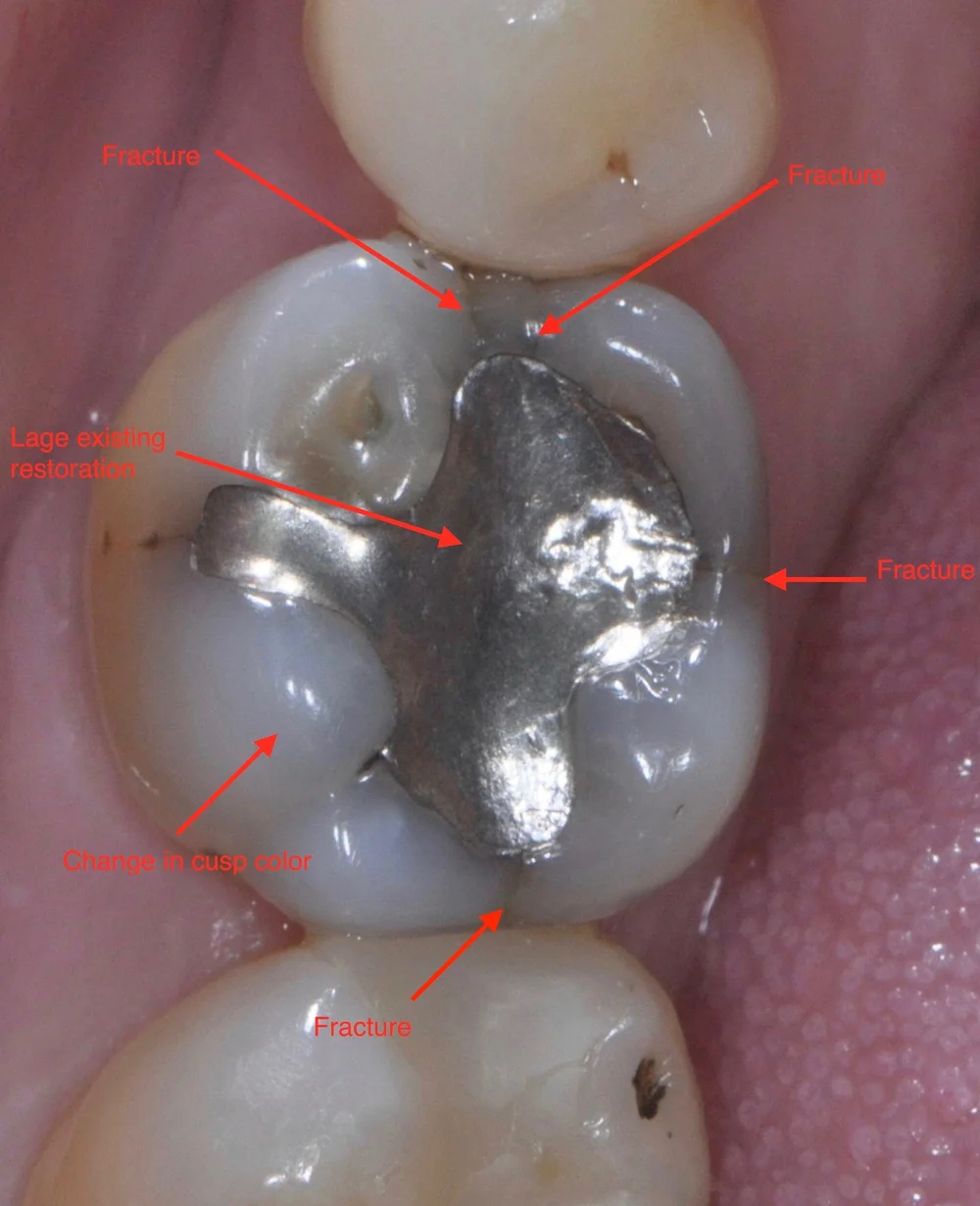
Clinical photograph: Dr. C.J. Henley.
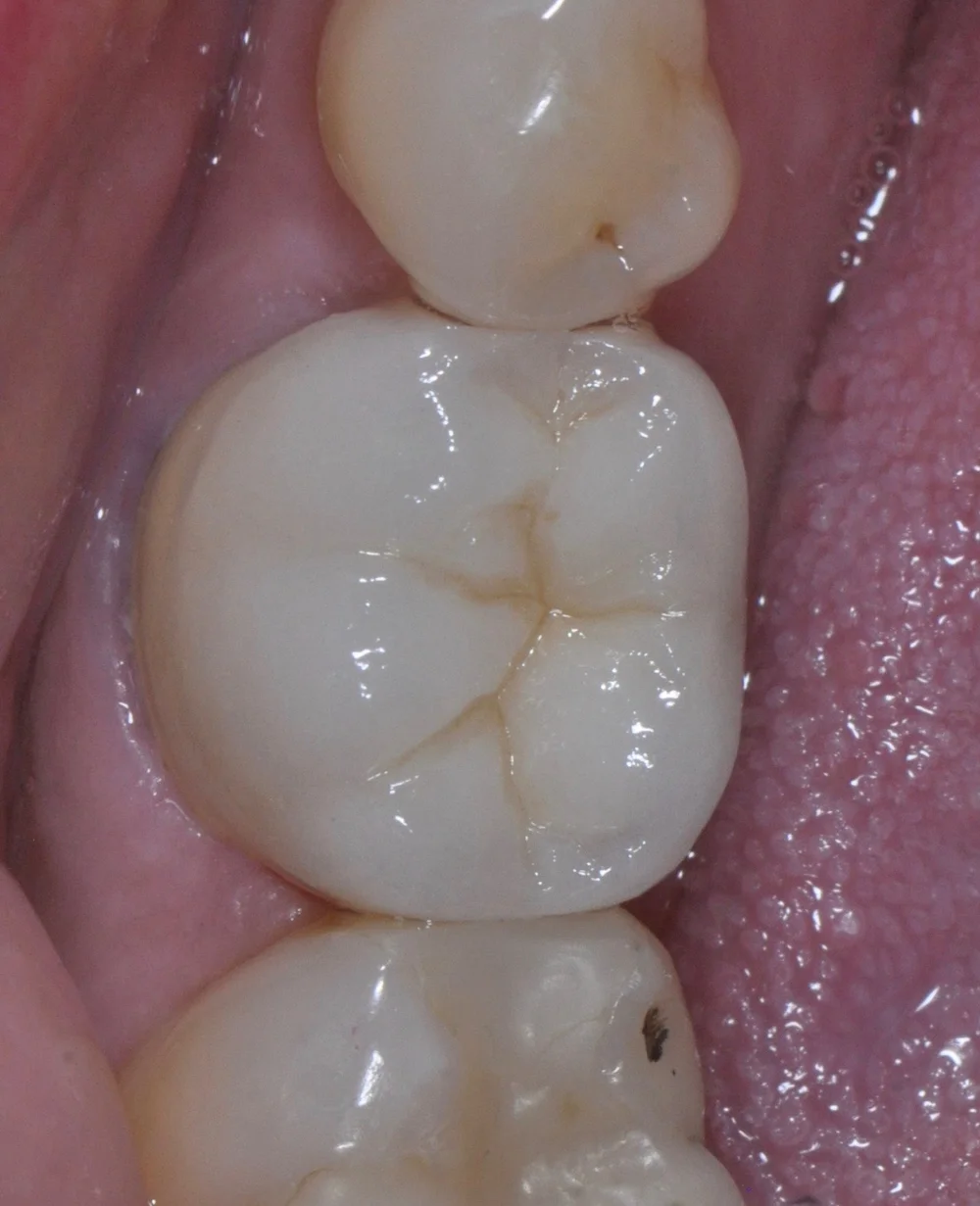
Clinical photograph: Dr. C.J. Henley.
These photographs illustrate an individual case, not a promise of a particular outcome. Treatment needs and results vary.
How to compare two dental crown estimates
Ask both offices to identify the tooth, proposed procedure, crown material, and any additional treatment. Then use this checklist.
| Compare this | Ask this question |
|---|---|
| Diagnosis and alternatives | Why is a crown recommended? Could a filling, onlay, or another option be appropriate? |
| Crown material | What material is proposed, and why is it suitable for this tooth? |
| Examination and imaging | Are these included in the estimate or charged separately? |
| Buildup or post | Is either needed? If so, what is its purpose and fee? |
| Root canal or gum treatment | Is additional treatment expected, and is its cost included? |
| Temporary and final crown | What is included for the temporary, laboratory work, and final placement? |
| Follow-up | What follow-up visits or adjustments are included? Are there written replacement policies? |
| Insurance and payment | What is the full fee, estimated benefit, amount due at treatment, and expected final patient cost? |
Compare the whole treatment
Crown fee + other necessary treatment = planned treatment total.
Planned total − applicable discounts or contractual adjustments − actual insurance payment = final patient responsibility.
The amount due at your appointment may differ from your final cost if your insurer reimburses you afterward. Estimates can change if clinical findings or benefits differ from expectations.
Why does insurance change what I pay for a crown?
The dentist’s fee, the plan’s allowed amount, and your reimbursement are different figures. A plan that describes crowns as “50% covered” may calculate that percentage using its own allowance and apply other limits.
- Deductible: An amount you may need to pay before benefits apply.
- Annual maximum: A limit on what the plan will pay during the benefit year.
- Waiting periods and replacement limits: Coverage may depend on when the plan began or how recently a previous crown was placed.
- Alternative benefits: Some plans base payment on a less expensive alternative rather than the proposed restoration.
- Network status: In-network and out-of-network benefits and payment arrangements may differ.
A pretreatment estimate can help you plan, but it is not a guarantee of payment. Ask your insurer which limits apply to your specific tooth and procedure. [2] [3]
Using PPO benefits at CJ Henley, DMD
Our office files PPO claims as an out-of-network provider, with reimbursement directed to the patient. Coverage depends on your plan. Review our dental insurance information and contact the team to discuss the payment process for your treatment.
Discuss a crown estimate in Jacksonville
Dr. Henley’s office is at 3675 Hendricks Avenue, Jacksonville, FL 32207, serving San Marco and the surrounding Jacksonville community. An examination can help clarify why a crown is recommended, whether additional treatment is needed, and which options fit your situation.
Our documented crown process includes careful tooth preparation, a custom temporary crown made by the doctor, and checks of the final fit and bite. You can review those steps in our crown treatment guide.
Understand your crown options before deciding
Bring your questions and any existing treatment estimate. Discuss the tooth, the alternatives, and the scope of care with Dr. Henley.
Frequently asked questions about crown costs
Why is one dentist’s crown more expensive than another’s?
The estimates may differ in material, laboratory work, treatment complexity, included services, or insurance assumptions. Ask for an itemized explanation before comparing the final numbers. Price alone does not establish clinical quality.
Does every crown require a root canal?
No. A crown restores or protects the tooth; root canal treatment addresses the pulp and root canal system when indicated. Many crowned teeth do not need root canal treatment. If both are needed, confirm whether the estimate includes both procedures. The American Association of Endodontists explains the distinction.
What is a crown buildup, and why might it cost extra?
A core buildup replaces missing tooth structure to help support the crown. Whether it is needed depends on the remaining tooth. It may appear as a separate procedure on an estimate; ask why it is recommended and how your plan handles it.
Are zirconia crowns always more expensive than porcelain crowns?
No fixed price order applies to every practice or restoration. Zirconia is a ceramic, and “porcelain” can describe different restorations. Ask for the specific material, design, and fee instead of comparing labels alone.
Is an implant crown the same price as a crown on a natural tooth?
They are different treatments. An implant restoration may involve a separate implant, connecting component called an abutment, and crown. An advertised implant-crown fee may not include surgery or every component. Compare complete treatment plans.
Can I get a crown without dental insurance?
Yes. You can pay directly for dental treatment. Ask for the full estimate, when payment is due, and any payment options currently available. Insurance benefits do not determine whether a tooth needs treatment.
Will paying more make a crown last longer?
A higher fee is not a lifespan guarantee. The tooth’s condition, fit, bite, material selection, oral hygiene, and ongoing care all matter. Ask how the proposed treatment addresses the risks specific to your tooth.
About C.J. Henley, DMD
C.J. Henley, DMD is a Jacksonville general dentist and a graduate of the University of Florida College of Dentistry. His practice includes cosmetic and restorative dentistry, oral medicine, and care for patients with complex medical needs. His crown treatment guide includes original clinical photographs and an explanation of preparation, temporary crowns, and final fit.
Sources and further reading
- American Dental Association. Crowns: purpose and common indications.
- American Dental Association. Least Expensive Alternative Treatment Clause.
- American Dental Association. Dental insurance frequently asked questions.
- American Association of Endodontists. Root canal treatment explained.