


Interesting Facts About Christmas: Merry Christmas from the Team at CJ Henley, DMD
Ever wondered where some of our Christmas traditions started?

Origin of Christmas Trees: The tradition of decorating Christmas trees dates back to 16th-century Germany. It became popular in England during the 19th century when Queen Victoria's German husband, Prince Albert, introduced the Christmas tree to the royal family.

First Christmas Card: The first commercially produced Christmas card was created in London in 1843 by Sir Henry Cole. It featured a family enjoying a festive meal, and about 1,000 copies were printed.

Santa Claus's Evolution: The modern image of Santa Claus is often credited to the Coca-Cola Company. In the 1930s, Coca-Cola commissioned artist Haddon Sundblom to create a series of images featuring a plump, jolly Santa enjoying Coca-Cola. This contributed to the popularization of the contemporary image of Santa Claus.

Christmas Stockings: The tradition of hanging stockings by the fireplace is said to have originated from the story of St. Nicholas, who, according to legend, left gifts in the stockings of three poor sisters.

Christmas Colors: The traditional colors of Christmas, red and green, have symbolic meanings. Red represents the blood of Christ, while green symbolizes eternal life.

Mistletoe Tradition: The custom of kissing under the mistletoe is believed to have originated from ancient Norse mythology. It was associated with Frigg, the Norse goddess of love, and evolved into a Christmas tradition over time.

World Record for Lights: The Guinness World Record for the most Christmas lights on a residential property is held by a family in LaGrangeville, New York. They set up an astonishing 601,736 lights in 2014.

Tallest Christmas Tree: The tallest artificial Christmas tree ever made was constructed in the city of Sri Lanka in 2019. It stood at a staggering 236 feet.

Caroling Tradition: The tradition of Christmas caroling has ancient roots. Early carolers used to dance from house to house, and the word "carol" originally meant a circle dance. Over time, it evolved into singing festive songs.

Christmas Traditions Around the World: Different countries have unique Christmas traditions. For example, in Iceland, there are 13 Santas who visit children over the Christmas season. In Japan, it's a tradition to eat KFC for Christmas dinner.

What Is Beauty?
Sheila Samton is the author-illustrator of many award-winning books for children, as well as a designer and muralist. Her first children’s book, “The World from My Window” (Crown, 1985), also dealt with the subject of beauty. Ms. Samton has two sons and lives in New York City.
This is the “golden ratio,”a.k.a. the “golden mean,”the “golden section,” and the “divine proportion.” It is a proportional relation obtained by dividing a line, or a plane figure, so that the shorter part is to the longer part as the longer part is to the whole. If you take a “golden rectangle” — one whose length-to-breadth is in the golden ratio — and snip out a square, what remains is another, smaller golden rectangle. What makes the golden ratio special to mathematicians is the number of properties it possesses. But what makes it extraordinary to the world is its relation to beauty. The golden ratio has been evoked through the ages to express perfection.
Examples abound. The Egyptians called it the “sacred ratio,” and applied it to the building of the pyramids.
The Greeks used it in the construction of the Parthenon. It is said that daVinci painted the face of the Mona Lisa to fit inside a golden rectangle. People like the architect Corbusier and the composer Bartók have consciously embodied it in their work. And daily in art and science classrooms students discover that geometric forms expressing the golden ratio are simply the most appealing to the eye.

Paul Revere: The first American forensic dentist
Paul Revere inadvertently became America’s first forensic dentist when he was given the gruesome task of identifying the body of Dr. Joseph Warren, the man who sent him on his famous “midnight ride.” Warren was struck down by a British bullet during the Battle of Bunker Hill on June 17, 1775 and his corpse was buried in a mass grave. When Warren’s family unearthed the grave nine months later, visual identification of the bodies inside was near impossible because they had decomposed. So Revere, the man who crafted the slain officer’s false teeth, was asked to locate Warren’s remains by finding the ivory dentures he crafted and wired to Warren’s jaw.
Read the full article at Strange Remains
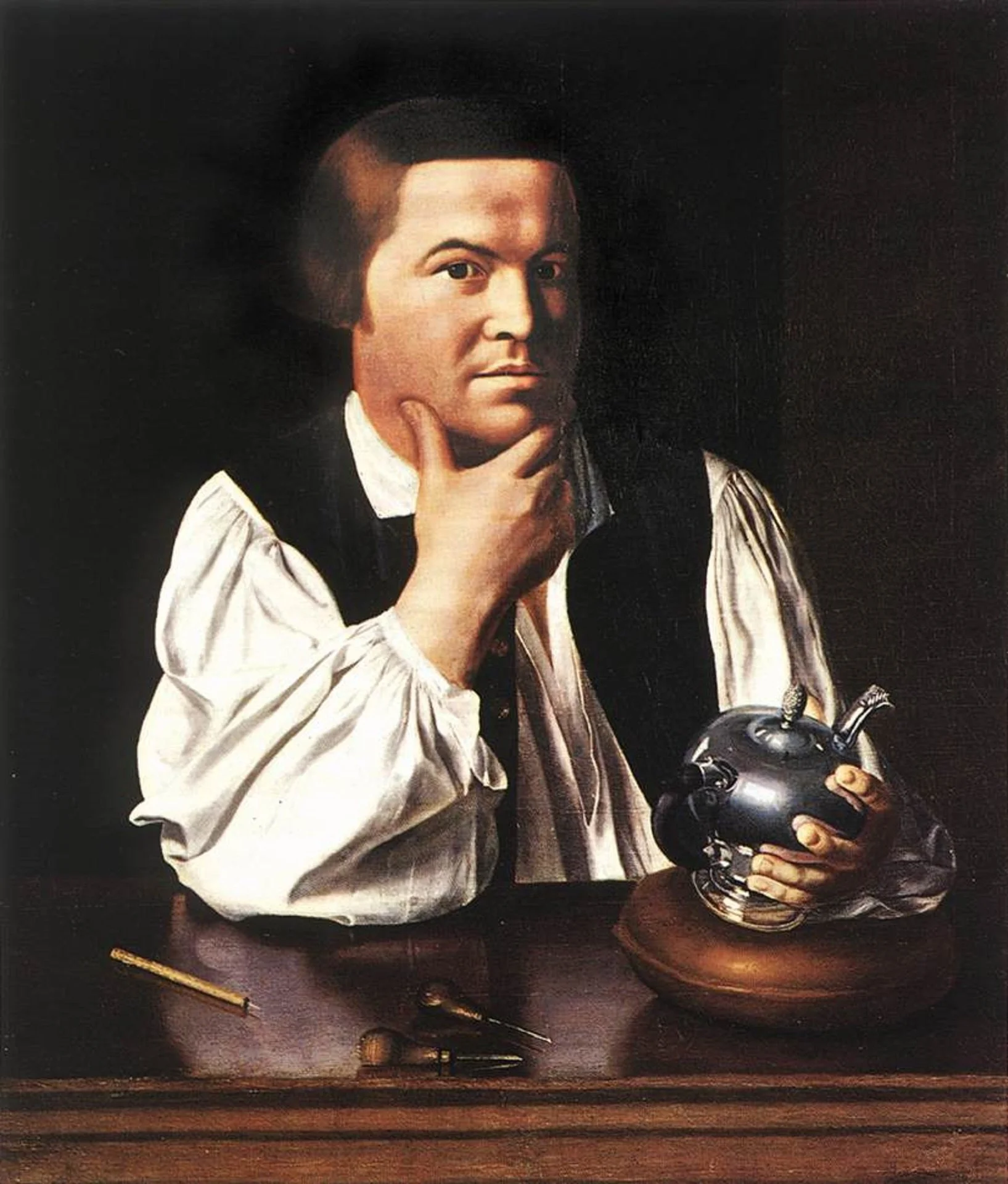
Paul Revere, silversmith and patriot, is widely regarded as America’s first forensic dentist after identifying Dr. Joseph Warren through dental prosthetics following the Battle of Bunker Hill.
Paul Revere is best known for his midnight ride that helped ignite the American Revolution, but few people realize he also played a pivotal role in the early history of forensic dentistry. In fact, Paul Revere is widely regarded as America’s first forensic dentist—long before the field had a name.
Revere’s contribution to forensic identification occurred after the death of his close friend, Dr. Joseph Warren. Warren, a respected physician, patriot, and leader of the revolutionary movement, was killed by a British musket ball during the Battle of Bunker Hill on June 17, 1775. His body was buried hastily in a mass grave alongside other fallen soldiers.
Nine months later, Warren’s family sought to recover his remains. By that time, decomposition had made visual identification nearly impossible. Facial features, clothing, and other distinguishing characteristics were no longer reliable. What remained identifiable, however, was something far more durable than soft tissue: dentistry.
Paul Revere had crafted Warren’s dental prosthetics—ivory dentures wired directly to the jaw, a common practice in 18th-century dentistry. When the grave was exhumed, Revere was asked to examine the remains. He located the body by identifying the custom dentures he himself had fabricated. This moment is widely considered the first documented case of dental identification used for forensic purposes in the United States.
Why this matters today
This event marks the foundation of what we now call forensic odontology—the use of dental science to identify human remains. Teeth and dental restorations are among the most durable structures in the human body. They withstand decomposition, fire, and trauma better than most tissues, making them invaluable in forensic investigations.
Modern forensic dentistry builds on the same principle Revere used over 250 years ago: individualized dental characteristics can uniquely identify a person. Today, this includes dental charts, radiographs, restorations, implants, bite patterns, and even microscopic enamel features.
The evolution of forensic dentistry
What began with hand-carved ivory dentures has evolved into a highly specialized field used worldwide. Forensic dentists now assist in identifying victims of natural disasters, aviation accidents, criminal investigations, and mass casualty events. Digital radiography, 3D imaging, and advanced dental materials have dramatically increased accuracy and reliability—but the core concept remains unchanged.
Dentistry’s role beyond teeth
This story also highlights an often overlooked truth: dentistry has always been deeply connected to medicine, anatomy, and public service. Dentists are trained to recognize patterns, document structures, and work with precision—skills that translate directly into forensic science.
From the American Revolution to modern disaster victim identification, dental science has played a quiet but critical role in history.
Reviewrd and Updated January 2026

Apollo 11 Moon Landing Anniversary: Facts About Lunar Mission 47 Years Ago
Even though Yuri Gagarin from what was then the U.S.S.R. became the first man in outer space, the lead he gave the Soviets in the space race in 1961 was overcome by the United States eight years later. On July 20, 1969, Neil Armstrong and Edwin “Buzz” Aldrin became the first men to step on the moon’s surface, a defining moment in human history.
Even though Yuri Gagarin from what was then the U.S.S.R. became the first man in outer space, the lead he gave the Soviets in the space race in 1961 was overcome by the United States eight years later. On July 20, 1969, Neil Armstrong and Edwin “Buzz” Aldrin became the first men to step on the moon’s surface, a defining moment in human history.
It has been 47 years to the day since three U.S. astronauts (Michael Collins was the third, but he never went to the lunar surface, staying behind in the command ship) went to the moon as part of the Apollo 11 mission. In the three years that followed, 10 more men made the journey as part of NASA’s Apollo missions, but none has been as iconic as Armstrong’s “one small step for man.”
Here’s a look at some of the interesting facts from the Apollo 11 mission.
- Armstrong messed up his opening line somewhat. He was supposed to say “That’s one small step for a man, one giant leap for mankind” but he forgot the “a.”
- “The Eagle has landed” were not the first words spoken after the lunar module touched down on the surface of the moon. Aldrin said “contact light” at the moment of contact, the two astronauts then went through a checklist before Armstrong said the famous words.
- The U.S. flag that the astronauts planted on the moon is almost certainly long gone. It was knocked over by the thrusters of the module Armstrong and Aldrin left the lunar surface in, and the harsh conditions there must have disintegrated it by now.
- Among the objects the U.S. astronauts also left behind on the moon were medallions honoring Russian cosmonauts, Gagarin and Vladimir Komarov, both recently deceased.
- Both Armstrong and Aldrin said the moon had an unpleasant smell.
- Thanks to Aldrin, the first food consumed on the moon was a communion wafer.
- Richard Nixon, president of the United States at the time, had prepared a speech in case the mission failed.
- The total duration from takeoff from Earth to splashing down in the Pacific Ocean was 195 hours, 18 minutes and 35 seconds, about 36 minutes longer than planned.