
Cosmetic dentistry looks natural when the teeth fit the face, the gums frame them evenly, and the material, thickness and shape let light behave the way it does in natural enamel. Whiteness alone doesn't do it. Most of the result is decided in planning, before any tooth is touched, and in choosing a material that suits each tooth.
A before and after: replacing earlier restorations
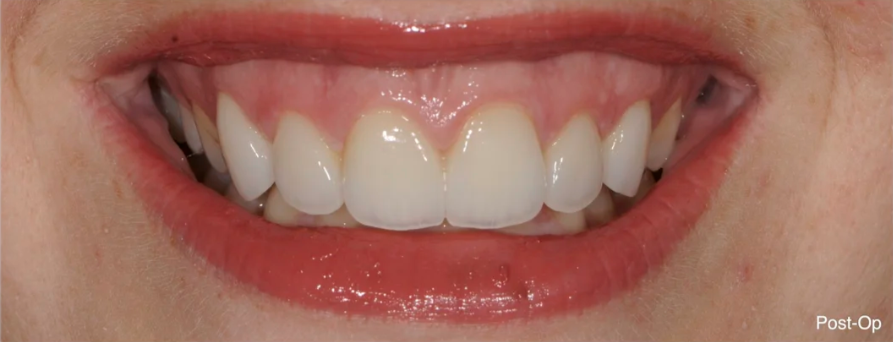
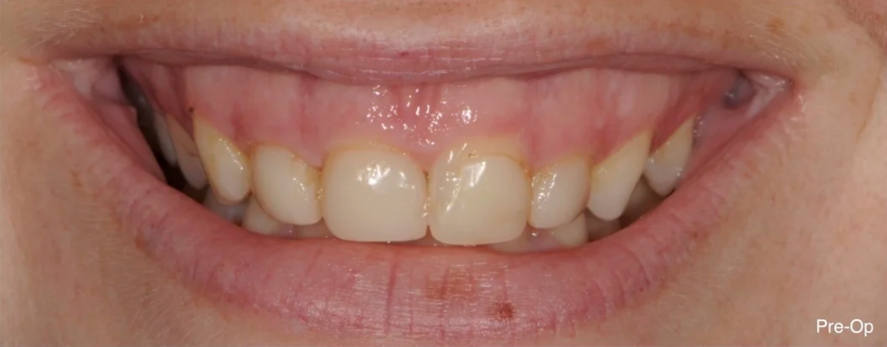
The before photo shows earlier restorations on the upper front teeth. They look more opaque than natural enamel, they are fuller than the natural tooth outline, and there is staining where they meet the teeth. Together these make the teeth stand apart from the rest of the smile.
Restorations are replaced for many reasons. Materials age and stain, gums change over the years, and a person's goals change too. We don't know the full history of earlier work, and the aim here isn't to judge it. The after photo shows the replacement restorations, which blend more closely with natural teeth in color, translucency and contour.
Replacing existing veneers or crowns usually means removing them completely and starting the design again.
What makes a smile look natural?
Facial harmony. The center of the smile lines up with the center of the face, and the teeth are in proportion to the face and lips. Oversized or flat restorations look artificial.
The smile arc. In most natural smiles, the edges of the upper teeth follow the curve of the lower lip. A flat, even line of teeth can look like piano keys.
Shape and proportion. Natural front teeth vary slightly from one to the next. The central incisors are usually a little longer than they are wide.
Color, not just whiteness. Brightness, translucency at the edges and surface texture decide whether teeth look natural. A shade that is too bright or too opaque stands out from across the room.
The gum line. Even, healthy gums frame the teeth. Uneven gums can make good restorations look wrong.
How can each treatment look natural or not?
Teeth whitening
Professional whitening is one of the simplest ways to brighten a smile. Checking enamel, existing fillings and sensitivity first helps avoid uneven results or discomfort.
Porcelain veneers
Veneers can make a large change, which is why planning and material choice matter. Veneers tend to look artificial when the ceramic is too opaque, the veneers are too thick, the contours are wrong or the translucency of natural enamel isn't considered. Well-planned ceramic veneers should be hard to tell from natural teeth.
Dental bonding
Bonding works well for small chips and gaps. Technique, polish and material matter, because composite that isn't finished and maintained well can stain and look dull over time. Our composite bonding post shows examples.
Gum contouring
Uneven gums can undermine otherwise good cosmetic work. Evaluating gum symmetry is part of planning, not an afterthought.
Clear aligners
Straight teeth are only part of the goal. Clear aligners should also account for the bite, the shape of the arch and long-term stability.
How do I plan a natural-looking result?
Listen first. What bothers you about your smile, and what would you like it to look like?
Photographs and records. Photos of your face, smile and teeth show proportions and the gum line. Models or scans show the bite.
Design around you. Tooth shapes are planned around your face, lips and gums, not a template.
Preview the change. A mock-up or temporary restorations let you see the new shape and adjust it before anything is final.
Material by tooth. I often use lithium disilicate ceramics such as e.max for front teeth because of their translucency. Other teeth or a heavy bite may call for a different material.
Work closely with the laboratory. Shade photographs, notes and approved temporaries go to the ceramist, who controls contour, texture and how the ceramic handles light.
You can see an example of this process in our e.max front teeth case.
What should you ask before cosmetic treatment?
How will the result be previewed before treatment starts?
Which material do you recommend for each tooth, and why?
Can I see before-and-after cases similar to mine?
How will my bite and gums be evaluated?
What maintenance should I expect afterward?
Price matters, but it shouldn't be the only factor. Ask what each estimate includes and how the result will be planned.
Frequently asked questions
How long do porcelain veneers last?
A systematic review of ceramic veneers estimated that about 89 percent were still in service after a median of 9 years. Chipping or fracture was the most common problem. How long yours last depends on your bite, grinding habits, gum health and care.
Is cosmetic dentistry painful?
Many cosmetic treatments, such as whitening and small bonding repairs, need little or no numbing. When teeth are prepared for veneers or crowns, they are numbed first. Some temporary sensitivity afterward is common.
What's the difference between whitening and veneers?
Whitening lightens the color of your natural teeth. Veneers can change shape, length and proportion as well as color.
Planning a natural-looking smile in Jacksonville
If you're considering a change to your smile, or replacing older cosmetic work, the first step is a conversation and an examination. Read more about cosmetic dentistry at our office, look through our before and after gallery, or see what to expect as a new patient. You can contact the office at 3675 Hendricks Avenue or call 904-398-1549.
Sources
Morimoto S, Albanesi RB, Sesma N, Agra CM, Braga MM. Main clinical outcomes of feldspathic porcelain and glass-ceramic laminate veneers: a systematic review and meta-analysis of survival and complication rates. Int J Prosthodont. 2016;29(1):38-49. doi:10.11607/ijp.4315 (retrieved via PubMed)
About the author. CJ Henley, DMD, is a general dentist in Jacksonville whose practice focuses on cosmetic and restorative dentistry, dental implants and dental care around head and neck cancer. Meet Dr. Henley.
CJ Henley, DMD, PA · 3675 Hendricks Avenue, Jacksonville, FL 32207 · 904-398-1549
Updated October 2026.