


Digital Dental Impressions: An Option Without Trays
3D Printing and Dentistry
We recently had a patient that simply could not tolerate dental impressions, however it had to be done to complete her treatment. So we used a digital 3D scanner to scan her mouth and had her models 3D be printed. Technology in dentistry today is amazing!
Yes, in many situations a digital 3D scan can record the shape of your teeth instead of a tray filled with impression material. We used this approach for a patient who simply could not tolerate traditional impressions. A scan isn't the right tool for every step of every treatment, but when it fits, it can make an uncomfortable part of the visit much easier.
A patient who couldn't tolerate impressions
We recently treated a patient who could not get through a traditional dental impression. The impression still had to be taken to finish her treatment, so we needed another way to record her teeth.
Instead of a tray, we used a digital 3D scanner to scan her mouth. The scan was then used to 3D print physical models of her teeth, which gave us what we needed to complete her care without the step she found so difficult.
What is a traditional dental impression?
A traditional impression uses a tray filled with a soft material that sets in a few minutes. It captures a mold of your teeth and gums. The mold is used to make models, crowns, bridges, night guards, aligners and other appliances.
For many people this is only a minor inconvenience. For others, the tray, the taste or texture of the material, or a strong gag reflex makes it very hard to tolerate.
How does a digital scan work?
A digital impression uses a small handheld scanner that is moved over your teeth. It records many images and combines them into a 3D model on the computer screen. There is no tray of material to hold in your mouth.
You still need to keep your mouth open while the scan is taken, and the scanner tip moves around your teeth. Most people find that easier than a full tray, and the scan can be paused if you need a break.
Where does 3D printing come in?
The digital model can be sent to a 3D printer to make a physical model of the teeth. That model can be used in the same ways a stone model from a traditional impression is used, such as checking the bite or making an appliance.
Is a scan always used instead of an impression?
No. I choose the method that gives the most accurate record for that particular step. Some situations still call for a traditional impression. The scan is a tool that helps when it fits the treatment, and it doesn't replace the examination and judgment that go into planning your care.
Research supports what we saw with this patient. A 2025 systematic review of studies on implant restorations found that patients consistently preferred digital impressions to traditional ones, and that scanning took less time in the studies that measured it. That review looked at implant treatment specifically, so it doesn't answer every question about other procedures.
If impressions have been hard for you
Tell us before your appointment if impressions, a strong gag reflex or dental anxiety have made past visits difficult. We can talk about which steps of your treatment could use a scan and how to make the visit more comfortable.
You can read more about the digital and 3D imaging we use, see what to expect at your first visit on our new patients page, or contact our Jacksonville office at 3675 Hendricks Avenue. You can also call the office at 904-398-1549.
Sources
Ribeiro CSC, Brandão MTO, Moreira GC, Bitencourt SB, de Carvalho RF, Lemos CAA. Intraoral scanning versus conventional impression for implant prostheses: a systematic review. Eur J Prosthodont Restor Dent. 2025;33(2):206-218. doi:10.1922/EJPRD_2811Ribeiro13 (retrieved via PubMed)
About the author. CJ Henley, DMD, is a general dentist in Jacksonville whose practice focuses on cosmetic and restorative dentistry, dental implants and dental care around head and neck cancer. Meet Dr. Henley.
CJ Henley, DMD, PA · 3675 Hendricks Avenue, Jacksonville, FL 32207 · 904-398-1549
Updated October 2026.
How Do Dental Implants Work?
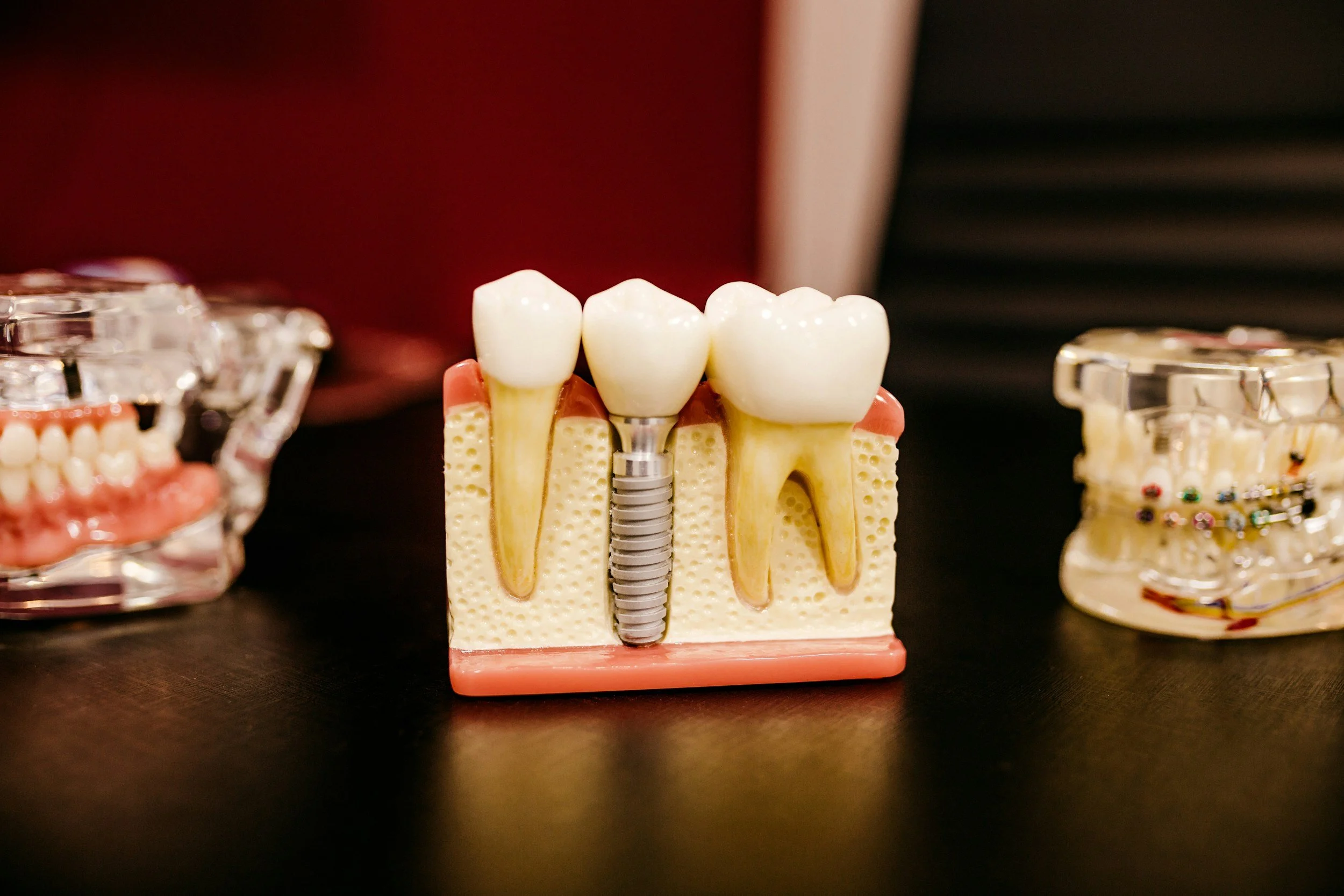
A dental implant replaces the root of a missing tooth. A small titanium or ceramic post is placed in the jawbone, the bone heals tightly against it, and then a crown, bridge or denture is attached on top. Whether an implant is the right choice depends on your bone, gums, bite and health, so the planning matters as much as the surgery.
What are the parts of a dental implant?
An implant restoration has three parts, and each has a job. Replacing teeth is not new: in colonial Boston, Paul Revere made and fitted false teeth carved from ivory and held in place with wire.
The implant. A post, usually titanium, placed in the jawbone where the root used to be.
The abutment. A connector that attaches to the implant and comes through the gum.
The restoration. The part you see and chew with: a crown for one tooth, a bridge for several, or a denture held in place by implants.
What is osseointegration, and why does healing take time?
Implants rely on living bone. After placement, bone grows onto the implant's surface and locks it in place. This is called osseointegration, and it usually takes a few months. Until it happens, the implant cannot take full chewing force.
For that healing to hold up long term, a few things need to be true:
Enough healthy bone in the right place
Healthy gums around the implant
An implant positioned for the way your teeth meet
A healing period that isn't overloaded or disturbed
When one of these is missed, an implant can seem fine at first and develop bone loss, loosening or a broken part years later.
What is evaluated before implant treatment?
I look at the whole mouth before recommending an implant for one space.
How your teeth meet and how hard you bite or grind
Bone volume and anatomy, often with 3D imaging when it answers a real planning question
The teeth and restorations next to the space
How well you can clean around an implant
Your health history and medications
Some situations call for more careful planning or a different approach. These include dry mouth, smoking, uncontrolled diabetes, some bone medications and previous radiation to the head and neck. Radiation in particular changes how the jawbone heals, so implant decisions after cancer treatment are made together with the patient's medical team.
How does the implant support the tooth you see?
Once the implant has healed, the abutment and restoration are attached. The crown is shaped and shaded to match your other teeth and designed for your bite. This step deserves as much attention as the surgery. A crown with the wrong contours can trap plaque or overload the implant, even when the implant itself was placed well.
Can implants replace one tooth or all of them?
Implants can replace:
A single missing tooth
Several missing teeth, often with an implant-supported bridge
A full arch, with a fixed bridge or a removable denture held by implants
Replacing many teeth takes more planning and sequencing. The bite, the bone and long-term wear have to be worked out together.
How long do dental implants last?
Many implants last for decades. A 2019 systematic review of modern implants found that about 96 percent were still in place after 10 years. A more cautious analysis in the same review, which allowed for patients lost to follow-up, estimated about 93 percent, and survival was somewhat lower in people 65 and older. [1]
An implant that is still in place is not the same as one with no problems. The crown can wear or break, screws can loosen, and gum and bone inflammation around an implant can develop. Cleaning at home, regular checkups and protecting implants from grinding all affect how well they hold up.
Is a dental implant right for everyone?
No. Bone loss, some medical conditions, smoking or previous radiation may call for more evaluation, extra procedures such as bone grafting, or a different solution. A bridge or a removable partial denture is sometimes the better choice. Our article on replacing missing teeth with a bridge compares the options.
What should you ask about implant treatment in Jacksonville?
Who will place the implant, and who will make and attach the crown?
What imaging is needed, and what question will it answer?
How long will healing take, and what will I have in the space meanwhile?
What are the alternatives, and what does each need over time?
What maintenance should I expect after treatment?
To talk through a missing tooth, start with a comprehensive dental examination at our office on Hendricks Avenue near San Marco. Bring your medication list and any previous X-rays or treatment plans. You can read more on our dental implants page or contact the office.
Sources
Howe MS, Keys W, Richards D. Long-term (10-year) dental implant survival: a systematic review and sensitivity meta-analysis. J Dent. 2019;84:9-21. doi:10.1016/j.jdent.2019.03.008 (retrieved via PubMed)
U.S. Food and Drug Administration. Dental implants: what you should know.
About the author. CJ Henley, DMD, is a general dentist in Jacksonville whose practice focuses on cosmetic and restorative dentistry, dental implants and dental care around head and neck cancer. Meet Dr. Henley.
CJ Henley, DMD, PA · 3675 Hendricks Avenue, Jacksonville, FL 32207 · 904-398-1549
Updated October 2026.