


Dental Bridge vs. Implant: Replacing Missing Teeth
Your smile is often the first thing that people will notice about you. It is not unusual for people to feel extremely self-conscious about their smile, especially if they have missing front teeth. How can we help you smile?
A dental bridge and a dental implant both replace missing teeth with fixed teeth that you don't take out. A bridge is supported by crowns on the teeth on either side of the gap. An implant is anchored in the jawbone and doesn't rely on the neighboring teeth. Which one fits you depends on the health of those neighboring teeth, the bone where the tooth is missing, your medical history, your timeline and your budget.
How does a dental bridge work?
A bridge literally spans the gap left by one or more missing teeth. It is made as one piece:
Abutments are crowns on the teeth on either side of the space. They hold the bridge in place.
Pontics are the replacement teeth that sit over the gap and are attached to the crowns.
Bridges are commonly made of ceramic, porcelain fused to metal, or metal alloys such as gold. For front teeth, appearance usually guides the choice. For back teeth, strength and the bite play a larger role.
To place a traditional bridge, the supporting teeth are shaped for crowns. That is the main trade-off: two teeth are reshaped to replace one.
How does an implant replace a tooth?
A dental implant is a small post placed in the jawbone where the tooth is missing. After the bone heals around it, a crown is attached. The neighboring teeth are left alone. Several missing teeth in a row can also be replaced with a bridge supported by implants instead of natural teeth.
Our dental implants page and our article on how dental implants work explain the steps in more detail.
When might a bridge make sense?
The teeth beside the gap already have large fillings or crowns and would benefit from new crowns anyway.
The bone where the tooth is missing isn't suitable for an implant, or building it up isn't something you want to do.
A health condition or medication makes implant surgery less advisable. For example, some bone-strengthening medicines affect how the jaw heals (see our page on osteoporosis medications and your dental health).
You want the replacement finished in a shorter time. A bridge usually takes a few weeks, while an implant needs months for healing.
When might an implant make sense?
The teeth beside the gap are healthy and unrestored, and you'd rather not reshape them.
There is enough healthy bone, or it can be rebuilt.
You want each tooth to stand on its own so you can floss normally around it.
How long do bridges and implants last?
Both have good track records, and neither is permanent. A systematic review of tooth-supported bridges found that about 94 percent of metal-ceramic bridges were still in place after five years. A separate review of single implant crowns found about 96 percent of the crowns still in service after five years and about 89 percent after ten. That review also noted that complications such as loose screws and gum problems around the implant were fairly common.
These figures come from different groups of patients, so they aren't a direct contest between the two. How long your restoration lasts depends more on your gums, home care, bite and regular checkups.
Why replace a missing tooth at all?
A gap does more than change your smile. Replacing a missing tooth can help you:
Chew and speak comfortably
Keep neighboring and opposing teeth from drifting or tipping into the space
Spread biting forces more evenly across your teeth
Not every missing tooth must be replaced. A missing back tooth sometimes causes no problems, and leaving the space can be a reasonable choice. We'll talk through that option too.
How do you care for a bridge or implant?
Bridge: Clean under the replacement tooth every day with a floss threader, super floss or a small brush. Decay on the supporting teeth is a common reason bridges fail.
Implant: Brush and floss around it like a natural tooth. Gum inflammation around an implant can lead to bone loss, so regular cleanings matter.
Both: If you clench or grind, ask about a night guard.
Talk about replacing a missing tooth in Jacksonville
The right choice starts with an examination of the teeth next to the gap, the bone and your bite. Dr. CJ Henley sees patients at 3675 Hendricks Avenue in San Marco. Contact the office or call 904-398-1549 to schedule a visit.
Sources
Pjetursson BE, Sailer I, Makarov NA, Zwahlen M, Thoma DS. All-ceramic or metal-ceramic tooth-supported fixed dental prostheses (FDPs)? A systematic review of the survival and complication rates. Part II: Multiple-unit FDPs. Dent Mater. 2015;31(6):624-639. doi:10.1016/j.dental.2015.02.013 (retrieved via PubMed)
Jung RE, Zembic A, Pjetursson BE, Zwahlen M, Thoma DS. Systematic review of the survival rate and the incidence of biological, technical, and aesthetic complications of single crowns on implants reported in longitudinal studies with a mean follow-up of 5 years. Clin Oral Implants Res. 2012;23 Suppl 6:2-21. doi:10.1111/j.1600-0501.2012.02547.x (retrieved via PubMed)
About the author. CJ Henley, DMD, is a general dentist in Jacksonville whose practice focuses on cosmetic and restorative dentistry, dental implants and dental care around head and neck cancer. Meet Dr. Henley.
CJ Henley, DMD, PA · 3675 Hendricks Avenue, Jacksonville, FL 32207 · 904-398-1549
Updated October 2026.

How Do Dental Implants Work?
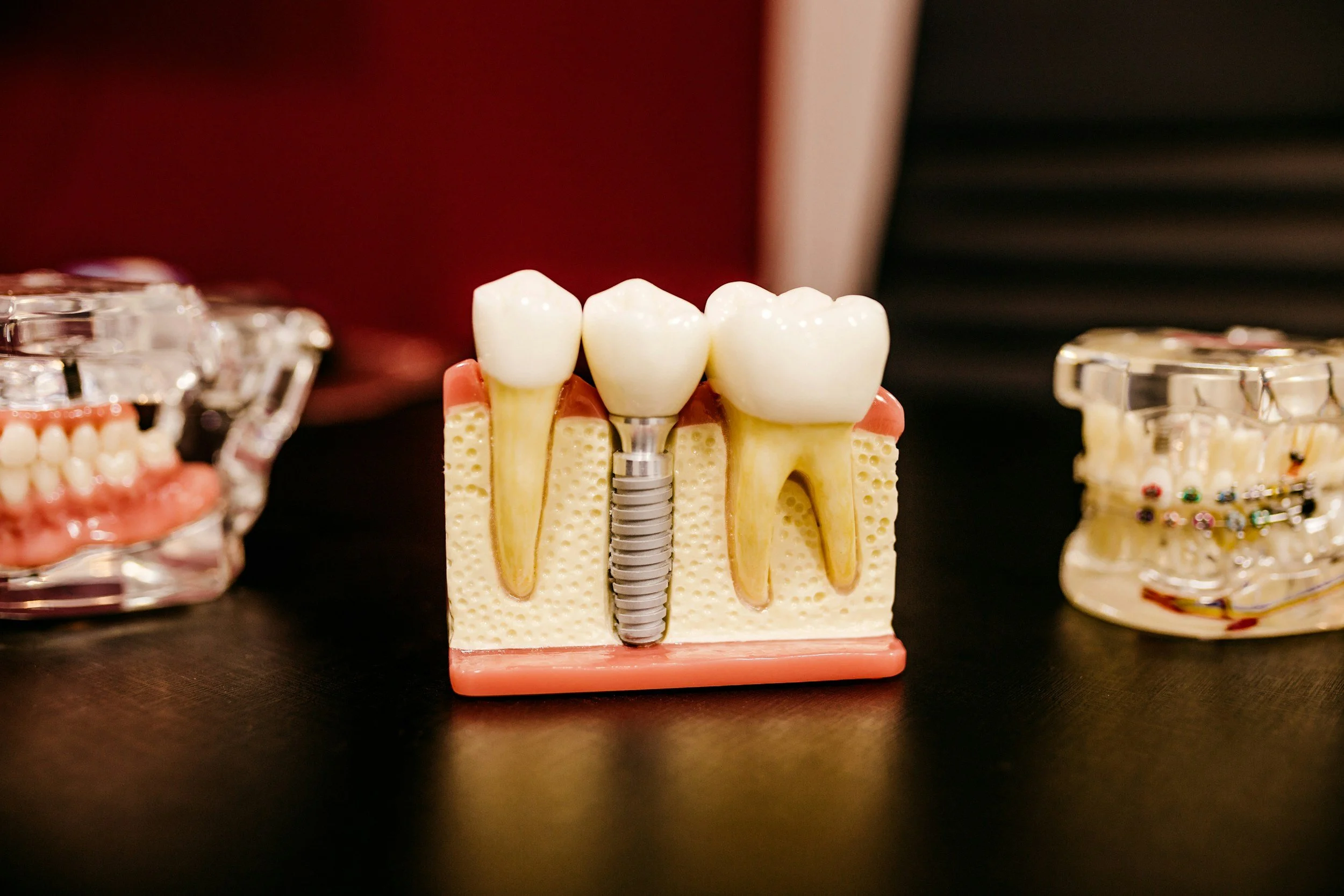
A dental implant replaces the root of a missing tooth. A small titanium or ceramic post is placed in the jawbone, the bone heals tightly against it, and then a crown, bridge or denture is attached on top. Whether an implant is the right choice depends on your bone, gums, bite and health, so the planning matters as much as the surgery.
What are the parts of a dental implant?
An implant restoration has three parts, and each has a job.
The implant. A post, usually titanium, placed in the jawbone where the root used to be.
The abutment. A connector that attaches to the implant and comes through the gum.
The restoration. The part you see and chew with: a crown for one tooth, a bridge for several, or a denture held in place by implants.
What is osseointegration, and why does healing take time?
Implants rely on living bone. After placement, bone grows onto the implant's surface and locks it in place. This is called osseointegration, and it usually takes a few months. Until it happens, the implant cannot take full chewing force.
For that healing to hold up long term, a few things need to be true:
Enough healthy bone in the right place
Healthy gums around the implant
An implant positioned for the way your teeth meet
A healing period that isn't overloaded or disturbed
When one of these is missed, an implant can seem fine at first and develop bone loss, loosening or a broken part years later.
What is evaluated before implant treatment?
I look at the whole mouth before recommending an implant for one space.
How your teeth meet and how hard you bite or grind
Bone volume and anatomy, often with 3D imaging when it answers a real planning question
The teeth and restorations next to the space
How well you can clean around an implant
Your health history and medications
Some situations call for more careful planning or a different approach. These include dry mouth, smoking, uncontrolled diabetes, some bone medications and previous radiation to the head and neck. Radiation in particular changes how the jawbone heals, so implant decisions after cancer treatment are made together with the patient's medical team.
How does the implant support the tooth you see?
Once the implant has healed, the abutment and restoration are attached. The crown is shaped and shaded to match your other teeth and designed for your bite. This step deserves as much attention as the surgery. A crown with the wrong contours can trap plaque or overload the implant, even when the implant itself was placed well.
Can implants replace one tooth or all of them?
Implants can replace:
A single missing tooth
Several missing teeth, often with an implant-supported bridge
A full arch, with a fixed bridge or a removable denture held by implants
Replacing many teeth takes more planning and sequencing. The bite, the bone and long-term wear have to be worked out together.
How long do dental implants last?
Many implants last for decades. A 2019 systematic review of modern implants found that about 96 percent were still in place after 10 years. A more cautious analysis in the same review, which allowed for patients lost to follow-up, estimated about 93 percent, and survival was somewhat lower in people 65 and older. [1]
An implant that is still in place is not the same as one with no problems. The crown can wear or break, screws can loosen, and gum and bone inflammation around an implant can develop. Cleaning at home, regular checkups and protecting implants from grinding all affect how well they hold up.
Is a dental implant right for everyone?
No. Bone loss, some medical conditions, smoking or previous radiation may call for more evaluation, extra procedures such as bone grafting, or a different solution. A bridge or a removable partial denture is sometimes the better choice. Our article on replacing missing teeth with a bridge compares the options.
What should you ask about implant treatment in Jacksonville?
Who will place the implant, and who will make and attach the crown?
What imaging is needed, and what question will it answer?
How long will healing take, and what will I have in the space meanwhile?
What are the alternatives, and what does each need over time?
What maintenance should I expect after treatment?
To talk through a missing tooth, start with a comprehensive dental examination at our office on Hendricks Avenue near San Marco. Bring your medication list and any previous X-rays or treatment plans. You can read more on our dental implants page or contact the office.
Sources
Howe MS, Keys W, Richards D. Long-term (10-year) dental implant survival: a systematic review and sensitivity meta-analysis. J Dent. 2019;84:9-21. doi:10.1016/j.jdent.2019.03.008 (retrieved via PubMed)
U.S. Food and Drug Administration. Dental implants: what you should know.
About the author. CJ Henley, DMD, is a general dentist in Jacksonville whose practice focuses on cosmetic and restorative dentistry, dental implants and dental care around head and neck cancer. Meet Dr. Henley.
CJ Henley, DMD, PA · 3675 Hendricks Avenue, Jacksonville, FL 32207 · 904-398-1549
Updated October 2026.