

Why Does Orange Juice Taste Bad After Brushing? A Dentist Explains the Science
Toothpaste's foaming agent mutes sweetness and makes orange juice taste bitter. Dr. Henley explains the science, and the morning routine that protects your enamel.
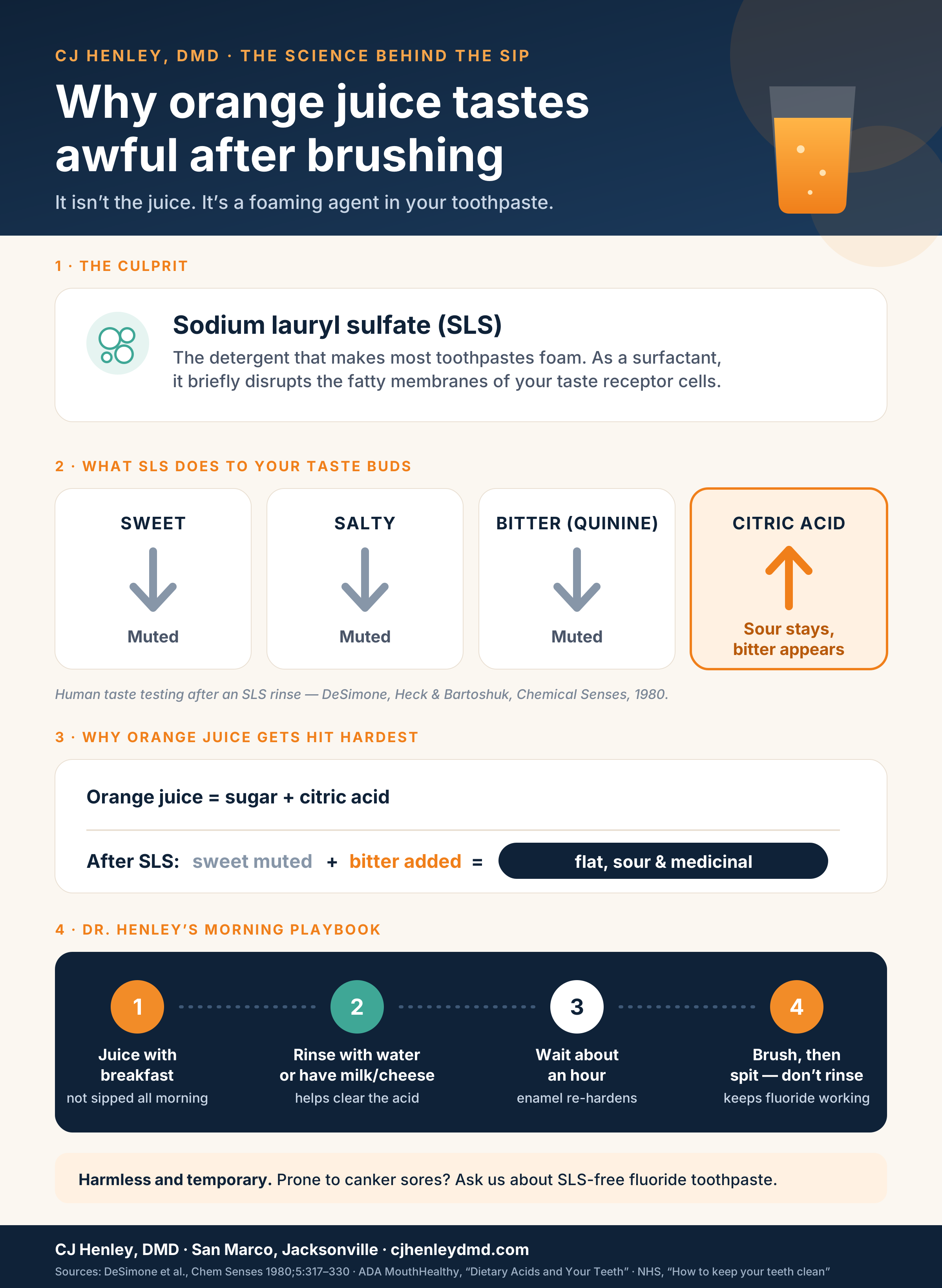
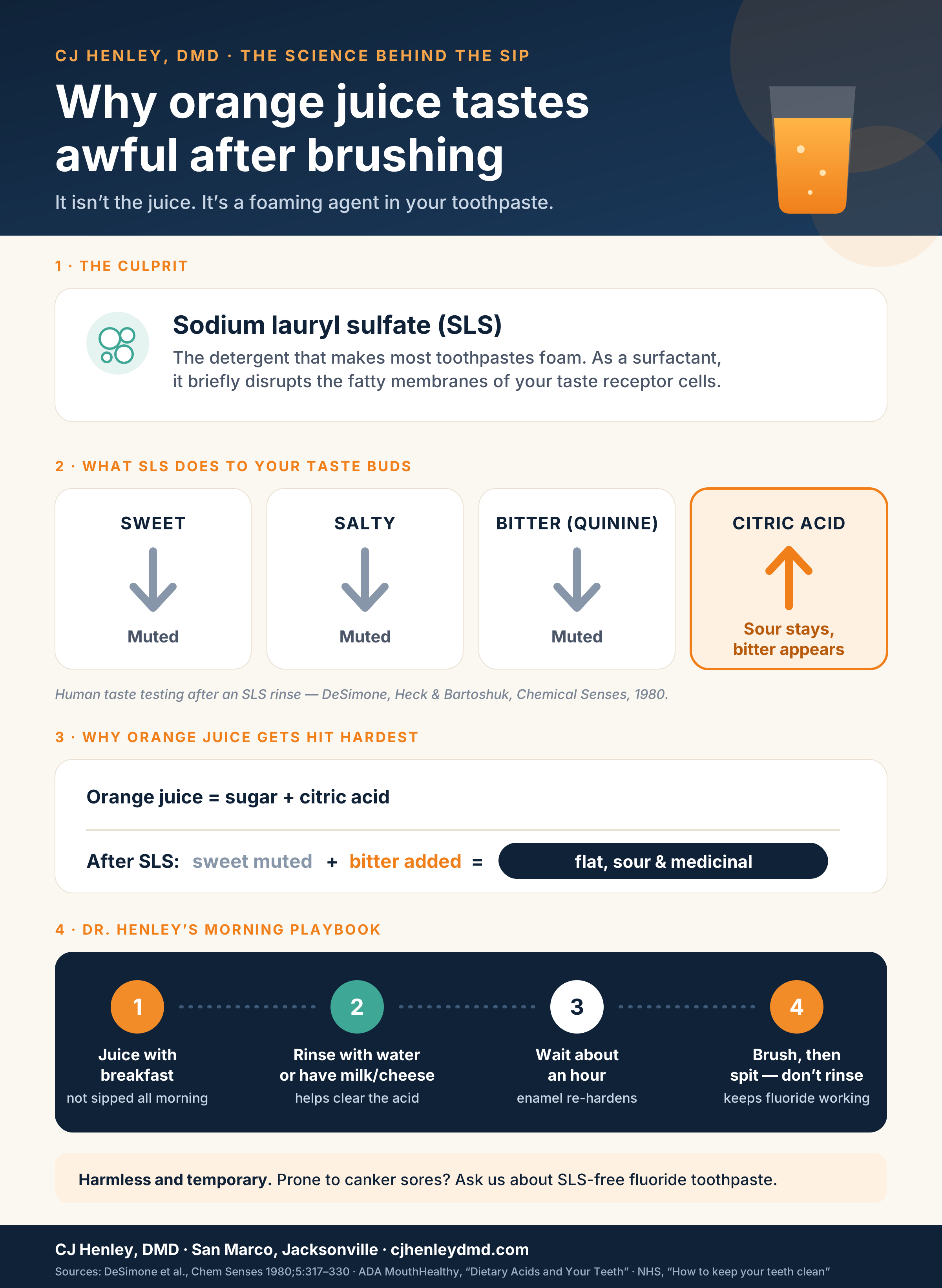
Most toothpastes contain sodium lauryl sulfate (SLS), the detergent that makes them foam. For a short time after brushing, SLS mutes your ability to taste sweetness and gives acids a bitter edge. Orange juice is mostly sugar plus citric acid, so you lose the sweet and gain the bitter. It's harmless and temporary, and the better fix is to change the order: juice first, brush about an hour later, and spit instead of rinsing.
By CJ Henley, DMD
The culprit: sodium lauryl sulfate
SLS is a surfactant, which means a detergent. It's in most mainstream toothpastes because it foams, spreads the paste around your mouth and helps lift debris.
It also happens to be a powerful taste modifier. In a 1980 study published in Chemical Senses, volunteers rinsed with a dilute SLS solution and then tasted test solutions. Sweet (sugar), salty and bitter (quinine) tastes were all suppressed. Citric acid stayed just as sour, but it picked up a distinct bitter taste it didn't have before. (1)
Why orange juice gets hit the hardest
Orange juice tastes good because of a balance between natural sugar and citric acid. After brushing, SLS knocks out the sugar side and adds bitterness to the acid side. What's left is flat, sour and faintly medicinal.
Coffee, water and most other breakfast foods don't have the same sugar-versus-acid balance to disrupt, which is why orange juice is the one everyone notices.
How SLS actually changes taste
Your taste receptor cells are wrapped in fatty membranes. The researchers behind the 1980 study concluded that SLS most likely works by physically disturbing those membranes rather than locking onto one specific receptor, much the way it breaks up grease on a dish. (1)
A second effect may add to the first. Phospholipids (fatty molecules) can selectively blunt bitter taste, as Japanese researchers showed in Nature in 1993. (2) SLS is very good at breaking phospholipids apart, so it may strip away some of that natural bitterness buffer at the same time. Add the lingering mint flavor, which clashes with citrus, and the result is unmistakable.
Is it harmful?
No. The taste distortion is temporary and fades as saliva clears the SLS from your mouth. But the question points to two habits that do matter for your teeth, and most people get them backwards.
1. Don't brush right after orange juice
Orange juice is acidic. Acid temporarily softens the outer surface of enamel, and brushing that softened surface can wear it away. The American Dental Association recommends waiting about an hour after acidic foods or drinks before brushing, so saliva can wash away the acid and help enamel re-harden. (3)
Enamel erosion is permanent. We rebuild worn, eroded teeth in our office, and you can see what that involves in our case studies and before-and-after gallery. Still, the easiest version of that treatment is never needing it. If your teeth already feel sensitive to cold or sweets, erosion is one of the things we look for at a comprehensive exam.
2. Spit, don't rinse
Rinsing with water after brushing seems like the obvious way to get rid of the toothpaste taste. It also washes away the concentrated fluoride your toothpaste just left on your teeth. The UK's National Health Service advises spitting out the excess without rinsing, and not using mouthwash right after brushing either. (4)
My morning routine for juice drinkers
If you drink juice with breakfast:
Have your orange juice with the meal, not sipped over the whole morning.
Afterward, rinse with water, or have a little milk or cheese. (3)
Wait about an hour.
Brush with fluoride toothpaste. Spit, don't rinse.
If you'd rather brush as soon as you wake up, brush, spit and don't rinse, then save the orange juice for later in the morning.
Should you switch to an SLS-free toothpaste?
For most people, timing solves the orange juice problem. But an SLS-free fluoride toothpaste is worth considering if you:
Get recurring canker sores. A systematic review of double-blind trials found that people with recurrent canker sores who switched to SLS-free toothpaste had fewer ulcers, shorter-lasting ulcers and less pain. (5)
Have a dry or sensitive mouth, including during or after cancer treatment.
Simply prefer it and want breakfast to taste right.
Whatever you choose, make sure it contains fluoride. Our toothpaste guide breaks down which ingredients actually matter. For the short version, see the toothpaste I use myself.
When it isn't the toothpaste
If food tastes off all the time, whether metallic, bitter, burning or just wrong, that isn't SLS. Persistent taste changes can come from medications, dry mouth, burning mouth syndrome, or radiation and chemotherapy for head and neck cancer.
Our practice evaluates these mouth symptoms, including taste changes, burning, dryness and unexplained soreness, through careful oral medicine diagnosis. Dr. Henley serves on the Head and Neck Tumor Board at Baptist MD Anderson, where his role is dental care and coordination, and physicians refer patients to our San Marco office for dental care before, during and after cancer treatment.
Frequently asked questions
Why does orange juice taste bitter after brushing my teeth?
Sodium lauryl sulfate, the foaming agent in most toothpastes, temporarily suppresses sweet taste and adds a bitter note to citric acid. Orange juice depends on sweetness to balance its acidity, so it tastes sour and bitter until the effect fades.
Is it bad to brush right after drinking orange juice?
It's better to wait. Acid softens enamel, and brushing immediately can wear it away. The ADA recommends waiting about an hour after acidic foods or drinks before brushing.
Should I rinse after brushing to get rid of the taste?
No. Rinsing washes away the fluoride left by your toothpaste. Spit out the excess and leave the rest.
Does every toothpaste do this?
Toothpastes that contain sodium lauryl sulfate cause it. SLS-free toothpastes generally don't, so check the ingredient list.
When should I see a dentist about taste changes?
If the bad taste lasts beyond the minutes after brushing, happens with every food, or comes with burning, dryness or soreness, have it evaluated. These can signal dry mouth, medication effects, burning mouth syndrome or other oral conditions.
Questions about taste changes or enamel wear?
Dr. CJ Henley practices general, cosmetic and restorative dentistry in San Marco and welcomes patients from across Jacksonville. New-patient visits are about two hours, so there's time to ask questions and get straight answers, including the "why does this happen?" ones.
Meet Dr. Henley · New patients · Book online · Call 904-398-1549
Related reading: Is sparkling water bad for your teeth? · Foods that support healthy teeth · Dry mouth causes and treatment · Are you brushing too hard?
This article is for general education and isn't a substitute for an exam. Questions about your own mouth? Contact our office.
Sources
DeSimone JA, Heck GL, Bartoshuk LM. Surface active taste modifiers: a comparison of the physical and psychophysical properties of gymnemic acid and sodium lauryl sulfate. Chem Senses. 1980;5(4):317-330. doi:10.1093/chemse/5.4.317 (checked at publisher)
Katsuragi Y, Kurihara K. Specific inhibitor for bitter taste. Nature. 1993;365(6443):213-214. doi:10.1038/365213b0 (retrieved via PubMed)
American Dental Association, MouthHealthy. Dietary acids and your teeth.
NHS. How to keep your teeth clean. Reviewed June 2025.
Alli BY, Erinoso OA, Olawuyi AB. Effect of sodium lauryl sulfate on recurrent aphthous stomatitis: a systematic review. J Oral Pathol Med. 2019;48(5):358-364. doi:10.1111/jop.12845 (retrieved via PubMed)
About the author. CJ Henley, DMD, is a general dentist in Jacksonville whose practice focuses on cosmetic and restorative dentistry, dental implants and dental care around head and neck cancer. Meet Dr. Henley.
CJ Henley, DMD, PA · 3675 Hendricks Avenue, Jacksonville, FL 32207 · 904-398-1549
Updated October 2026.

Does Removing Wisdom Teeth Change Your Sense of Taste?
Patients who had their wisdom teeth extracted had improved tasting abilities decades after having the surgery, according to a new study.
For most people, not in a way they would notice. Some people have a temporary change in taste after wisdom tooth surgery, which usually fades within a year. A 2021 study from the University of Pennsylvania found that people who had wisdom teeth removed, on average more than 20 years earlier, scored slightly better on taste tests than people who had not. The difference was small, the study cannot prove the surgery caused it, and it is not a reason to remove healthy wisdom teeth.
What question did the study ask?
Nerves that carry taste from the tongue run close to the lower wisdom teeth. Earlier research had focused on short-term problems, such as reduced or altered taste after surgery, and those problems were generally thought to resolve within a year. Dane Kim and Richard Doty at Penn's Smell and Taste Center asked what happens to taste over the long term.
How was it done?
The researchers looked back at records of 1,255 people who had been tested at the Smell and Taste Center over about 20 years. Of these, 891 had had wisdom teeth removed and 364 had not.
Everyone had taken the same whole-mouth taste test. They sipped and spat out solutions of sugar, salt, citric acid and caffeine at several strengths and identified each one as sweet, salty, sour or bitter. The analysis accounted for age.
What did it find?
The group that had wisdom teeth removed scored better for all four tastes.
The scores were not linked to how long ago the surgery took place.
In both groups, women scored higher than men, and taste declined with age.
According to the press release, the improvement was typically about 3 to 10 percent.
The authors suggested two possible explanations. Minor injury to one taste nerve might reduce the normal dampening it has on another taste nerve, so overall taste becomes slightly more sensitive. Or the injured nerve itself might become more sensitive over time. Neither has been tested.
What are the limits?
It looked back at existing records rather than following people before and after surgery.
The participants were people tested at a smell and taste clinic, so they may not represent the general public.
An association does not show that removing wisdom teeth improves taste. The authors said prospective studies are needed to confirm it.
What does this mean for you?
Taste changes are not a reason to remove wisdom teeth or to keep them. Whether a wisdom tooth should come out depends on whether it is causing problems or likely to, such as decay, gum infection, damage to a neighboring tooth or lack of room. Healthy, well-positioned wisdom teeth that can be kept clean are often left in place. Our post on whether wisdom teeth always need to be removed explains how that decision is made.
If you do have a wisdom tooth removed and notice a change in taste or numbness that does not improve within a few weeks, tell your dentist or oral surgeon. Our home care instructions cover recovery after an extraction. In Jacksonville, you can contact our office with questions about your wisdom teeth.
Sources
Kim D, Doty RL. Positive long-term effects of third molar extraction on taste function. Chem Senses. 2021;46:bjab032. doi:10.1093/chemse/bjab032. Retrieved via PubMed.
Penn Medicine. Press release on wisdom tooth extraction and long-term taste function, 2021.
About the author. CJ Henley, DMD, is a general dentist in Jacksonville whose practice focuses on cosmetic and restorative dentistry, dental implants and dental care around head and neck cancer. Meet Dr. Henley.
CJ Henley, DMD, PA · 3675 Hendricks Avenue, Jacksonville, FL 32207 · 904-398-1549
Updated October 2026.