
CJ Henley, DMD, PA / San Marco, Jacksonville, Florida
Cracked, chipped, or broken tooth in Jacksonville?
Find the crack. Fix it before it spreads.
A cracked tooth doesn’t heal on its own, and a crack that is caught early is usually much simpler to repair. At our San Marco office, Dr. CJ Henley finds cracks that X-rays often miss, repairs most chipped teeth with bonding in a single visit, and protects deeper cracks with a crown handcrafted by a local lab. Broke a tooth today? Call us; we hold time for same-day visits during office hours.
- 5types of cracked teeth, each with a different repair1
- 0cracks that heal on their own; treatment stops them getting worse1,2
- 79% vs 37%how often 3D cone beam scans vs regular X-rays detected root fractures in studies the AAE cites4
- 1 visitfor most chipped front teeth repaired with bonding
Top-rated on Google: 4.9 stars from more than 225 patient reviews.
Chipped vs cracked vs broken tooth
Chipped, cracked, or broken: what’s the difference?
A chipped tooth has lost a small piece of enamel, usually at an edge. A cracked tooth has a fracture line running into it, but the pieces are still together. A broken tooth has lost a large piece, sometimes exposing the nerve. All three need a dentist; how soon depends on pain, the size of the break, and whether the nerve is showing.
-
Chipped
A small piece is gone
Usually an edge or corner. Often no pain, but the edge can feel sharp to the tongue.
Smoothing or bonding, one visit
-
Cracked
A line runs into the tooth
The tooth is in one piece, but chewing flexes the crack and can irritate the nerve.
Depends on depth: see the 5 types
-
Broken
A large piece is missing
May expose the pink nerve, bleed, or ache with air and cold.
Same-day visit; crown, root canal, or more
Illustration: CJ Henley, DMD.
Cracked tooth symptoms
Cracked or broken tooth symptoms, and why some cracks don’t hurt.
The classic sign of a cracked tooth is a sharp pain when you bite down, especially the moment you let go. Pain with cold that comes and goes, and trouble telling which tooth hurts, are common too. Dentists sometimes call this cracked tooth syndrome. Many cracks cause no symptoms at all until they spread1,2.
Broken tooth with no pain? It still needs a visit. Pain often goes away because the crack hasn’t reached the nerve yet, or because the nerve has already been damaged. Either way, the tooth is weaker than it looks.
The five types of cracked teeth
The 5 types of cracked teeth, and what each one needs.
The American Association of Endodontists describes five kinds of cracks: craze lines, a fractured cusp, a cracked tooth, a split tooth, and a vertical root fracture1. They range from harmless surface lines to cracks that can’t be saved, and one can turn into the next over time. Where the crack is and how deep it goes decide the repair.
-
Type 1
Craze lines
Tiny lines in the enamel only. Common in adults, with no pain.
No treatment needed; cosmetic only
-
Type 2
Fractured cusp
A corner of the chewing surface breaks, often beside an old filling.
New filling, onlay, or crown
-
Type 3
Cracked tooth
A crack runs from the top down toward the root. The tooth is still in one piece.
Crown; root canal if the nerve is hurt
-
Type 4
Split tooth
A cracked tooth that has separated into two pieces.
Usually extraction; implant or bridge
-
Type 5
Vertical root fracture
Starts in the root, often with few signs until the gum or bone gets infected.
Usually extraction
Illustration: CJ Henley, DMD, after the American Association of Endodontists’ five crack types1.
| Type | Typical symptoms | Can it be saved? | What we usually do |
|---|---|---|---|
| Craze lines | None | ✓ Nothing to save | Leave alone; bonding or a veneer only if the look bothers you |
| Fractured cusp | Sharp edge, mild sensitivity | ✓ Usually | Bonded filling if small; onlay or crown if large |
| Cracked tooth | Pain on biting or release, cold sensitivity | Often, if caught early and the crack stops above the gumline | Crown to hold it together; root canal first if the nerve is inflamed |
| Split tooth | Pain, a loose piece, gum swelling | ✗ Rarely intact | Extraction, then a dental implant or bridge |
| Vertical root fracture | Mild ache, gum swelling, a pimple on the gum | ✗ Usually not | Extraction and replacement; sometimes an endodontist can remove one root |
How a cracked tooth is diagnosed
How we find a crack that X-rays can miss.
No single test shows every crack. Regular X-rays often miss them, because a crack runs in a direction the X-ray can’t see. Dr. Henley combines your history, a bite test on each cusp, a bright light, magnification, gum measurements, and when appropriate a 3D scan to find the tooth and judge how deep the crack goes2,3.
Your story
When it hurts, what sets it off, and whether letting go of a bite is worse. This narrows it to a few teeth.
Bite test
You bite on a small tool one cusp at a time. The cusp that reproduces the pain points to the crack.
Light and magnification
A bright light shone through the tooth stops at a crack line. Magnification shows lines too fine for the naked eye.
Gum measurements
A deep, narrow pocket beside one spot on a tooth can mean a crack running down the root.
X-rays and 3D imaging
X-rays check the nerve and bone. A 3D cone beam scan can show the bone loss a root fracture leaves behind, though it can’t see the finest cracks in the crown3,4.
Cracked and chipped tooth repair
How we repair a chipped or cracked tooth in Jacksonville.
We use the smallest repair that will hold. A small chip is smoothed or bonded the same day. A broken corner gets a bonded filling or an onlay. A cracked tooth usually needs a crown to hold the pieces together, with a root canal first if the nerve is inflamed. A tooth split below the gum can’t be saved and is replaced.
01 Smallest
Smooth and polish
Tiny chips and sharp edges. A few minutes, often no numbing.
02 One visit
Bonding
Tooth-colored composite sculpted onto the chip. One visit. See dental bonding.
03 Cusp broken
Filling or onlay
A broken cusp or a crack beside a large filling. An onlay covers the cusps.
04 Crack
Crown
Holds a cracked tooth together. Handcrafted by our local lab; two visits with a temporary in between.
05 Nerve involved
Root canal + crown
When the crack has inflamed the nerve. Front teeth and premolars here; most molars go to an endodontist.
06 Not savable
Extraction + replacement
For a split tooth or root fracture. An implant or a bridge replaces it.
Why a crown for a cracked tooth?
A crown wraps the whole tooth, so biting pushes the pieces together instead of apart. It gives a cracked tooth the most protection, though no repair can promise a crack won’t spread1. Read why do I need a crown?
No same-day crowns, on purpose
Every crown we make is handcrafted by a local dental lab, so a crown takes two visits. The temporary crown protects the cracked tooth in between, and you get a crown chosen and layered for your tooth. See dental crowns and bridges.
Chipped front tooth repair
Fixing a chipped front tooth so no one can tell.
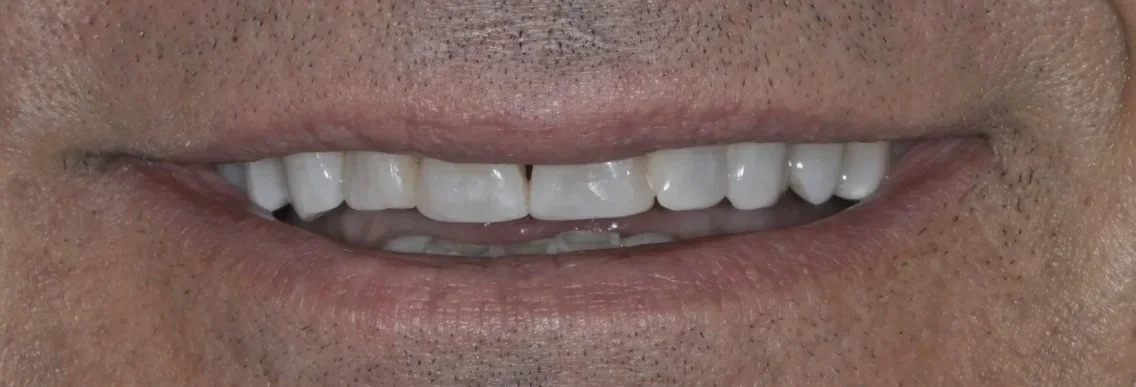
Most chipped front teeth are repaired with composite bonding in one visit: the tooth is lightly roughened, composite is layered in matching shades, then shaped and polished. Bring any broken piece you saved; occasionally it can be bonded back on, though fresh bonding usually gives a stronger, better-matched result. Larger breaks, or several worn and chipped teeth, may do better with porcelain veneers or crowns.
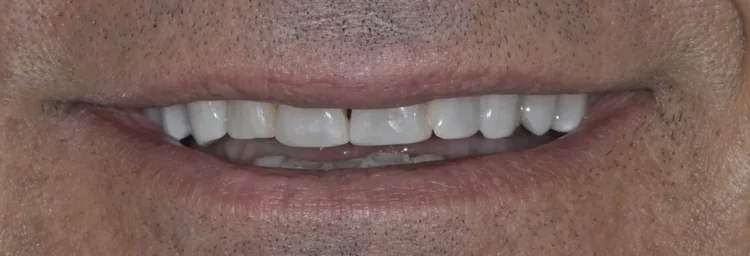
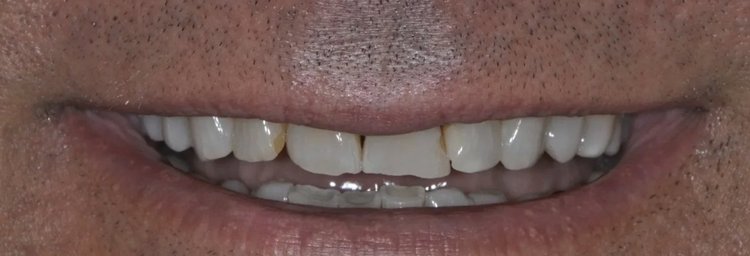
Chipped front teeth, repaired with bonding
Chips along the edges of the upper front teeth were rebuilt with tooth-colored bonding for an even, natural smile line. No drilling into healthy tooth, no lab, one visit.
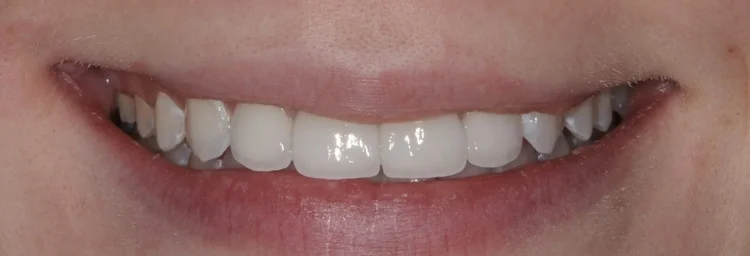
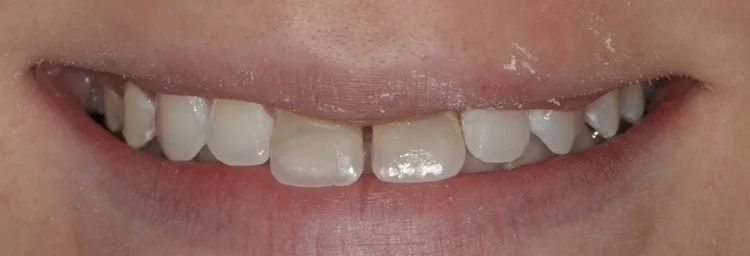
When bonding isn’t enough
Front teeth broken in childhood had been patched for years. Some needed full crowns and others only veneers, all in e.max so they read as one smile.
Bonding, veneer, or crown for a chipped tooth?
Bonding suits small to medium chips and is the least invasive. A porcelain veneer suits a larger chip on a tooth that also needs a color or shape change. A crown is for a front tooth that is broken badly or was already heavily filled.
Chipped veneer or crown?
A small chip in porcelain can often be polished or repaired with bonding. A larger chip, or one that keeps happening, usually means replacing it and checking the bite. See veneer replacement.
Can a cracked tooth heal?
Can a cracked tooth heal or be saved?
A cracked tooth can’t heal. Unlike bone, enamel and dentin don’t knit back together, and chewing tends to drive a crack deeper over time1,2. Many cracked teeth can be saved, and most treated cracked teeth keep working comfortably for years1. The earlier a crack is protected, the better the odds.
What decides whether a cracked tooth can be saved
- Depth: a crack that stops above the gumline is usually restorable; one that runs below it into the root usually isn’t.
- The nerve: a healthy nerve means a crown alone may be enough; an inflamed nerve adds a root canal.
- Direction: a crack running side to side can sometimes be removed with the broken cusp; one running down the middle is more serious.
- Time: cracks progress. Pain that comes and goes is not a reason to wait.
Why teeth crack
Why teeth crack: grinding, big old fillings, and more.
The most common reasons are clenching and grinding, large old fillings that leave thin walls, back teeth that had a root canal without a crown, and biting hard things like ice or popcorn kernels. Cracked teeth are more common after age 40, as teeth wear2.
Protecting a repaired tooth with a night guard
If grinding cracked the tooth, it will keep working on the repair. After we fix a cracked tooth in a grinder, we recommend a custom night guard to spread the biting force, and for heavy biters we often choose a stronger crown material such as full-contour zirconia. A night guard only helps on the nights you wear it.
Just chipped or broke a tooth?
What to do before you come in.
Rinse with warm water, save any piece of tooth in milk or a clean container, cover a sharp edge with dental wax or sugar-free gum, and chew on the other side. Call us to be seen. For swelling, heavy bleeding, a knocked-out tooth, or a hit to the head, follow our dental emergency guide.
Do
- Call 904.398.1549 and tell us what broke.
- Rinse gently with warm water; a cold compress on the cheek for swelling.
- Keep any broken piece moist in milk or saliva and bring it.
- Take an over-the-counter pain reliever as directed on the label.
Avoid
- Aspirin or numbing gel placed directly on the gum1
- Chewing on that side, or very hot and cold foods
- Super glue or any household adhesive
- Waiting because the pain went away
Chipped teeth in children
My child chipped a tooth. What should I do?
Find the piece if you can and keep it in milk, rinse the mouth, and call us. Chipped baby teeth are often just smoothed, while a chipped adult tooth is usually bonded. If your child hit their head, seems confused, or vomits, see a doctor or go to the ER first.
We see children from age 2, and we see children with dental injuries the same day during office hours. Even a small chip in a baby tooth is worth a look, because the blow can bruise the nerve and the tooth may darken weeks later. For a knocked-out adult tooth, every minute counts: follow the steps on our knocked-out tooth guide. Never put a knocked-out baby tooth back in.
A sports mouthguard is the simplest way to prevent most chipped teeth in kids who play contact sports. Read more on our children’s dentistry page.
Cost and insurance
What does it cost to fix a cracked or chipped tooth in Jacksonville?
The cost depends on the type of crack and the repair it needs: smoothing and bonding cost far less than a crown, and a root canal or extraction adds to it. That is the strongest reason to have a crack checked early, while it is still a small repair. We give you the fee before treatment begins.
We are an out-of-network practice. Some dental plans cover part of a repair for a cracked or chipped tooth, often with a frequency limit on crowns. We can help you understand how to use your benefits; you are responsible for amounts your plan does not pay. Call our team with your plan details to ask about fees and payment arrangements. See dental insurance and payment.
Why patients choose our office
Why Jacksonville patients bring a cracked or broken tooth to Dr. Henley.
The same dentist from diagnosis to final repair, a careful search for the crack before anything is drilled, and crowns handcrafted by a local lab instead of milled while you wait.
Cracked tooth repair near you
Cracked and chipped tooth repair in San Marco, for all of Jacksonville.
Dr. CJ Henley is a general dentist in Jacksonville who earned his DMD at the University of Florida. Much of his restorative work is saving cracked and broken teeth, and rebuilding teeth worn down by grinding.
Our office on Hendricks Avenue is easy to reach from San Marco, Southbank, San Jose, Riverside, Avondale, Ortega, St. Nicholas, Downtown, and Mandarin. Patients with complex medical histories are welcome; read about our complex and medically involved care.
See what patients say in our reviews, or learn more about our San Marco dental office.
San Marco
On Hendricks Avenue, in the neighborhood
Chipped a tooth at lunch? We’re minutes away.
Downtown and Southbank
Southbank borders us; Downtown is across the Main Street Bridge
A bonding repair fits around a workday.
Riverside, Avondale, and Ortega
Across the St. Johns River on the Fuller Warren Bridge
See our Riverside and Avondale dentist page.
San Jose and Mandarin
North on San Jose Boulevard, which becomes Hendricks Avenue
See our Mandarin dentist page.
Jacksonville Beach, Neptune Beach, and Atlantic Beach
West on Atlantic Boulevard or Beach Boulevard
See our Jacksonville Beach dentist page.
Ponte Vedra and Nocatee
West on J. Turner Butler Boulevard, then north on I-95
See our Ponte Vedra dentist page.
Orange Park, Fleming Island, and St. Augustine
North on US-17 or I-95
See our Orange Park and St. Augustine pages.
Frequently asked questions
Questions about cracked, chipped, and broken teeth in Jacksonville.
How do I know if my tooth is cracked?
The most telling sign is sharp pain when you bite down and especially when you release. Cold sensitivity that comes and goes and pain you can’t pin to one tooth are common too. Many cracks are invisible and don’t show on X-rays, so an exam with a bite test is the way to know.
Can a cracked tooth heal on its own?
No. Enamel and dentin don’t grow back together, and chewing tends to make a crack deeper. Treatment stops the crack from spreading and protects the tooth.
Can a cracked tooth be saved?
Often, yes, especially when the crack stops above the gumline and is treated early. A crown holds it together, with a root canal first if the nerve is inflamed. A tooth that has split, or has a crack running down the root, usually has to be removed and replaced.
Is a chipped tooth an emergency?
A small chip with no pain can wait a few days, but should still be checked. A large break, pain, bleeding, or a pink or red spot in the center of the tooth needs to be seen the same day. Call 904.398.1549.
How do you fix a chipped front tooth?
Usually with bonding: tooth-colored composite is layered onto the chip, shaped, and polished in one visit. A larger break, or a tooth that also needs a color change, may need a porcelain veneer or a crown.
Can a broken piece of tooth be glued back on?
Occasionally. A clean piece of a front tooth can sometimes be bonded back in place, but new bonding is usually the stronger, better-matched repair. Keep the piece moist in milk or saliva and bring it with you. Never use super glue or household adhesive.
Does a cracked tooth always need a crown?
Not always. Craze lines need nothing, and a small broken cusp may only need a filling or an onlay. A true crack running toward the root usually needs a crown to hold the tooth together.
Does a cracked tooth need a root canal?
Only if the crack has inflamed or infected the nerve. Lingering pain after cold, throbbing, or swelling suggest it has. Many cracked teeth get a crown with no root canal. We do root canals on front teeth and premolars and usually refer molars to an endodontist.
My tooth broke but doesn’t hurt. Do I still need to come in?
Yes. No pain can mean the crack hasn’t reached the nerve yet, which is the best time to fix it. It can also mean the nerve was already damaged. Either way, the tooth is weaker and can break further.
What are craze lines?
Tiny vertical lines in the enamel, common on adult front teeth. They’re harmless and need no treatment. If they pick up stain and bother you, whitening, bonding, or veneers can improve the look.
Can grinding crack my teeth?
Yes. Grinding and clenching are among the most common causes of cracked teeth and broken cusps. A custom night guard spreads the force and protects both natural teeth and repairs.
Why did my tooth crack for no reason?
There is almost always a reason: night grinding, a large old filling, a back tooth that had a root canal without a crown, or years of chewing ice or hard foods. The crack builds slowly and then shows itself on an ordinary bite.
Can you fix a chipped tooth the same day?
Most chips repaired with bonding are done in one visit. Crowns take two visits, because every crown we make is handcrafted by a local lab; a temporary crown protects the tooth in between.
Does insurance cover a cracked or broken tooth?
Many plans cover part of bonding, fillings, and crowns, often with frequency limits. We are an out-of-network practice and can help you understand how to use your benefits. Call our team with your plan details to ask about fees before scheduling.
Where can I get a cracked tooth fixed in Jacksonville?
CJ Henley, DMD, PA repairs cracked, chipped, and broken teeth at 3675 Hendricks Avenue, Jacksonville, FL 32207, in San Marco. Call 904.398.1549; new patients are welcome.
More reading: Dental emergencies · Dental bonding · Dental FAQ
Your next step
Get the crack checked while it’s still small.
A crack caught early is usually a crown or a bonding repair. A crack left alone can become a root canal or a lost tooth. Call us, describe what happened, and we’ll find a time. If there is swelling or a tooth was knocked out, see emergency dental care.
CJ Henley, DMD, PA3675 Hendricks Avenue
Jacksonville, FL 32207
Prefer a nonurgent text? 904.762.5616 is our practice on-call and text line. Please don’t send sensitive health information by text, and call for anything urgent.
Related pages
Sources
- American Association of Endodontists. Cracked teeth. Accessed October 2026.
- Li F, Diao Y, Wang J, et al. Review of cracked tooth syndrome: etiology, diagnosis, management, and prevention. Pain Res Manag. 2021.
- Cleveland Clinic. Cracked tooth (fractured tooth). Accessed October 2026.
- American Association of Endodontists. Endodontics: Colleagues for Excellence. CBCT in diagnosis. 2018.
- American Dental Association, MouthHealthy. Teeth grinding. Accessed October 2026.