
CJ Henley, DMD, PA / San Marco, Jacksonville, Florida
Tooth-colored fillings in Jacksonville, FL.
Found early, placed carefully, built to last.
A dental filling repairs a tooth after a cavity by removing the decay and rebuilding the tooth with a bonded material. At our San Marco office, Dr. CJ Henley places tooth-colored composite fillings that match your tooth (and, in the rare case it is the better choice, amalgam), finds cavities early with an exam and X-rays, and tells you honestly when early decay can heal with fluoride instead of a drill.
- 80%+of Americans have at least one cavity by their mid-30s1
- 1.8%yearly failure rate of back-tooth composite fillings over five years in a 2014 review2
- 1–2 wksfor normal sensitivity after a new filling to settle3
- Every oneplaced by Dr. Henley himself, not an associate
Top-rated on Google: 4.9 stars from more than 225 patient reviews.
What is a cavity?
How a cavity grows, and when it needs a filling.
A cavity is a hole in a tooth caused by tooth decay. Bacteria in plaque turn sugar into acid, the acid pulls minerals out of the enamel, and over months a weak spot becomes a hole. Early decay often causes no pain at all, which is why cavities are usually found at a checkup, not by a toothache.
-
Stage 1
Healthy tooth
Hard enamel outside, softer dentin underneath, and the nerve (pulp) in the center.
Brush with fluoride, regular checkups
-
Stage 2
Early decay
A chalky white spot where minerals have been lost. No hole yet, and usually no pain.
Fluoride can stop or reverse it
-
Stage 3
Cavity
Decay breaks through the enamel and spreads faster in the softer dentin. Cold or sweets may start to sting.
A tooth-colored filling
-
Stage 4
Into the nerve
Decay reaches the pulp. Lingering pain, throbbing, or swelling can follow, and an abscess can form.
Root canal and crown, or extraction
Illustration: CJ Henley, DMD. Based on the stages of tooth decay described by Cleveland Clinic1 and NIDCR4.
How we find cavities before they hurt
Many cavities start between the teeth, where you can’t see them and we can’t either without X-rays. At a comprehensive exam, Dr. Henley checks every surface, looks at low-dose bitewing X-rays that show the spaces between back teeth, and compares them with your past films to see whether a spot is growing. When a crack or a deep cavity needs a closer look, we use digital and 3D imaging. You see the same images we see.
Can a cavity go away?
Can a cavity heal on its own? Early decay can. A true cavity can’t.
Early decay that hasn’t broken through the enamel can be stopped or even reversed. Saliva and fluoride put minerals back into the weakened spot. Once the enamel has collapsed into a hole, it can’t grow back, and the cavity needs a filling before it reaches the nerve4.
This is where an honest dentist matters. Not every dark line or white spot needs a drill. Depending on the tooth and your cavity risk, early decay can often be watched instead: prescription-strength fluoride toothpaste, fluoride varnish at your visit, fewer sugary drinks between meals, and a recheck on your next X-rays. If the spot stays the same or hardens, you keep your natural tooth intact.
When we watch, and when we fill
- Watch: a white spot or shallow enamel decay, with no hole and no change from your last X-rays.
- Fill: decay into the dentin on the X-ray, a hole you can catch with floss or a fingernail, or a spot that got bigger since last time.
- Treat sooner: dry mouth, frequent snacking, or many new cavities at once, because decay moves faster.
Not sure which fluoride toothpaste to use? See our toothpaste guide and our notes on fluoride and Jacksonville water.
Cavity symptoms
Signs you might have a cavity.
Early cavities usually have no symptoms. As decay grows you may notice a quick zing with cold or sweets, a rough spot or hole your tongue finds, floss that shreds in one place, a brown or black stain, or pain when you bite. Pain that lingers or throbs suggests the decay is near the nerve.
Tooth-colored fillings
Tooth-colored dental fillings: what composite is and why we use it.
A tooth-colored filling is made of composite resin, a blend of plastic and fine glass particles that bonds to the tooth and is shaded to match it. Because it bonds, a composite filling usually needs less drilling than a silver filling, and it can be used on front and back teeth for small to medium cavities6.
| Material | Look | Strengths | Trade-offs |
|---|---|---|---|
| Composite (tooth-colored) | ✓ Matches the tooth | Bonds to the tooth, keeps more healthy structure, repairable | Placed in layers in a dry field; can stain at the edges over time |
| Amalgam (silver) | Silver-gray, darkens | Durable, tolerant of moisture, lower cost6 | Contains mercury; FDA advises certain groups avoid it5; needs more drilling to hold it in place |
| Glass ionomer | Tooth-colored, less lifelike | Releases fluoride; useful near the gumline and in baby teeth | Weaker; not for biting surfaces of adult molars |
| Lab-made onlay (porcelain or gold) | Porcelain matches; gold doesn’t | Strongest option for large cavities; covers and protects cusps | Two visits; made by our crown and bridge lab |
Are tooth-colored fillings strong enough for back teeth?
Yes, for small to medium cavities. In a 2014 review of back-tooth composite fillings, the yearly failure rate was 1.8% over five years and 2.4% over ten. It was higher in patients at high risk for cavities, and the main reasons for failure were new decay and fracture2. Very large cavities are often better served by an onlay or a crown.
Will the filling match my tooth?
Most fillings we place are composite, and it comes in many shades. For a front tooth we can layer more than one shade, so the edge looks translucent and the body looks like the teeth beside it. Front-tooth chips repaired this way are called dental bonding.
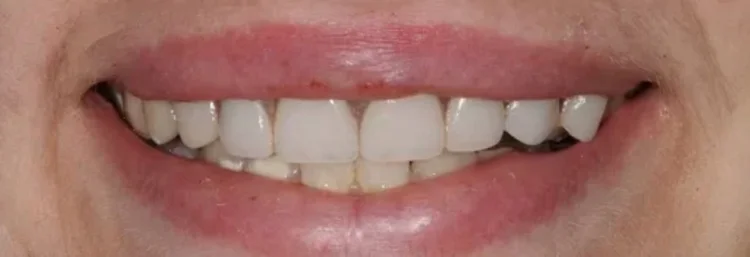
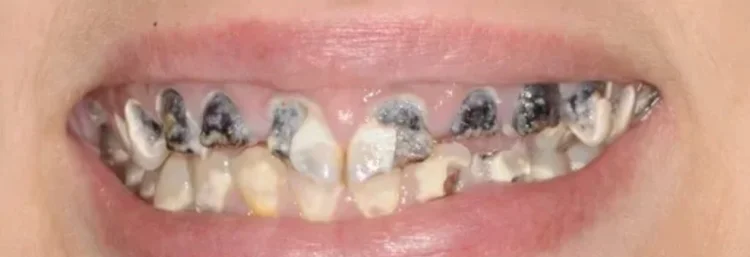
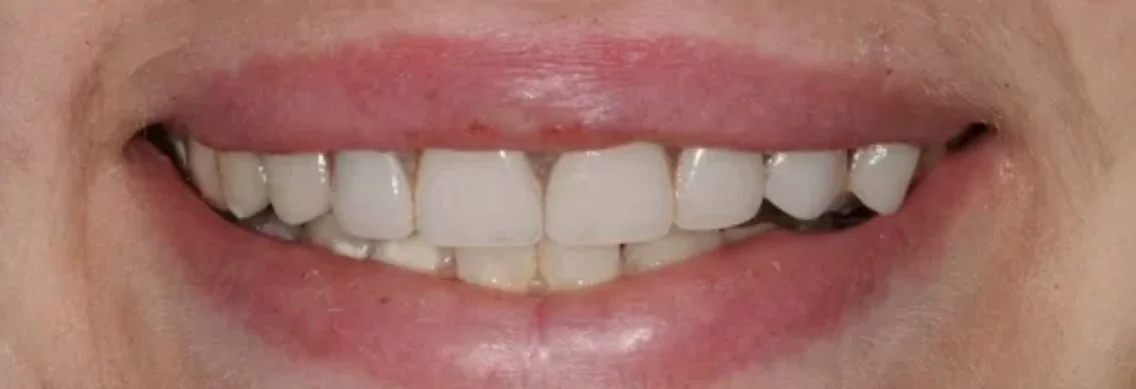
Ready for the Navy: decay repaired on a budget
Years of soda left widespread tooth decay that kept this patient from applying to the Navy. Over about four visits, the teeth that could be saved were rebuilt with tooth-colored composite and the rest were replaced with a flexible partial. She has since finished boot camp.
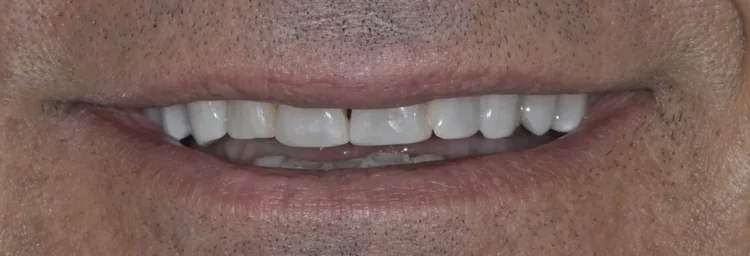
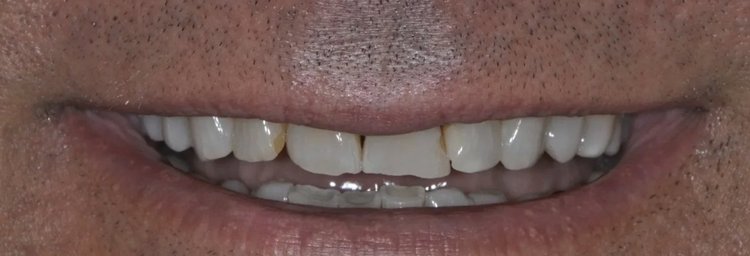
The same material on front teeth
Composite isn’t only for cavities. Here it repaired chips along the front teeth in a single visit, shaded and polished to blend in. That is the same tooth-colored material we use in a filling.
Replacing old silver fillings
Should you replace your old silver fillings? Only for a reason.
Silver (amalgam) fillings that are intact and sealed don’t need to come out just because they are silver. The FDA does not recommend removing amalgam fillings in good condition, because drilling them out briefly raises mercury vapor exposure and removes healthy tooth5. We replace them when they are cracked, leaking, decayed underneath, or when you want a tooth-colored look and understand the trade-off.
Good reasons to replace a silver filling
- New decay at the edge or under the filling on X-rays
- A crack in the filling or a crack line running from it into the tooth
- A gap you can catch with floss, or food packing in one spot
- Pain when biting on that tooth
- A visible gray filling on a tooth that shows when you smile
Do we still use amalgam?
Rarely. Amalgam tolerates moisture well, so it can still be the better choice for a hard-to-reach cavity that is difficult to keep dry. We’ll explain why if we recommend it.
Who the FDA says should avoid new amalgam
In 2020 the FDA recommended that these groups avoid new amalgam fillings when possible: pregnant women, women planning a pregnancy, nursing mothers, children (especially under 6), people with certain neurological diseases or impaired kidney function, and anyone allergic to mercury or other amalgam components5. Tooth-colored fillings avoid the question.
Big old silver fillings often hide cracks. When a large one comes out, the tooth underneath sometimes needs an onlay or a crown rather than another filling. We’ll show you what we find before we decide.
Getting a filling
What happens at a filling visit, step by step.
Most fillings take one visit, often 30 minutes to an hour per tooth depending on size and location. The tooth is numbed, the decay is removed, and tooth-colored composite is bonded in thin layers, hardened with a blue curing light, then shaped and polished to your bite. You can usually go back to work the same day.
Numbing
A topical gel first, then local anesthetic. Most patients feel pressure and vibration, not pain. Anxious? We offer nitrous oxide and minimal oral sedation for adults when appropriate.
Removing the decay
Only the soft, decayed tooth comes out. Healthy tooth stays. If decay is close to the nerve, we may place a protective liner first.
Bonding
The tooth is cleaned, kept dry, and coated with a bonding agent so the filling grips the tooth instead of sitting in it.
Layering and curing
Composite goes in thin layers, each hardened with a curing light, which helps the filling seal and stay strong.
Shaping, bite check, polish
We shape the filling to match the tooth, check your bite with marking paper, and polish it smooth so floss glides past.
After your filling
After a filling: eating, numbness, and sensitivity.
A composite filling is fully hard when you leave, so you can eat once the numbness wears off, usually in two to four hours. Mild sensitivity to cold or biting is common and usually settles within a week or two3. A bite that feels high, or pain that is getting worse, should be checked.
Normal
- Numb lip and cheek for a few hours
- A little sensitivity to cold, air, or biting for several days
- Sore gum or jaw from the visit for a day or two
- A new feel to the tooth that your tongue gets used to
Call us
- Your bite feels high or you hit that tooth first
- Sensitivity is getting worse instead of better, or lasts beyond a few weeks
- Throbbing or pain that keeps you up
- Swelling, or a rough edge cutting your tongue
Until the numbness wears off, avoid hot drinks and chewing on that side so you don’t bite your cheek. For a full guide to what’s normal, read tooth pain after a filling.
Filling, onlay, or crown?
When a filling isn’t enough: matching the repair to the damage.
The bigger the cavity, the less tooth is left to hold a filling. Small and medium cavities get a filling. When decay or an old filling has taken out the walls or cusps of a back tooth, a lab-made onlay or a crown holds the tooth together so it doesn’t split. We always use the smallest repair that will last.
-
Small cavity
Filling
Most of the tooth is healthy. One visit.
Tooth-colored composite
-
Medium cavity
Larger filling
The walls of the tooth are still thick and strong.
Composite, checked yearly
-
Cusps weakened
Onlay
Covers the biting surface and cusps but keeps healthy tooth at the sides.
Lab-made, two visits
-
Cracked or very large
Crown
Wraps the whole tooth so a crack can’t split it apart.
Illustration: CJ Henley, DMD. The blue outline marks the restoration.
After a root canal
When decay reaches the nerve, the tooth needs root canal treatment or extraction. A back tooth usually needs an onlay or crown afterward, because a root-canal-treated tooth is more brittle.
Chipped front tooth?
A chip on a front tooth is usually repaired with composite bonding, the same material as a filling, sculpted to the tooth’s shape.
How long do fillings last?
How long dental fillings last, and what makes them fail early.
Many fillings last 10 years or more, and Cleveland Clinic notes some last up to 20 years3. The size of the filling matters more than the material: fillings that cover more surfaces fail sooner, and new decay at the edges and fractures are the most common reasons a filling has to be redone2.
- Keep the edges clean: brush twice a day with fluoride toothpaste and floss daily.
- Cut down sipping and snacking: frequent sugar and acid is what restarts decay at the edges.
- Protect against grinding: a custom night guard if you clench or grind your teeth.
- Treat dry mouth: less saliva means more decay. Ask about prescription fluoride if you have dry mouth.
- Keep your checkups: X-rays catch a leaking edge while it’s still a small repair.
Filling fell out or cracked
Lost, cracked, or chipped filling? What to do today.
A lost or broken filling is usually not an emergency unless it hurts badly or the area is swelling, but it should be fixed within days, not weeks. The exposed tooth is softer and can decay or break quickly. Call us, keep the area clean, and chew on the other side.
Do
- Call 904.398.1549. We see urgent problems the same day during office hours.
- Rinse with warm water and brush gently.
- Cover a sharp edge with dental wax or sugar-free gum.
- Use a pharmacy temporary filling kit if the visit is a day or two away.
Avoid
- Chewing hard or sticky foods on that side
- Very hot, cold, or sugary food and drinks
- Super glue or any household adhesive
- Waiting until it hurts
you have swelling in your face or gum, a fever, throbbing pain, or a large piece of tooth broke off with the filling. See emergency dental care. Existing patients can reach our on-call line after hours.
Fillings for children
Do baby teeth need fillings?
Often, yes. Baby teeth hold space for adult teeth and some stay until about age 12, so a cavity left alone can cause pain, infection, and early tooth loss. Small cavities in baby teeth can sometimes be slowed with fluoride and watched; larger ones need a tooth-colored filling.
We see children from age 2. Sealants and fluoride varnish prevent many cavities in the first place; see the value of sealants and our children’s dentistry page.
Cost and insurance
What does a filling cost in Jacksonville?
The fee for a filling depends on the tooth, how many surfaces the cavity involves, and whether a liner or buildup is needed. A small one-surface filling costs much less than a large one that wraps around the tooth, which is one more reason to catch cavities early. We give you the fee before treatment begins.
We are an out-of-network practice. Some dental plans cover part of a filling, often with a frequency limit. Some plans pay for tooth-colored fillings on back teeth only at the silver-filling rate. We can help you understand how to use your benefits; you are responsible for amounts your plan does not pay. Call our team with your plan details to ask about fees and payment arrangements. See dental insurance and payment.
Why patients choose our office
Why Jacksonville patients trust Dr. Henley with their fillings.
The same dentist at every visit, an honest call on what needs treatment now and what can be watched, and the time to place a filling in careful layers instead of rushing it.

Tooth-colored fillings near you
Tooth-colored fillings in San Marco, for all of Jacksonville.
Dr. CJ Henley is a general dentist in Jacksonville who earned his DMD at the University of Florida. Fillings are everyday dentistry, and he treats them that way: careful diagnosis, a conservative plan, and work you won’t have to redo soon. Families come to us for general and family dentistry, from a child’s first filling to replacing old silver fillings.
Our office on Hendricks Avenue is easy to reach from San Marco, Southbank, San Jose, Riverside, Avondale, Ortega, St. Nicholas, Downtown, and Mandarin. Patients with complex medical histories are welcome; read about our complex and medically involved care.
See what patients say in our reviews, or learn more about our San Marco dental office.
San Marco
On Hendricks Avenue, in the neighborhood
A small filling fits into a lunch break.
Downtown and Southbank
Southbank borders us; Downtown is across the Main Street Bridge
Easy to fit around a workday.
Riverside, Avondale, and Ortega
Across the St. Johns River on the Fuller Warren Bridge
A short trip over the river; see our Riverside and Avondale dentist page.
San Jose and Mandarin
North on San Jose Boulevard, which becomes Hendricks Avenue
One road to our door; see our Mandarin dentist page.
Jacksonville Beach, Neptune Beach, and Atlantic Beach
West on Atlantic Boulevard or Beach Boulevard
See our Jacksonville Beach dentist page.
Ponte Vedra and Nocatee
West on J. Turner Butler Boulevard, then north on I-95
See our Ponte Vedra dentist page.
Orange Park, Fleming Island, and St. Augustine
North on US-17 or I-95
See our Orange Park and St. Augustine pages.
Frequently asked questions
Questions about cavities and dental fillings in Jacksonville.
Does getting a filling hurt?
Most patients feel pressure and vibration, not pain, because the tooth is numbed first. The injection pinches briefly; a numbing gel beforehand helps. Mild soreness or sensitivity for a few days afterward is common. Anxious adults can ask about nitrous oxide or minimal oral sedation.
How long does a filling take?
Usually 30 minutes to an hour per tooth, depending on the size and location of the cavity. Several fillings on the same side of the mouth can often be done in one visit.
How long do fillings last?
Many fillings last 10 years or more, and some last up to 20. Larger fillings, high cavity risk, and grinding shorten that. New decay at the edges and fractures are the most common reasons a filling has to be replaced.
Can a cavity go away on its own?
Early decay that hasn’t formed a hole can be stopped or reversed with fluoride and better habits. Once a true cavity forms, it can’t heal, and it grows over time. An exam and X-rays tell which one you have.
If a cavity hurts, is it too late for a filling?
Not always. A short sting with cold or sweets often means a cavity that a filling can still fix. Pain that lingers, throbs, or wakes you up suggests the nerve is involved, which may mean a root canal or extraction. Come in sooner rather than later.
Are tooth-colored fillings as strong as silver fillings?
For small to medium cavities, composite fillings perform well, including on back teeth. For very large cavities, neither material is ideal, and an onlay or a crown usually protects the tooth better.
Should I replace my silver fillings?
Only if there is a reason: decay, a crack, a leaking edge, pain, or a visible filling you want changed. The FDA does not recommend removing amalgam fillings that are in good condition. We’ll check each one and tell you which, if any, need attention.
Are silver fillings safe?
The FDA considers intact amalgam fillings acceptable to leave in place for most people. We place amalgam rarely, only when it suits a specific tooth better than composite. In 2020 it recommended that higher-risk groups, including pregnant and nursing women, young children, and people with certain neurological or kidney conditions, avoid new amalgam fillings when possible.
When can I eat after a filling?
A composite filling is hard when you leave, so you can eat once the numbness is gone, usually in two to four hours. Until then, avoid hot drinks and chewing on that side so you don’t bite your lip or cheek.
Why is my tooth sensitive after a filling?
Some sensitivity to cold or biting is normal and usually fades within a week or two. If your bite feels high, or the sensitivity is getting worse or lasts beyond a few weeks, call us; a quick bite adjustment often fixes it.
My filling fell out. Is that an emergency?
Usually not, unless you have strong pain or swelling, but it should be fixed within days. Keep the area clean, avoid chewing on it, and call 904.398.1549. We see urgent problems the same day during office hours.
When do I need a crown instead of a filling?
When so much tooth is missing or cracked that a filling would leave thin, weak walls. That often happens with very large old fillings, cracked cusps, and back teeth after a root canal. An onlay is a middle option that covers the cusps but keeps more natural tooth.
Do baby teeth need fillings?
Often, yes. Some baby teeth stay until about age 12, and an untreated cavity can cause pain, infection, and early tooth loss. Small cavities can sometimes be watched with fluoride; larger ones need a filling. We see children from age 2.
Does insurance cover tooth-colored fillings?
Many plans cover fillings, though some pay for tooth-colored fillings on back teeth only at the silver-filling rate. We are an out-of-network practice and can help you understand how to use your benefits. Call our team with your plan details to ask about fees before scheduling.
Where can I get tooth-colored fillings in Jacksonville?
CJ Henley, DMD, PA places tooth-colored fillings at 3675 Hendricks Avenue, Jacksonville, FL 32207, in San Marco. Call 904.398.1549 or request an appointment online. Bring any recent X-rays from another office.
More reading: Tooth pain after a filling · Cavity pain · Dental FAQ
Your next step
Find out if that spot is a cavity.
Start with an exam and X-rays. You’ll see what we see, hear whether it can be watched or needs a filling, and get the fee before anything is done. If a filling has broken and it hurts, see emergency dental care.
CJ Henley, DMD, PA3675 Hendricks Avenue
Jacksonville, FL 32207
Prefer a nonurgent text? 904.762.5616 is our practice on-call and text line. Please don’t send sensitive health information by text, and call for anything urgent.
Related pages
Sources
- Cleveland Clinic. Cavities (tooth decay). Accessed October 2026.
- Opdam NJM, van de Sande FH, Bronkhorst E, et al. Longevity of posterior composite restorations: a systematic review and meta-analysis. J Dent Res. 2014;93(10):943-949.
- Cleveland Clinic. Dental fillings. Accessed October 2026.
- National Institute of Dental and Craniofacial Research. Tooth decay. Accessed October 2026.
- U.S. Food and Drug Administration. FDA issues recommendations for certain high-risk groups regarding mercury-containing dental amalgam. September 24, 2020.
- American Dental Association, MouthHealthy. Dental filling options. Accessed October 2026.